
 África
 Ásia
Ásia Europa
 América do Sul
 Austrália e Oceânia
 Antártida
 Oceano Pacífico
 Oceano Atlântico
 Oceano Índico
 Oceano Ártico
 Mar Mediterrâneo
 Mar Vermelho
 Mar das Caraíbas
 Mar de Coral
 Mar da China Meridional
 Mar das Filipinas
 Mar de Andamão
 Mar do Norte
 Mar de Timor e de Arafura
 Golfo de Bengala
 Golfo da Califórnia
Golfodulcean poison frog
 Veneno na pele
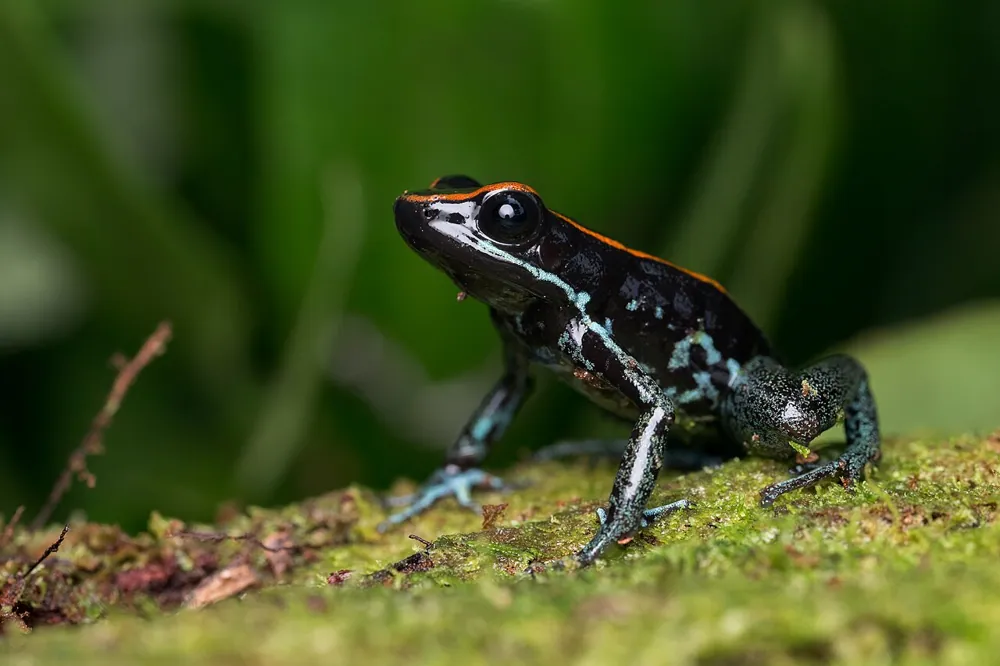
The Golfodulcean poison frog is a small, brightly marked frog that lives only in Costa Rica. Its skin contains a strong nerve poison, so it is one of the most toxic frogs in its genus, and it is a reminder that bright colours can be a warning. It lives in wet forests near streams.1

 Como reconhecê-lo
- The body is black, but it can look glittery because of pigments in the skin.1
- Two stripes run down the back from just above the vent to the tip of the nose. They are usually fire orange, but can be golden, yellow or green.1
- The legs are mottled blue, and the sides often have a blue or green marble pattern.1
- It is a fairly large poison frog for its genus, with a smooth, sloping back. Its shoulder blades are usually hidden under the skin, so it can look a little plump.1
- Females are typically larger than males. Adults reach about 3.5 cm long.1
Muitas vezes confundido com: The related P. bicolor and P. terribilis have visible shoulder blades under the skin, which the Golfodulcean poison frog usually lacks, so it looks smoother and rounder.1
Poder tóxico
A pele é venenosa. É perigoso tocar-lhe, lambê-lo ou comê-lo.
O que faz a sua toxina?
Its skin contains batrachotoxin, a neurotoxic alkaloid poison, which attacks the nerves. A large enough dose causes severe pain, then tonic-clonic seizures (violent convulsions) and paralysis.1
Quão perigoso é para as pessoas?
Perigo para as pessoas: DolorosoPode doer muito, mas quase nunca é grave.It is highly toxic, though it is only the fourth most toxic species in the genus Phyllobates. The poison is in the skin, so the risk comes from handling the frog or getting the poison from its skin into the body.1
O que faz quando tem medo?
Its bright, multi-coloured body advertises its toxin as a warning to predators.1
 Se alguém lhe tocou ou o comeu
- Se alguém lhe tocou: lava bem as mãos e não toques nos olhos nem na boca. Se uma criança ou um animal o lambeu ou comeu: liga para o centro antivenenos ou para o número de emergência.
Liga sempre primeiro para o teu número de emergência (112, 000, 911). Isto são orientações gerais de primeiros socorros, não conselho médico. Primeiros socorros básicos
 Fica em segurança
- Nunca toques, apanhes ou provoques um animal selvagem, mesmo pequeno, e mesmo que pareça a dormir ou morto.
- Dá-lhe espaço. Se encontrares um, mantém a calma, recua devagar e deixa-o seguir o seu caminho.
- Se lhe tocaste ou o comeste: não esfregues os olhos nem a boca, lava as mãos e procura ajuda médica.
Não anda atrás de ti. O veneno só existe para que nada o coma. Mais sobre como estar seguro
Que tamanho tem?
Quanto mede?
 mais ou menos o comprimento de um clipe
 conseguia percorrer 100 metros em 100 segundos (o humano mais rápido precisa de 9,6)
Que tamanho tem Golfodulcean poison frog comparado contigo?
São só contas no teu navegador. Nada é guardado nem enviado para lado nenhum.
Quão rápido é?


Factos
It is one of the few frogs whose poison is named batrachotoxin, a potent nerve toxin.1
Its climbing toe pads stick to leaves in a similar way to geckos, and it can climb out of an unsealed container.1
Male frogs carry their tadpoles on their backs, often for 1 to 2 days, to puddles, pools in palm leaves, or water-filled tree holes.1
Frogs in captivity have no toxin, which shows that their poison comes from what they eat.1
Its skin holds a large amount of poison, because it is comparatively large for a poison dart frog.1
The tadpoles become frogs after about 45 days, and the young frogs become sexually mature after ten months.1
Para especialistas em veneno
- Nome científico
- Phyllobates vittatus
- Grupo
- Rãs venenosas, sapos e tritões
- Família
- Dendrobatidae2
- Ordem
- Anura
- Continentes
- América do Norte
- Crias
- During the breeding season, the female lays 7 to 21 eggs per clutch on leaves, about every one or two weeks, and the male guards the eggs and carries the hatched tadpoles on his back to water.1
- Perigo para as pessoas
- 2 / 5: Doloroso3
De onde vêm os factos
- Golfodulcean poison frog (Wikipedia (CC BY-SA 4.0))
- Phyllobates vittatus (iNaturalist): nomes e classificação.
- Venom Wiki: o nível de perigo, o tamanho típico e a velocidade estimada são nossos. Vê como os calculamos: Como avaliamos o perigo.
Cada facto desta página tem um número que aponta para a sua fonte. Se nos enganámos em alguma coisa, desculpa, somos fãs de animais, não uma revista científica. Diz-nos em [email protected] e nós corrigimos.
 O escorpião tem fome! A Venom Wiki é um projeto de uma só pessoa: gratuito, sem anúncios e sem rastreadores. Uma pequena gorjeta ajuda a mantê-la online.Alimenta o escorpião
Mais do mesmo grupo: Rãs venenosas, sapos e tritões
 Cane toadRãs venenosas, sapos e tritõesPrecisa de médicoNão tocar
 Strawberry poison-dart frogRãs venenosas, sapos e tritõesSó dóiNão tocar
 California newtRãs venenosas, sapos e tritõesPode matarNão tocar
 Rough-skinned newtRãs venenosas, sapos e tritõesPode matarNão tocar
 Colorado River toadRãs venenosas, sapos e tritõesPrecisa de médicoNão tocar
 Panamanian golden frogRãs venenosas, sapos e tritõesPrecisa de médicoNão tocar
 Terciopelo
 Eastern coral snake
 Eastern diamondback rattlesnake
 Eyelash viper
 Timber rattlesnake
 Western diamondback rattlesnake