
 África
 Ásia
Ásia Europa
 América do Sul
 Austrália e Oceânia
 Antártida
 Oceano Pacífico
 Oceano Atlântico
 Oceano Índico
 Oceano Ártico
 Mar Mediterrâneo
 Mar Vermelho
 Mar das Caraíbas
 Mar de Coral
 Mar da China Meridional
 Mar das Filipinas
 Mar de Andamão
 Mar do Norte
 Mar de Timor e de Arafura
 Golfo de Bengala
 Golfo da Califórnia
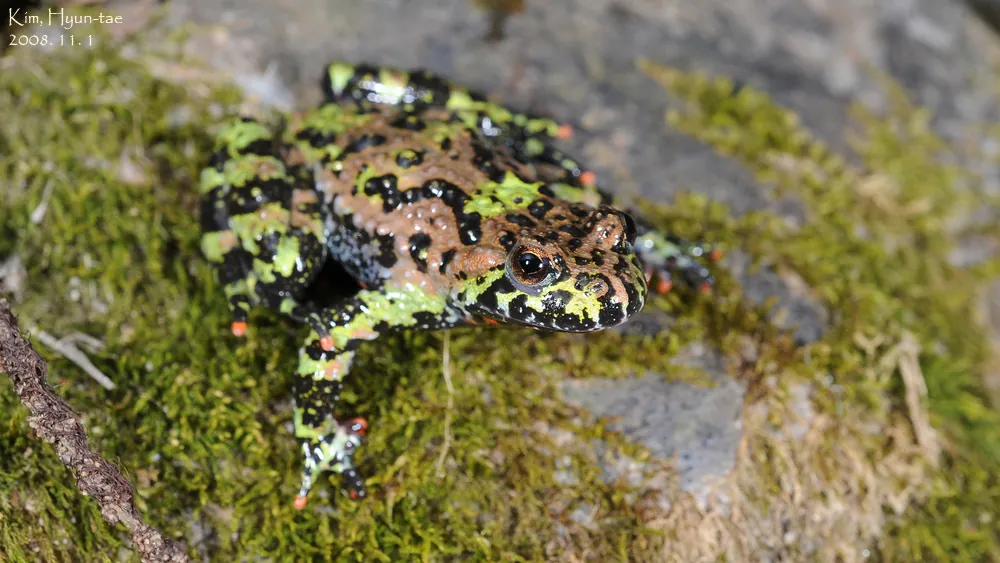
Oriental fire-bellied toad
 Veneno na pele
The Oriental fire-bellied toad is a small frog that lives in northeastern Asia, mostly near slow streams, ponds and forests. Its bright belly is a warning: when it is disturbed, it gives off a mild toxin through its skin. It is common across much of its range.1



 Como reconhecê-lo
- Bright grey, brownish or green upper skin with black mottling.1
- Bright yellow, red or orange-red belly, mottled with dark spots.1
- Red finger and toe tips are usually present.1
- Skin on the upper side is covered in small bumps called tubercles, which give it a toad-like look.1
- Adults are about 3.8 to 5.1 cm long.1
Muitas vezes confundido com: It is often mistaken for a toad, but it is not a true toad. Compared with other Bombina frogs, it has no gular sacs (throat pouches), its belly is usually more red than yellow, and it has bright finger tips.1
Poder tóxico
A pele é venenosa. É perigoso tocar-lhe, lambê-lo ou comê-lo.
O que faz a sua toxina?
The toad's skin releases a milky, mildly toxic substance when it is disturbed or frightened, mostly from the hind legs and sometimes the belly. Its toxins are described as mild, and the toxin does not pose a significant threat to human health. Captive toads are generally less toxic than wild ones, because their diet in the wild adds to their toxicity.1
Quão perigoso é para as pessoas?
Perigo para as pessoas: LigeiroComo uma picada de abelha ou menos. Praticamente inofensivo para as pessoas.The toxin does not pose a significant threat to human health, but its skin mucus can cause discomfort to the mouth and eyes if the toad is handled.1
O que faz quando tem medo?
When threatened, it releases toxin from its skin, lies on its back to show its brightly coloured belly, and arches its head and holds up its limbs as a warning.1
 Se alguém lhe tocou ou o comeu
- Se alguém lhe tocou: lava bem as mãos e não toques nos olhos nem na boca. Se uma criança ou um animal o lambeu ou comeu: liga para o centro antivenenos ou para o número de emergência.
Liga sempre primeiro para o teu número de emergência (112, 000, 911). Isto são orientações gerais de primeiros socorros, não conselho médico. Primeiros socorros básicos
 Fica em segurança
- Nunca toques, apanhes ou provoques um animal selvagem, mesmo pequeno, e mesmo que pareça a dormir ou morto.
- Dá-lhe espaço. Se encontrares um, mantém a calma, recua devagar e deixa-o seguir o seu caminho.
- Se lhe tocaste ou o comeste: não esfregues os olhos nem a boca, lava as mãos e procura ajuda médica.
Não anda atrás de ti. O veneno só existe para que nada o coma. Mais sobre como estar seguro
Que tamanho tem?
Quanto mede?
Quanto pesa?
 mais curto do que o teu dedo mindinho
 conseguia percorrer 100 metros em 180 segundos (o humano mais rápido precisa de 9,6)
Que tamanho tem Oriental fire-bellied toad comparado contigo?
São só contas no teu navegador. Nada é guardado nem enviado para lado nenhum.
Quão rápido é?


Factos
Unusually for a frog, this species has no eardrum or resonator, and it makes its calls by inhaling.1
In experiments, these toads learned to solve mazes using water as a reward, which other frog types did not manage.1
Its skin contains bombesin, a peptide that affects stomach function in mammals. It was first found in its relative, the European fire-bellied toad.1
Males call to females with a light sound that is compared to a musical triangle.1
Grass snakes and other water-dwelling snakes are known to eat these toads without any ill effect.1
In captivity they often live for around 12 years, and some have lived up to 30 years.1
Caça-mitos
Mito: It is a true toad.
Verdade: It is not a true toad, although its bumpy skin gives it a toad-like appearance.1
Para especialistas em veneno
- Nome científico
- Bombina orientalis
- Grupo
- Rãs venenosas, sapos e tritões
- Família
- Bombinatoridae2
- Ordem
- Anura
- Continentes
- Ásia
- Crias
- Females lay 40 to 110 eggs in a large cluster near the surface of the water.1
- Esperança de vida
- cerca de 12 anos1
- Como está na natureza
- Least Concern1
- Perigo para as pessoas
- 1 / 5: Ligeiro3
De onde vêm os factos
- Oriental fire-bellied toad (Wikipedia (CC BY-SA 4.0))
- Bombina orientalis (iNaturalist): nomes e classificação.
- Venom Wiki: o nível de perigo, o tamanho típico e a velocidade estimada são nossos. Vê como os calculamos: Como avaliamos o perigo.
Cada facto desta página tem um número que aponta para a sua fonte. Se nos enganámos em alguma coisa, desculpa, somos fãs de animais, não uma revista científica. Diz-nos em [email protected] e nós corrigimos.
 O escorpião tem fome! A Venom Wiki é um projeto de uma só pessoa: gratuito, sem anúncios e sem rastreadores. Uma pequena gorjeta ajuda a mantê-la online.Alimenta o escorpião
Mais do mesmo grupo: Rãs venenosas, sapos e tritões
 Japanese fire-bellied newtRãs venenosas, sapos e tritõesPrecisa de médicoNão tocar
 Common toadRãs venenosas, sapos e tritõesSó dóiNão tocar
 Asian common toadRãs venenosas, sapos e tritõesPrecisa de médicoNão tocar
 Asiatic toadRãs venenosas, sapos e tritõesSó dóiNão tocar
 Emperor newtRãs venenosas, sapos e tritõesSó dóiNão tocar
 Himalayan newtRãs venenosas, sapos e tritõesSó dóiNão tocar
 Escorpião-amarelo-palestino
 Cobra-indiana
 Víbora-de-escamas-serrilhadas-indiana
 Cobra-real
 Víbora-ladradora
 Víbora-de-russell