
 Africa
 Asia
Asia Europa
 America dal Sid
 Australia ed Oceania
 Antarctica
 Ocean Pacific
 Ocean Atlantic
 Ocean Indic
 Ocean Arctic
 Mar Mediterran
 Mar Cotschen
 Mar Caribic
 Mar da Coral
 Mar da la China dal Sid
 Mar da las Filippinas
 Mar d'Andaman
 Mar dal Nord
 Mar da Timor e d'Arafura
 Golf dal Bengal
 Golf da California
Desert night snake
 Morsas
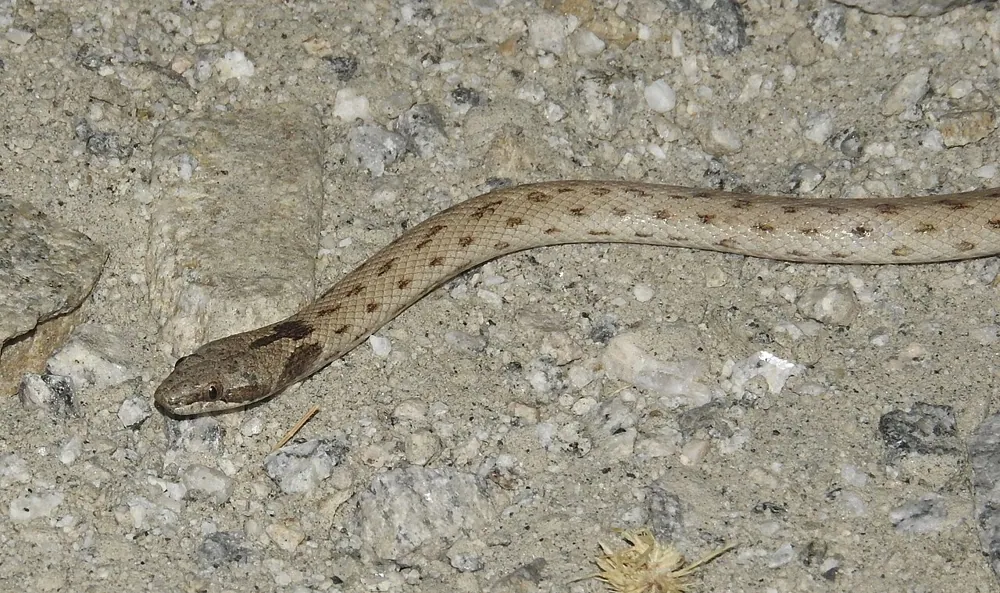
The desert nightsnake is a small, slender snake that hunts at night and spends the day hidden. It lives in dry parts of western North America, from the southwestern United States into northwestern Mexico. It is mildly venomous, but it poses no danger to people.1



 Co renconuscher el
- Small and slender, usually 30 to 66 cm long in total.1
- Base colour is beige, yellowish or grey, with dark grey-brown blotches that usually form offset pairs down the back.1
- Three long dark blotches on the neck and one behind each eye.1
- Triangular head with vertical pupils.1
- Smooth scales on the back and no rattle at the tail.1
Savens confundì cun: It is often mistaken for a juvenile rattlesnake because of its triangular head, vertical pupils and blotched pattern. Unlike a rattlesnake, it has no rattle and its back scales are smooth.1
Forza dal tissi
Il tissi vegn or tras ses dents da tissi u ses dents, cura ch'el morda.
Tge fa ses tissi?
It is mildly venomous and uses its venom to subdue prey. It has rear fangs, which are grooved teeth at the back of the upper jaw.1
Quant privlus è el per umans?
Privel per umans: LevSco ina piztgada d'avieul u main. Practicamain nunprivlus per umans.It is mildly venomous and poses no danger to humans.1
 Sch'el morda
- Lava la morsa, tegna la persuna quieta e tschertga agid medicinal. Tschertas spezias (sco il boomslang) pon esser mortalas pir uras pli tard.
Clama adina l'emprim tes numer d'urgenza (112, 000, 911). Quai è in cussegl general d'emprim agid, betg in cussegl medicinal. Basa da l'emprim agid
 Resta en segirezza
- Na tutga, na piglia e na tizza mai in animal selvadi, gnanc in pitschen, ed era sch'el para da durmir u d'esser mort.
- Dà spazi a l'animal. Sche ti scuntras in, resta calm, va plaun enavos e lascha ir el per sia via.
- Sch'in tal animal ta morda: resta calm, na ta mova betg, clama tes numer d'urgenza (112, 000, 911) u va spert en in ospital. Ta regorda co ch'el veseva or, ina foto gida.
El n'ha betg quai sin tai. El dovra ses tissi per pigliar nutriment u per sa defender, e sa zuppa bler pli gugent. Dapli davart la segirezza
Quant grond è el?
Quant lung è el?
 uschè lung sco 4 bananas ina suenter l'autra
 pudess currer 100 meters en 80 secundas (l'uman il pli svelt dovra 9,6)
Quant grond è Desert night snake cumpareglià cun TAI?
Mo matematica en tes navigatur. Nagut na vegn memorisà u tramess.
Quant svelt è el?


Fatgs
It is a rear-fanged snake, with enlarged grooved teeth at the back of the upper jaw that help it subdue prey.1
In Canada, it is federally listed as Endangered, because its small population is threatened by habitat loss.1
Females are generally longer and heavier than males.1
It is mainly active at night and at dusk, which is why it has the name nightsnake.1
Destructur da mits
Mit: It is a juvenile rattlesnake.
Vardad: It is a separate species. It has no rattle and its back scales are smooth.1
Per experts da tissi
- Num scientific
- Hypsiglena chlorophaea
- Gruppa
- Serps cun dents davos
- Famiglia
- Colubridae2
- Urden
- Squamata
- Continents
- America dal Nord
- Poppins
- It lays eggs. Females lay a single clutch of 2 to 9 eggs, usually around 4, between April and July, hidden in rock crevices or abandoned burrows. The eggs hatch in late summer, and the hatchlings are about 17 cm long.1
- Co ch'i va ad el en la natira
- Least Concern globally (IUCN); Endangered in Canada (COSEWIC)1
- Privel per umans
- 1 / 5: Lev3
Da nua che vegnan ils fatgs
- Hypsiglena chlorophaea (Wikipedia (CC BY-SA 4.0))
- Hypsiglena chlorophaea (iNaturalist): nums e classificaziun.
- Venom Wiki: il stgalim da privel, la grondezza tipica e la stima da la sveltezza èn noss agens. Guarda co che nus als calculain: Co che nus valitain il privel.
Mintga fatg sin questa pagina ha in numer che renvia a sia funtauna. Sche nus avain fatg in sbagl, perstgisa, nus essan fans d'animals, betg ina revista scientifica. Scriva a nus a [email protected] e nus curregin.
 Il scorpiun ha fom! Venom Wiki è in project d'ina suletta persuna: gratuit, senza reclama e senza trackers. In pitschen bunamaun gida a tegnair el online.Pavlar il scorpiun
 Western hognose snake
 Brown vine snake
 Eastern hognose snake
 Green vine snake
 Night snake
 Sonoran lyre snake
 Terciopelo
 Eastern coral snake
 Eastern diamondback rattlesnake
 Eyelash viper
 Timber rattlesnake
 Western diamondback rattlesnake