
 Africa
 Asia
Asia Europa
 America dal Sid
 Australia ed Oceania
 Antarctica
 Ocean Pacific
 Ocean Atlantic
 Ocean Indic
 Ocean Arctic
 Mar Mediterran
 Mar Cotschen
 Mar Caribic
 Mar da Coral
 Mar da la China dal Sid
 Mar da las Filippinas
 Mar d'Andaman
 Mar dal Nord
 Mar da Timor e d'Arafura
 Golf dal Bengal
 Golf da California
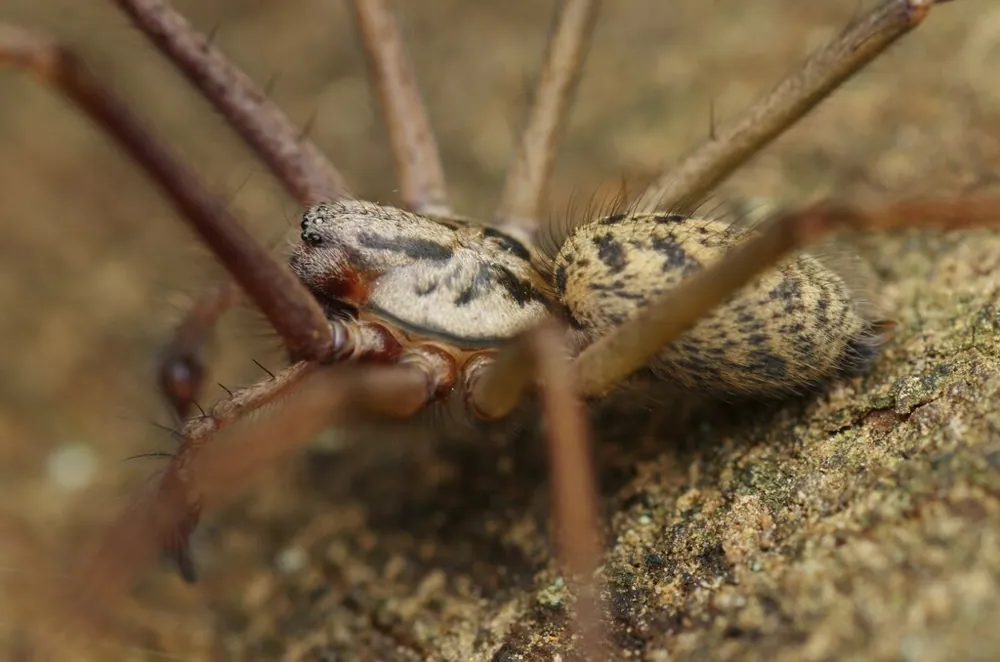
Giant house spider
 Morsas
The giant house spider is a large, brown spider that often lives indoors, especially in Europe, where it is native. It is also found in parts of North America, where it was introduced. Its bite is not considered dangerous to people or pets.1
 Co renconuscher el
- Mainly dark-brown body, in earthy tones of brown and muddy-red or yellow.1
- A lighter arrow-shaped marking on the front part of the body (the sternum), with three light spots on each side.1
- A lighter middle line on the abdomen, with six light spots on each side.1
- Conspicuously hairy legs, palps and abdomen.1
- Females reach up to 18.5 mm in body length. Males are slightly smaller, at around 12 to 15 mm. Males have larger palps and a slimmer abdomen than females.1
Savens confundì cun: The giant house spider has the same colouring as the domestic house spider, Tegenaria domestica. The two closest relatives, E. duellica and E. saeva, look the same as E. atrica. The three species can only be separated by microscopic measurements of the body parts.1
Forza dal tissi
Il tissi vegn or tras ses dents da tissi u ses dents, cura ch'el morda.
Quant privlus è el per umans?
Privel per umans: LevSco ina piztgada d'avieul u main. Practicamain nunprivlus per umans.Bites are not considered dangerous to humans or pets.1
 Sch'el morda
- Lava la morsa e metta in pachet da glatsch sin ella cunter las dolurs. Tschertga agid medicinal, sche las dolurs èn fermas, sa derasan u sche la persuna na sa senta betg bain.
Clama adina l'emprim tes numer d'urgenza (112, 000, 911). Quai è in cussegl general d'emprim agid, betg in cussegl medicinal. Basa da l'emprim agid
 Resta en segirezza
- Na tutga, na piglia e na tizza mai in animal selvadi, gnanc in pitschen, ed era sch'el para da durmir u d'esser mort.
- Dà spazi a l'animal. Sche ti scuntras in, resta calm, va plaun enavos e lascha ir el per sia via.
- Sch'in tal animal ta morda: resta calm, na ta mova betg, clama tes numer d'urgenza (112, 000, 911) u va spert en in ospital. Ta regorda co ch'el veseva or, ina foto gida.
El n'ha betg quai sin tai. El dovra ses tissi per pigliar nutriment u per sa defender, e sa zuppa bler pli gugent. Dapli davart la segirezza
Quant grond è el?
Quant lung è el?
 pli curt che tes det pitschen
 pudess currer 100 meters en 190 secundas (l'uman il pli svelt dovra 9,6)
Quant grond è Giant house spider cumpareglià cun TAI?
Mo matematica en tes navigatur. Nagut na vegn memorisà u tramess.
Quant svelt è el?


Fatgs
The eyes are all the same size and sit in two rows. They contain few visual cells, so the spider can probably only tell light from dark.1
Until 2018, the giant house spider was treated as one species. Research then showed three separate species, which can only be told apart under a microscope.1
Males wander while searching for females during mating season, which runs from late summer into autumn. This is when they are most often noticed.1
Males have no Y chromosome. Males carry X1 and X2, and females carry two pairs of X chromosomes. This form of sex determination is the most common in spiders and is probably the ancestral form.1
Da nua che vegnan ils fatgs
- Eratigena atrica (Wikipedia (CC BY-SA 4.0))
- Eratigena atrica (iNaturalist): nums e classificaziun.
- Venom Wiki: il stgalim da privel, la grondezza tipica e la stima da la sveltezza èn noss agens. Guarda co che nus als calculain: Co che nus valitain il privel.
Mintga fatg sin questa pagina ha in numer che renvia a sia funtauna. Sche nus avain fatg in sbagl, perstgisa, nus essan fans d'animals, betg ina revista scientifica. Scriva a nus a [email protected] e nus curregin.
 Il scorpiun ha fom! Venom Wiki è in project d'ina suletta persuna: gratuit, senza reclama e senza trackers. In pitschen bunamaun gida a tegnair el online.Pavlar il scorpiun
Dapli da la medema gruppa: Filiens
 Mediterranean black widow
 Diving bell spider
 European yellow sac spider
 Noble false widow
 Tarantula wolf spider
 Daddy long-legs spider
Viva era en: Europa
 Common European adderViprasDovra in medi
 Spanish flyAuters animals tossicsDovra in mediBetg tutgar
 Common waspAvieuls, vespras e calabrunsFa mo mal
 European hornetAvieuls, vespras e calabrunsFa mo mal
 Fire salamanderRaunas tossicas, rospis e salamandras d'auaFa mo malBetg tutgar
 Western honey beeAvieuls, vespras e calabrunsFa mo mal