
 Africa
 Asia
Asia Europa
 America dal Sid
 Australia ed Oceania
 Antarctica
 Ocean Pacific
 Ocean Atlantic
 Ocean Indic
 Ocean Arctic
 Mar Mediterran
 Mar Cotschen
 Mar Caribic
 Mar da Coral
 Mar da la China dal Sid
 Mar da las Filippinas
 Mar d'Andaman
 Mar dal Nord
 Mar da Timor e d'Arafura
 Golf dal Bengal
 Golf da California
Greater blue-ringed octopus
 Morsas
The greater blue-ringed octopus is a small sea creature that lives in the warm shallow waters of the Indo-West Pacific, including around Australia. It is one of the most venomous marine animals in the world, so knowing what it looks like matters.1



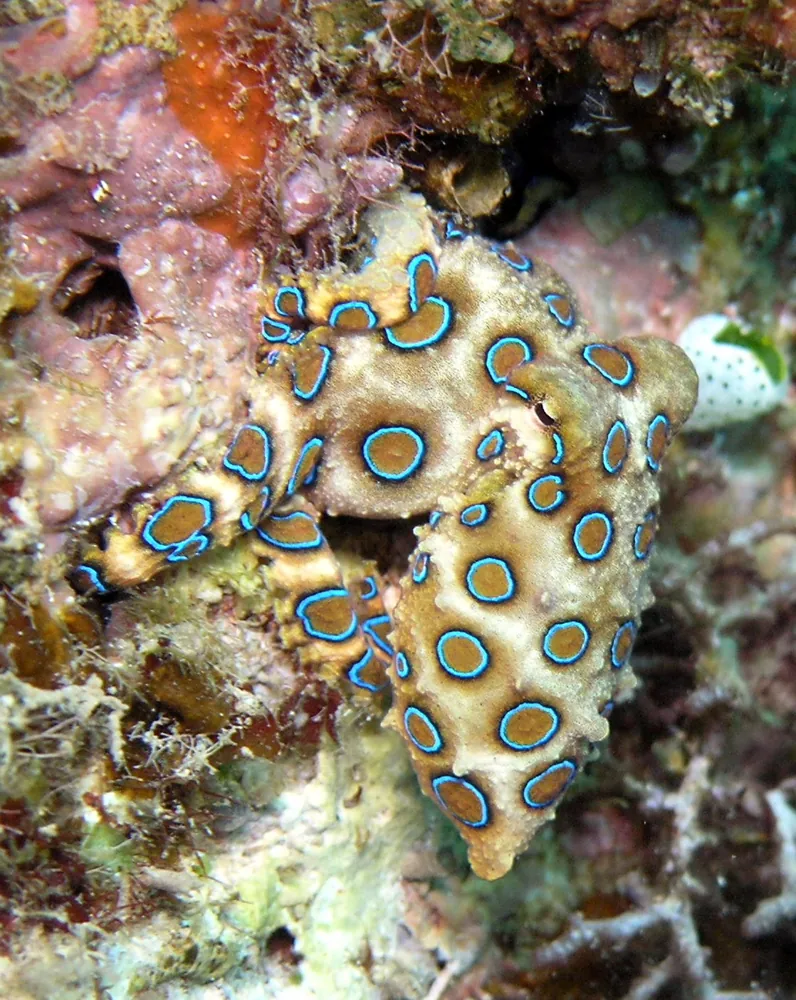
 Co renconuscher el
- A small octopus, up to 10 cm with its arms included, weighing about 80 grams on average.1
- Electric blue rings, about 7 to 8 mm across, roughly 60 of them, spread over its whole skin.1
- The rings flash iridescent blue as a warning signal, each flash lasting about a third of a second.1
- Its body colour varies from yellow ochre to light brown, or whitish when inactive.1
- Blue lines run through its eyes.1
Forza dal tissi
Il tissi vegn or tras ses dents da tissi u ses dents, cura ch'el morda.
Tge fa ses tissi?
Its venom contains tetrodotoxin (TTX), a powerful neurotoxin, which is a poison that attacks the nerves. It paralyses the muscles needed for movement, and in people it can lead to death through respiratory paralysis, which means the breathing muscles stop working. Symptoms include tingling and numbness of the face and lips, sweating, severe headaches, dizziness, speech problems, weakness and vomiting. Symptoms can appear between 15 minutes and four hours after a bite, and the victim stays conscious throughout.1
Quant privlus è el per umans?
Privel per umans: MortalIn dals animals ils pli privlus dal mund.The bite is capable of being fatal to humans. The bite is painless, so a person may not notice it. Children are more sensitive to the toxin. Death can occur between 20 minutes and 24 hours after symptoms begin.1
Tge fa el, cura ch'el ha tema?
It flashes its blue rings as a warning to predators, and it uses its venom to defend itself.1
 Sch'el morda
- Immobilisaziun cun squitsch: envolva ina bandascha elastica ferma sur la morsa e lura vi da l'entir member ensi, fixescha el cun ina stecca e tegna la persuna dal tut immobila, fin che l'agid arriva.
- In polip cun anels blaus u ina lindorna conica po far che ina persuna na respira betg pli, entant ch'ella è anc dasda: clama agid e sajas pront da dar respiraziun artifiziala, fin che l'equipa da l'ambulanza surpiglia.
Clama adina l'emprim tes numer d'urgenza (112, 000, 911). Quai è in cussegl general d'emprim agid, betg in cussegl medicinal. Basa da l'emprim agid
 Resta en segirezza
- Na tutga, na piglia e na tizza mai in animal selvadi, gnanc in pitschen, ed era sch'el para da durmir u d'esser mort.
- Dà spazi a l'animal. Sche ti scuntras in, resta calm, va plaun enavos e lascha ir el per sia via.
- Sch'in tal animal ta morda: resta calm, na ta mova betg, clama tes numer d'urgenza (112, 000, 911) u va spert en in ospital. Ta regorda co ch'el veseva or, ina foto gida.
El n'ha betg quai sin tai. El dovra ses tissi per pigliar nutriment u per sa defender, e sa zuppa bler pli gugent. Dapli davart la segirezza
Nua sin il mund?
Quant grond è el?
Quant lung è el?
 uschè lung sco 3 bluccs da construcziun in suenter l'auter
 pudess nudar la lunghezza d'in grond bassin (50 m) en 7,2 secundas
Quant grond è Greater blue-ringed octopus cumpareglià cun TAI?
Mo matematica en tes navigatur. Nagut na vegn memorisà u tramess.
Quant svelt è el?


Fatgs
The greater blue-ringed octopus is one of the most venomous marine animals in the world, despite being small.1
Its venom contains tetrodotoxin, the same toxin found in pufferfish.1
There is no known antidote or antitoxin for tetrodotoxin, and the toxin does not break down when heated or boiled.1
Its blue rings are a warning signal to predators, showing that it is highly venomous.1
Males die after mating, and females die after guarding their eggs because they refuse to eat.1
Destructur da mits
Mit: A small octopus is harmless.
Vardad: Despite its small size, its bite can be deadly to humans.1
Per experts da tissi
- Num scientific
- Hapalochlaena lunulata
- Gruppa
- Lindornas conicas e polips
- Famiglia
- Octopodidae2
- Urden
- Octopoda
- Continents
- Ocean Indic, Ocean Pacific, Mar da Coral, Mar da las Filippinas, Mar da Timor e d'Arafura, Ils oceans
- Poppins
- The female lays 50 to 100 eggs, which she carries under her arms for about a month. The young hatch as tiny planktonic paralarvae, about the size of a pea.1
- Durada da vita
- circa 2 onns1
- Privel per umans
- 5 / 5: Mortal3
Da nua che vegnan ils fatgs
- Greater blue-ringed octopus (Wikipedia (CC BY-SA 4.0))
- Hapalochlaena lunulata (iNaturalist): nums e classificaziun.
- Venom Wiki: il stgalim da privel, la grondezza tipica e la stima da la sveltezza èn noss agens. Guarda co che nus als calculain: Co che nus valitain il privel.
Mintga fatg sin questa pagina ha in numer che renvia a sia funtauna. Sche nus avain fatg in sbagl, perstgisa, nus essan fans d'animals, betg ina revista scientifica. Scriva a nus a [email protected] e nus curregin.
 Il scorpiun ha fom! Venom Wiki è in project d'ina suletta persuna: gratuit, senza reclama e senza trackers. In pitschen bunamaun gida a tegnair el online.Pavlar il scorpiun
Dapli da la medema gruppa: Lindornas conicas e polips
 Geography coneLindornas conicas e polipsMortal
 Southern blue-ringed octopusLindornas conicas e polipsMortal
 Blue sea dragonLindornas conicas e polipsFa mo mal
 Common octopusLindornas conicas e polipsNunprivlus
 Giant Pacific octopusLindornas conicas e polipsNunprivlus
 Blue-lined octopusLindornas conicas e polipsMortal
Viva era en: Ocean Indic
 Australian box jellyfishMedusas ed autras creaturas da mar che piztganMortalBetg tutgar
 Hawksbill sea turtleAuters animals tossicsPo mazzar
 Irukandji jellyfishMedusas ed autras creaturas da mar che piztganPo mazzarBetg tutgar
 Reef stonefishPeschs tissientadsPo mazzarBetg tutgar
 Crown-of-thorns starfishRitschs, stailas e vermsDovra in mediBetg tutgar
 Portuguese man o' warMedusas ed autras creaturas da mar che piztganDovra in mediBetg tutgar