
 Africa
 Asia
Asia Europa
 America dal Sid
 Australia ed Oceania
 Antarctica
 Ocean Pacific
 Ocean Atlantic
 Ocean Indic
 Ocean Arctic
 Mar Mediterran
 Mar Cotschen
 Mar Caribic
 Mar da Coral
 Mar da la China dal Sid
 Mar da las Filippinas
 Mar d'Andaman
 Mar dal Nord
 Mar da Timor e d'Arafura
 Golf dal Bengal
 Golf da California
Inland taipan
 Morsas
The inland taipan is a snake of the dry interior of Australia. Its venom is considered the most toxic of any snake in the world, though the snake is usually shy and rarely meets people. It lives on remote, hot clay plains, which is why bites are very rare.1

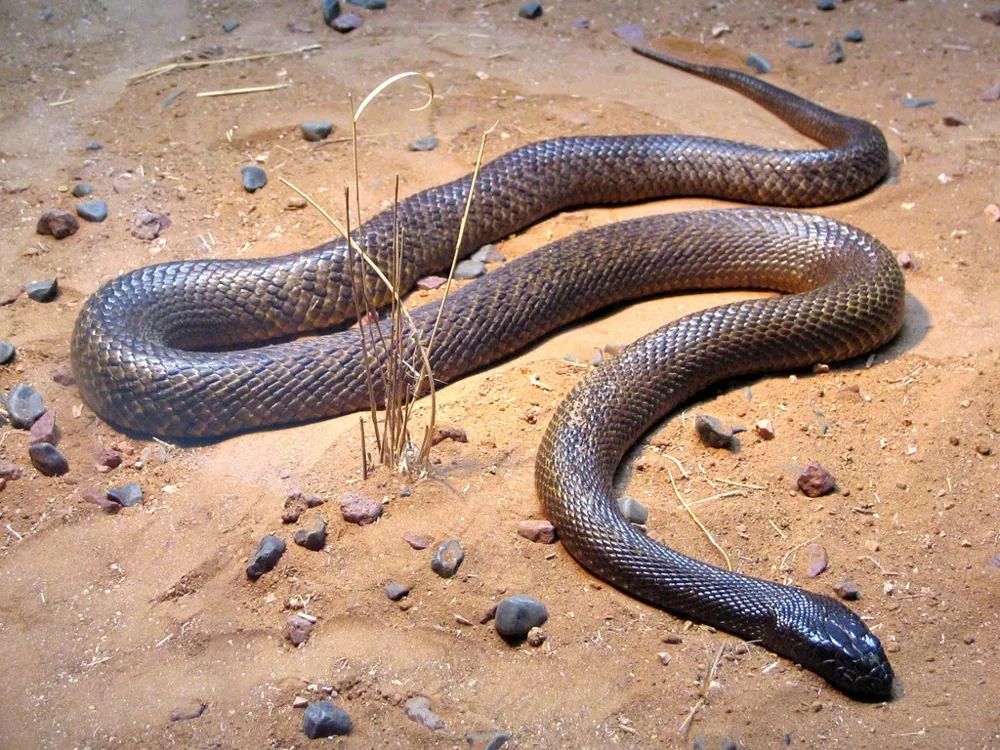
 Co renconuscher el
- Typically dark tan overall, ranging from rich dark brown to brownish light green depending on the season.1
- Many scales have broad blackish edges, forming broken chevron-like markings that slope backwards and downwards on the body.1
- The head, snout and neck are darker than the body: glossy black in winter and dark brown in summer.1
- Scales are smooth, without keels, arranged in 23 rows at midbody.1
- Adults average about 180 cm in total length, and larger individuals can reach 250 cm.1
Savens confundì cun: The coastal taipan (Oxyuranus scutellatus) is a close relative. The inland taipan's fangs are somewhat shorter, at about 3.5 to 6.2 mm. The coastal taipan lives closer to populated coastal regions and is more often met by people.1
Forza dal tissi
Il tissi vegn or tras ses dents da tissi u ses dents, cura ch'el morda.
Tge fa ses tissi?
The venom is extremely toxic and is particularly adapted to killing warm-blooded animals. Tests in laboratory mice and on human heart cell cultures show it is more toxic than the venom of any tested sea snake. A single bite is estimated to contain enough venom to kill more than 100 adult humans. In prey, the venom causes almost immediate incapacitation.1
Quant privlus è el per umans?
Privel per umans: MortalIn dals animals ils pli privlus dal mund.Its venom is among the most potent of any snake, but it is usually shy, reclusive and placid, and it rarely comes into contact with people because it lives in remote areas. The coastal taipan is considered the more dangerous species in practice because of its behaviour around people and its closer proximity to populated coastal regions.1
Tge fa el, cura ch'el ha tema?
It is usually shy and reclusive, with a generally placid disposition.1
 Sch'el morda
- Immobilisaziun cun squitsch: envolva ina bandascha elastica ferma sur la morsa e lura vi da l'entir member ensi, fixescha el cun ina stecca e tegna la persuna dal tut immobila, fin che l'agid arriva.
- Na lava betg la morsa: ils ospitals pon analisar il tissi ch'è restà sin la pel per tscherner il dretg antiserum.
Clama adina l'emprim tes numer d'urgenza (112, 000, 911). Quai è in cussegl general d'emprim agid, betg in cussegl medicinal. Basa da l'emprim agid
 Resta en segirezza
- Na tutga, na piglia e na tizza mai in animal selvadi, gnanc in pitschen, ed era sch'el para da durmir u d'esser mort.
- Dà spazi a l'animal. Sche ti scuntras in, resta calm, va plaun enavos e lascha ir el per sia via.
- Sch'in tal animal ta morda: resta calm, na ta mova betg, clama tes numer d'urgenza (112, 000, 911) u va spert en in ospital. Ta regorda co ch'el veseva or, ina foto gida.
El n'ha betg quai sin tai. El dovra ses tissi per pigliar nutriment u per sa defender, e sa zuppa bler pli gugent. Dapli davart la segirezza
Quant grond è el?
Quant lung è el?
 uschè lung sco 2,5 chauns dal nas fin a la cua
 uschè lung sco 14 bananas ina suenter l'autra
 pudess currer 100 meters en 43 secundas (l'uman il pli svelt dovra 9,6)
Quant grond è Inland taipan cumpareglià cun TAI?
Mo matematica en tes navigatur. Nagut na vegn memorisà u tramess.
Quant svelt è el?


Fatgs
A single bite is estimated to contain enough venom to kill more than 100 adult humans.1
Based on lab tests in mice, it is widely regarded as the most venomous snake in the world.1
It was thought to be lost to science for almost 90 years, until it was rediscovered in 1972.1
Its darkness changes with the seasons: it is darker in winter, which helps it absorb heat, and paler in summer.1
Its name "fierce" refers to the strength of its venom, not to its temperament.1
In captivity it usually lives 10 to 15 years, and one at Australia Zoo reportedly lived for more than 20 years.1
Destructur da mits
Mit: The "fierce" in its name means it is an aggressive snake.
Vardad: The word "fierce" refers to how strong its venom is. The snake is usually shy and placid.1
Per experts da tissi
- Num scientific
- Oxyuranus microlepidotus
- Gruppa
- Serps australianas
- Famiglia
- Elapidae2
- Urden
- Squamata
- Continents
- Australia ed Oceania
- Poppins
- It lays eggs, typically clutches of 10 to 24, usually in abandoned mammal burrows or deep rock crevices.1
- Co ch'i va ad el en la natira
- Least concern (IUCN Red List, 2018). It is presumed extinct in New South Wales and regionally extinct in Victoria.1
- Privel per umans
- 5 / 5: Mortal3
Da nua che vegnan ils fatgs
- Inland taipan (Wikipedia (CC BY-SA 4.0))
- Oxyuranus microlepidotus (iNaturalist): nums e classificaziun.
- Venom Wiki: il stgalim da privel, la grondezza tipica e la stima da la sveltezza èn noss agens. Guarda co che nus als calculain: Co che nus valitain il privel.
Mintga fatg sin questa pagina ha in numer che renvia a sia funtauna. Sche nus avain fatg in sbagl, perstgisa, nus essan fans d'animals, betg ina revista scientifica. Scriva a nus a [email protected] e nus curregin.
 Il scorpiun ha fom! Venom Wiki è in project d'ina suletta persuna: gratuit, senza reclama e senza trackers. In pitschen bunamaun gida a tegnair el online.Pavlar il scorpiun
Dapli da la medema gruppa: Serps australianas
 Coastal taipan
 Common death adder
 Eastern brown snake
 Tiger snake
 Collett's snake
 Desert death adder
Viva era en: Australia ed Oceania
 Sydney funnel-web spiderTarantulas e filiens funnel-webMortal
 Redback spiderFiliensDovra in medi
 Brown tree snakeSerps cun dents davosFa mo mal
 Hooded pitohuiAuters animals tossicsFa mo malBetg tutgar
 PlatypusMammifers tissientadsFa mo mal
 Northern tree-dwelling funnel-web spiderTarantulas e filiens funnel-webMortal