
 Africa
 Asia
Asia Europa
 America dal Sid
 Australia ed Oceania
 Antarctica
 Ocean Pacific
 Ocean Atlantic
 Ocean Indic
 Ocean Arctic
 Mar Mediterran
 Mar Cotschen
 Mar Caribic
 Mar da Coral
 Mar da la China dal Sid
 Mar da las Filippinas
 Mar d'Andaman
 Mar dal Nord
 Mar da Timor e d'Arafura
 Golf dal Bengal
 Golf da California
Woodlouse spider
 Morsas
The woodlouse spider is a small spider that hunts woodlice, the small grey creatures that curl up when touched. It lives in warm places under logs, stones and plant pots, and it is now found on almost every continent except Antarctica. It is a skilled hunter with large fangs, but it is not known to be a health risk to people.1



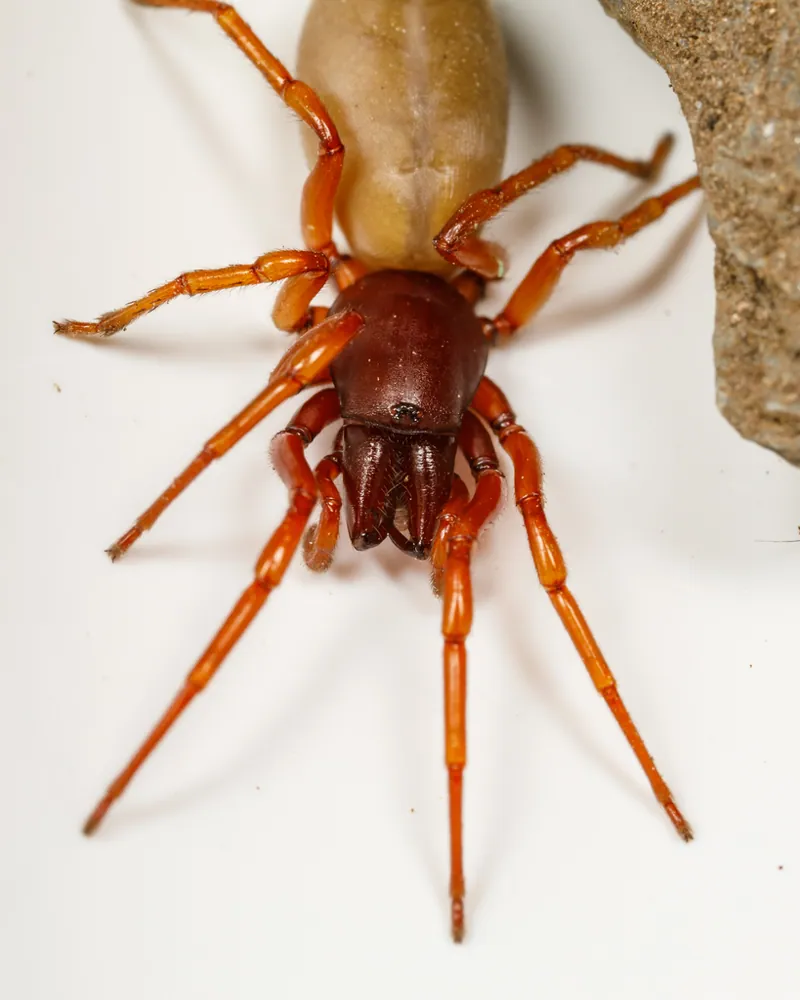
 Co renconuscher el
- Six eyes.1
- A tawny orange to dark red head and chest section (cephalothorax) and legs.1
- A shiny, pale beige to yellow-brown abdomen, which can be dark grey and sometimes very shiny.1
- Very large fangs (chelicerae) for a spider of its size.1
- Adult females are 11 to 15 mm long, and males are 9 to 10 mm long.1
Savens confundì cun: The woodlouse spider can be hard to tell apart from Dysdera erythrina, which is much less common. D. erythrina is not usually found near human homes, so location can help.1
Forza dal tissi
Il tissi vegn or tras ses dents da tissi u ses dents, cura ch'el morda.
Tge fa ses tissi?
It injects venom through its fangs to subdue its prey. In people, bites have been known to cause localised itching at the bite site.1
Quant privlus è el per umans?
Privel per umans: LevSco ina piztgada d'avieul u main. Practicamain nunprivlus per umans.It is a dangerous predator for woodlice but is not known to be a health hazard to humans or smaller animals. It has been known to bite people if handled. Verified bites have caused no major medical problems.1
 Sch'el morda
- Lava la morsa e metta in pachet da glatsch sin ella cunter las dolurs. Tschertga agid medicinal, sche las dolurs èn fermas, sa derasan u sche la persuna na sa senta betg bain.
Clama adina l'emprim tes numer d'urgenza (112, 000, 911). Quai è in cussegl general d'emprim agid, betg in cussegl medicinal. Basa da l'emprim agid
 Resta en segirezza
- Na tutga, na piglia e na tizza mai in animal selvadi, gnanc in pitschen, ed era sch'el para da durmir u d'esser mort.
- Dà spazi a l'animal. Sche ti scuntras in, resta calm, va plaun enavos e lascha ir el per sia via.
- Sch'in tal animal ta morda: resta calm, na ta mova betg, clama tes numer d'urgenza (112, 000, 911) u va spert en in ospital. Ta regorda co ch'el veseva or, ina foto gida.
El n'ha betg quai sin tai. El dovra ses tissi per pigliar nutriment u per sa defender, e sa zuppa bler pli gugent. Dapli davart la segirezza
Quant grond è el?
Quant lung è el?
 pli curt che tes det pitschen
Quant grond è Woodlouse spider cumpareglià cun TAI?
Mo matematica en tes navigatur. Nagut na vegn memorisà u tramess.
Quant svelt è el?


Fatgs
It is an unusually dominant predator for its size because of its large fangs and wide gape.1
It often dominates and sometimes kills other spiders and centipedes.1
Courtship is typically aggressive, and mates can be injured by each other's large fangs.1
It hunts at night and does not spin a web. Instead, it searches warm places for prey.1
Although it began in the Mediterranean, it is now found on several continents, including Australia and New Zealand.1
Destructur da mits
Mit: Woodlouse spiders are dangerous to people.
Vardad: They are not known to be a health hazard to humans. They can bite if handled, but verified bites have not caused major medical problems.1
Da nua che vegnan ils fatgs
- Woodlouse spider (Wikipedia (CC BY-SA 4.0))
- Dysdera crocata (iNaturalist): nums e classificaziun.
- Venom Wiki: il stgalim da privel, la grondezza tipica e la stima da la sveltezza èn noss agens. Guarda co che nus als calculain: Co che nus valitain il privel.
Mintga fatg sin questa pagina ha in numer che renvia a sia funtauna. Sche nus avain fatg in sbagl, perstgisa, nus essan fans d'animals, betg ina revista scientifica. Scriva a nus a [email protected] e nus curregin.
 Il scorpiun ha fom! Venom Wiki è in project d'ina suletta persuna: gratuit, senza reclama e senza trackers. In pitschen bunamaun gida a tegnair el online.Pavlar il scorpiun
Dapli da la medema gruppa: Filiens
 Mediterranean black widow
 Diving bell spider
 European yellow sac spider
 Noble false widow
 Tarantula wolf spider
 Daddy long-legs spider
Viva era en: Europa
 Common European adderViprasDovra in medi
 Spanish flyAuters animals tossicsDovra in mediBetg tutgar
 Common waspAvieuls, vespras e calabrunsFa mo mal
 European hornetAvieuls, vespras e calabrunsFa mo mal
 Fire salamanderRaunas tossicas, rospis e salamandras d'auaFa mo malBetg tutgar
 Western honey beeAvieuls, vespras e calabrunsFa mo mal