
 Afrika
 Asia
Asia Yuropa
 Amerika Borwa
 Australia le Oceania
 Antarctica
 Lewatle la Pacific
 Lewatle la Atlantic
 Lewatle la India
 Lewatle la Arctic
 Lewatle la Mediterranean
 Lewatle le Lefubedu
 Lewatle la Caribbean
 Lewatle la Coral
 Lewatle la China Borwa
 Lewatle la Philippine
 Lewatle la Andaman
 Lewatle la Leboya
 Lewatle la Timor le Arafura
 Kgwohlo ya Bengal
 Kgwohlo ya California
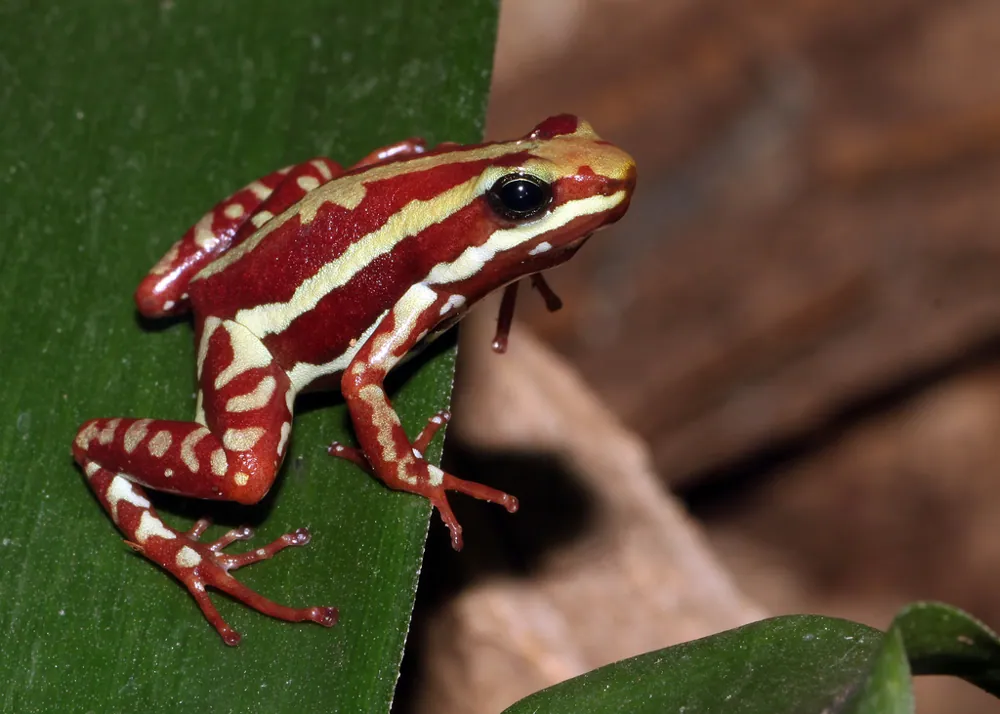
Anthony's poison arrow frog
 Chefo letlalong la yona
Anthony's poison arrow frog is a small, brightly marked frog that lives on the forest floor in southwestern Ecuador and northwestern Peru. It is poisonous rather than venomous: its skin carries a very strong toxin, so it should never be touched or handled. Scientists have used a chemical from this frog to study the nervous system.1
 Ho e tseba jwang
Matla a chefo
Letlalo la yona le a chefa. Ho kotsi ho e ama, ho e nyeka kapa ho e ja.
Chefo ya yona (e chefang ha o e ama kapa o e ja) e etsang?
This frog is poisonous, not venomous. Its skin contains epibatidine, an extremely toxic substance similar to nicotine, which acts on the nerves. It is not used in medicine because it is too toxic for human use, and it is now used only for research.1
E kotsi hakae ho batho?
Kotsi ho batho: E bohlokoE ka utlwisa bohloko haholo, empa hoo e batlang e le kamehla ha e kotsi haholo.The frog's skin toxin is described as extremely toxic. Contact with the skin is the main concern, and the frog should not be handled.1
 Haeba motho a e amme kapa a e jele
- Haeba motho a amme e nngwe: hlatswa matsoho hantle mme o se ke wa ama mahlo kapa molomo. Haeba ngwana kapa phoofolo ya lapeng e e nyeditse kapa e e jele: letsetsa setsi sa chefo (poison centre) kapa nomoro ya tshohanyetso.
Kamehla letsetsa nomoro ya tshohanyetso pele (112, 000, 911). Ena ke tataiso e akaretsang ya thuso ya pele, hase keletso ya bongaka. Metheo ya thuso ya pele
 Dula o bolokehile
- O se ke wa ama, wa tshwara kapa wa tena phoofolo ya naheng, leha e le e nyenyane, le leha e shebahala e robetse kapa e shwele.
- E fe sebaka. Ha o kopana le yona, dula o kgutsitse, kgutlela morao butle mme o e tlohele e tsamaye ka tsela ya yona.
- Haeba o e amme kapa o e jele: o se ke wa hohla mahlo kapa molomo, hlatswa matsoho mme o fumane thuso ya bongaka.
Ha e o batle. Chefo ya yona e teng feela hore ho se be le letho le e jang. Ho eketsehileng ka ho dula o bolokehile
Hokae lefatsheng?
E kgolo hakae?
E telele hakae?
 e telele jwaloka klipi ya pampiri
 e ka matha metara e 100 ka metsotswana e 110 (motho ya potlakang ka ho fetisisa o hloka 9,6)
Anthony's poison arrow frog e kgolo hakae ha e bapiswa le WENA?
Ke dipalo feela ka hara sebatli sa hao. Ha ho letho le bolokwang kapa le romelwang kae kapa kae.
E potlaka hakae?


Dintlha
Epibatidine, one of the most toxic substances found in this frog, was first derived from it and named after it.1
The toxin appears to come from the frog's diet, because frogs raised in captivity had none.1
The male, not the female, carries the tadpoles on his back to water.1
Frogs collected from different habitats had different levels of toxin.1
Bakeng sa ditsebi tsa chefo
- Lebitso la saense
- Epipedobates anthonyi
- Sehlopha
- Dihoho tse chefang, mampotsana le di-newt
- Lelapa
- Dendrobatidae2
- Tatelano
- Anura
- Dikontinente
- Amerika Borwa
- Masea
- The female lays a clutch of 15 to 40 eggs on the ground among leaf litter. The male guards the eggs until they hatch in about two weeks, then carries the tadpoles on his back to a suitable water body, where they develop into frogs in about sixty days.1
- Boemo ba yona naheng
- Near Threatened (IUCN and Peru); Least Concern in Ecuador1
- Kotsi ho batho
- 2 / 5: E bohloko3
Moo dintlha di tswang teng
- Anthony's poison arrow frog (Wikipedia (CC BY-SA 4.0))
- Epipedobates anthonyi (iNaturalist): mabitso le tlhophiso.
- Venom Wiki: boemo ba kotsi, boholo bo tlwaelehileng le kakanyo ya lebelo ke tsa rona. Bona kamoo re di balang ka teng: Kamoo re lekanyang kotsi ka teng.
Taba e nngwe le e nngwe leqepheng lena e na le nomoro e bontshang mohlodi wa yona. Haeba re entse phoso, re kopa tshwarelo, re barati ba diphoofolo, hase makasine wa saense. Re bolelle ho [email protected] mme re tla e lokisa.
 Phepheng e lapile! Venom Wiki ke projeke ya motho a le mong: ke mahala, ha e na dipapatso ebile ha e na di-tracker. Thuso e nyenyane ya tjhelete e e boloka e ntse e le inthaneteng.Fepa phepheng
Tse ding tsa sehlopha se le seng: Dihoho tse chefang, mampotsana le di-newt
 Golden poison frogDihoho tse chefang, mampotsana le di-newtE a bolayaO se ke wa ama
 Cane toadDihoho tse chefang, mampotsana le di-newtE hloka ngakaO se ke wa ama
 Dyeing poison dart frogDihoho tse chefang, mampotsana le di-newtE utlwisa bohloko feelaO se ke wa ama
 Black-legged poison frogDihoho tse chefang, mampotsana le di-newtE ka bolayaO se ke wa ama
 Bruno's casque-headed frogDihoho tse chefang, mampotsana le di-newtE hloka ngakaO se ke wa ama
 Harlequin poison frogDihoho tse chefang, mampotsana le di-newtE hloka ngakaO se ke wa ama
 Terciopelo
 Brazilian wandering spider
 Eyelash viper
 Golden lancehead
 South American bushmaster
 Peruvian giant centipede