
 Afrika
 Asia
Asia Yuropa
 Amerika Borwa
 Australia le Oceania
 Antarctica
 Lewatle la Pacific
 Lewatle la Atlantic
 Lewatle la India
 Lewatle la Arctic
 Lewatle la Mediterranean
 Lewatle le Lefubedu
 Lewatle la Caribbean
 Lewatle la Coral
 Lewatle la China Borwa
 Lewatle la Philippine
 Lewatle la Andaman
 Lewatle la Leboya
 Lewatle la Timor le Arafura
 Kgwohlo ya Bengal
 Kgwohlo ya California
Brazilian salmon pink birdeater
 Ho loma
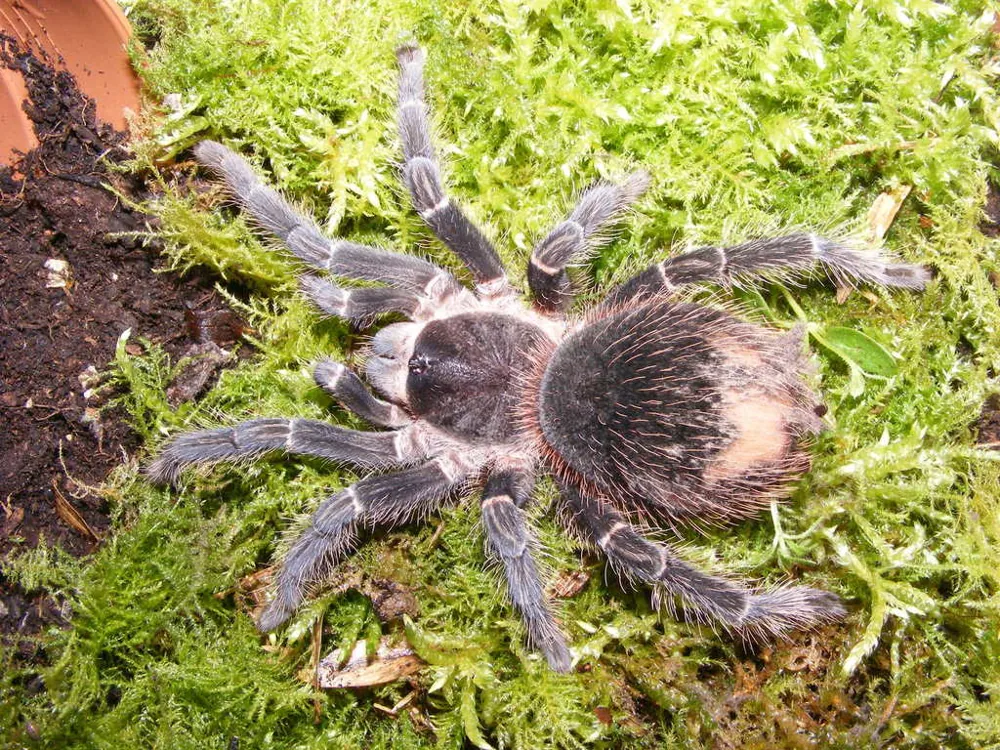
The Brazilian salmon pink bird-eating tarantula is a large spider from north-eastern Brazil. It is one of the biggest tarantulas in the world, and it is a popular pet among tarantula keepers because it is calm and breeds easily.1



 Ho e tseba jwang
Matla a chefo
Chefo e tswa ka meno a yona a chefo (fangs) kapa ka meno a mang ha e loma.
Chefo ya yona (eo e e kenyang ka ho loma kapa ho hlaba) e etsang?
The venom is weak to humans. The bite is painful, and the fangs, which can be up to 2.5 cm long, can penetrate human skin. Some sites claim the bite is similar to a cat bite, but this is not confirmed.1
E kotsi hakae ho batho?
Kotsi ho batho: E bobebeJwaloka ho hlajwa ke notshi kapa ho fetang moo. Ha e na kotsi ho batho.A bite is mechanically dangerous because of the fangs, but it is not medically significant. The tarantula bites only when provoked, and only as a last resort. Its urticating hairs can cause mild to severe skin irritation. Handling can also seriously injure or kill the tarantula, because a fall of more than a few inches can rupture its abdomen.1
E etsang ha e tshohile?
When threatened, it raises its legs and the front of its body to deter predators, flicks irritating urticating hairs from its abdomen, and only bites if the attack continues.1
 Haeba e loma
- Hlatswa moo e lomileng teng mme o pholise. Fumana thuso ya bongaka haeba bohloko bo le matla kapa motho a ikutlwa a kula.
Kamehla letsetsa nomoro ya tshohanyetso pele (112, 000, 911). Ena ke tataiso e akaretsang ya thuso ya pele, hase keletso ya bongaka. Metheo ya thuso ya pele
 Dula o bolokehile
- O se ke wa ama, wa tshwara kapa wa tena phoofolo ya naheng, leha e le e nyenyane, le leha e shebahala e robetse kapa e shwele.
- E fe sebaka. Ha o kopana le yona, dula o kgutsitse, kgutlela morao butle mme o e tlohele e tsamaye ka tsela ya yona.
- Haeba e nngwe e o loma: dula o kgutsitse, o se ke wa sisinyeha, letsetsa nomoro ya tshohanyetso (112, 000, 911) kapa o ye sepetlele kapele. Hopola hore e ne e shebahala jwang, foto e a thusa.
Ha e o batle. E sebedisa chefo ya yona ho tshwara dijo kapa ho itshireletsa, mme e kgetha ho ipata. Ho eketsehileng ka ho dula o bolokehile
Hokae lefatsheng?
E kgolo hakae?
E telele hakae?
E boima hakae?

 e telele jwaloka diboloko tsa ho bapala tse 9 moleng
 e ka matha metara e 100 ka metsotswana e 160 (motho ya potlakang ka ho fetisisa o hloka 9,6)
Brazilian salmon pink birdeater e kgolo hakae ha e bapiswa le WENA?
Ke dipalo feela ka hara sebatli sa hao. Ha ho letho le bolokwang kapa le romelwang kae kapa kae.
E potlaka hakae?


Dintlha
Males must hook back the female's fangs during mating, and slow males risk being eaten by the female.1
It is considered the fourth largest tarantula in the world, behind the three species in the genus Theraphosa.1
Before moulting, it lies on its back and forces itself out of its old skin, and it stops eating a few days beforehand.1
Males deposit sperm onto a webbed mat, called a sperm web, before finding a female.1
Ho senya ditshomo
Tshomo: Brazilian salmon pink tarantulas are bird-eaters.
Nnete: There is very little evidence that they catch and eat birds. In the wild they mainly eat large insects and sometimes amphibians and small reptiles.1
Moo dintlha di tswang teng
- Lasiodora parahybana (Wikipedia (CC BY-SA 4.0))
- Lasiodora parahybana (iNaturalist): mabitso le tlhophiso.
- Venom Wiki: boemo ba kotsi, boholo bo tlwaelehileng le kakanyo ya lebelo ke tsa rona. Bona kamoo re di balang ka teng: Kamoo re lekanyang kotsi ka teng.
Taba e nngwe le e nngwe leqepheng lena e na le nomoro e bontshang mohlodi wa yona. Haeba re entse phoso, re kopa tshwarelo, re barati ba diphoofolo, hase makasine wa saense. Re bolelle ho [email protected] mme re tla e lokisa.
 Phepheng e lapile! Venom Wiki ke projeke ya motho a le mong: ke mahala, ha e na dipapatso ebile ha e na di-tracker. Thuso e nyenyane ya tjhelete e e boloka e ntse e le inthaneteng.Fepa phepheng
Tse ding tsa sehlopha se le seng: Di-tarantula le di-funnel-web
 Goliath birdeaterDi-tarantula le di-funnel-webE utlwisa bohloko feela
 Chilean rose tarantulaDi-tarantula le di-funnel-webHa e na kotsi
 Greenbottle blue tarantulaDi-tarantula le di-funnel-webHa e na kotsi
 Pinktoe tarantulaDi-tarantula le di-funnel-webHa e na kotsi
 Brazilian funnel-web spiderDi-tarantula le di-funnel-webE hloka ngaka
 Burgundy goliath birdeaterDi-tarantula le di-funnel-webE utlwisa bohloko feela
 Golden poison frog
 Terciopelo
 Brazilian wandering spider
 Eyelash viper
 Golden lancehead
 South American bushmaster