
 Afrika
 Asia
Asia Yuropa
 Amerika Borwa
 Australia le Oceania
 Antarctica
 Lewatle la Pacific
 Lewatle la Atlantic
 Lewatle la India
 Lewatle la Arctic
 Lewatle la Mediterranean
 Lewatle le Lefubedu
 Lewatle la Caribbean
 Lewatle la Coral
 Lewatle la China Borwa
 Lewatle la Philippine
 Lewatle la Andaman
 Lewatle la Leboya
 Lewatle la Timor le Arafura
 Kgwohlo ya Bengal
 Kgwohlo ya California
Brazilian yellow scorpion
 Ho hlaba
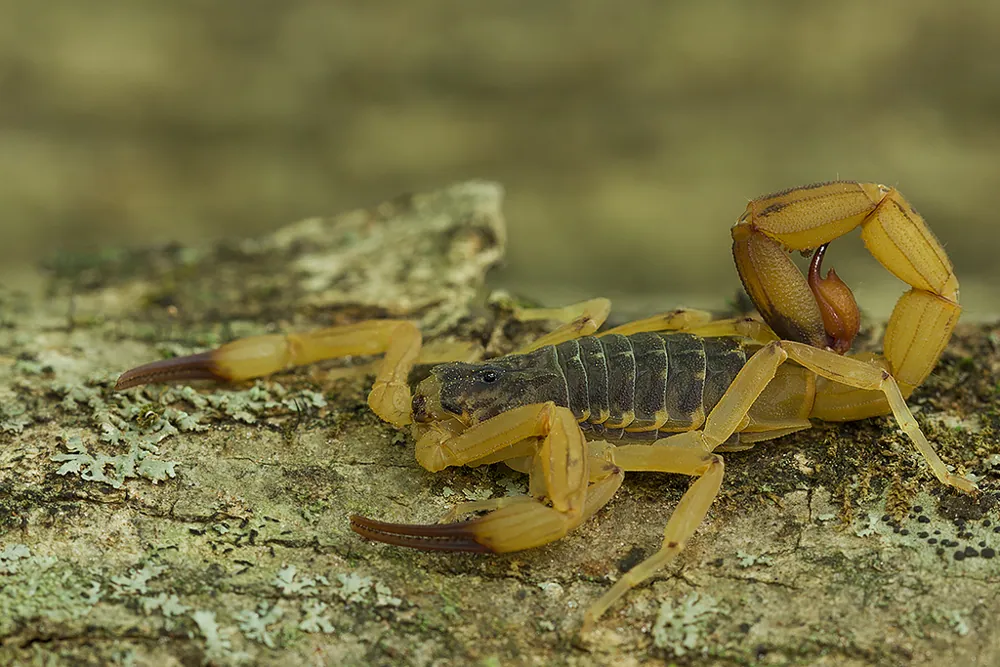
The Brazilian yellow scorpion is a small scorpion that lives in Brazil, often in towns and cities. Its venom is extremely toxic, and it is the most dangerous scorpion in South America.1

 Ho e tseba jwang
- Adults are usually 5 to 7 cm long.1
- Legs and pedipalps are pale yellow, while the body and the tip of the tail are a darker yellowish brown.1
- The tail is bulbous and segmented, with prominent ridges and serrations, and is often carried curved forward over the back.1
- The tail ends in a venom-injecting barb.1
Matla a chefo
Chefo e tswa ka lemao le hlabang.
Chefo ya yona (eo e e kenyang ka ho loma kapa ho hlaba) e etsang?
Its venom contains an excitatory neurotoxin, which attacks the nerves that control involuntary body functions and releases adrenaline and related chemicals. Mild cases cause mainly localised pain, while more serious cases can bring fever, sweating, tremors, vomiting, agitation, a fast heartbeat and inflammation of the pancreas. Deaths can occur within 1 to 6 hours, or 12 to 14 hours, depending on age, health and the amount of venom injected.1
E kotsi hakae ho batho?
Kotsi ho batho: E kotsi haholoE ka bolaya motho ya sa fumaneng kalafo.It is responsible for more medically significant accidents than any other scorpion in Brazil, and most of the country's fatal scorpion cases. Mortality rates are 1.0 to 2.0% among children and elderly people. In a nationwide study from 2000 to 2012, Brazil recorded 482,616 scorpion accidents and 728 deaths, and this species was believed to cause most of those deaths.1
E etsang ha e tshohile?
It uses its tail barb to deliver defensive strikes.1
 Haeba e hlaba
- Pholisa moo e hlabileng teng ka pakete ya leqhwa mme o boloke motho a sa sisinyehe. Fumana thuso ya bongaka kapele, haholoholo bakeng sa bana: diphepheng tse ding di bolaya bana.
Kamehla letsetsa nomoro ya tshohanyetso pele (112, 000, 911). Ena ke tataiso e akaretsang ya thuso ya pele, hase keletso ya bongaka. Metheo ya thuso ya pele
 Dula o bolokehile
- O se ke wa ama, wa tshwara kapa wa tena phoofolo ya naheng, leha e le e nyenyane, le leha e shebahala e robetse kapa e shwele.
- E fe sebaka. Ha o kopana le yona, dula o kgutsitse, kgutlela morao butle mme o e tlohele e tsamaye ka tsela ya yona.
- Haeba e nngwe e o hlaba: dula o kgutsitse, o se ke wa sisinyeha, letsetsa nomoro ya tshohanyetso (112, 000, 911) kapa o ye sepetlele kapele. Hopola hore e ne e shebahala jwang, foto e a thusa.
Ha e o batle. E sebedisa chefo ya yona ho tshwara dijo kapa ho itshireletsa, mme e kgetha ho ipata. Ho eketsehileng ka ho dula o bolokehile
Hokae lefatsheng?
E kgolo hakae?
E telele hakae?
 e telele jwaloka diboloko tsa ho bapala tse 2 moleng
 e ka matha metara e 100 ka metsotswana e 260 (motho ya potlakang ka ho fetisisa o hloka 9,6)
Brazilian yellow scorpion e kgolo hakae ha e bapiswa le WENA?
Ke dipalo feela ka hara sebatli sa hao. Ha ho letho le bolokwang kapa le romelwang kae kapa kae.
E potlaka hakae?


Dintlha
Reported scorpion stings in Brazil rose from 12,000 in 2000 to 140,000 by 2018.1
It has a low metabolic rate, so it can survive for months without eating.1
Scorpion numbers have grown in Brazilian cities, helped by plenty of cockroaches to eat and few predators.1
Its venom varies by region. Scorpions from Distrito Federal have an LD50 of 51.6 μg/kg, compared with 26 μg/kg for those from Minas Gerais. LD50 is the dose that kills half of the animals tested.1
Its tail is bulbous and segmented, with ridges and serrations, and it often curls forward over its back.1
Moo dintlha di tswang teng
- Tityus serrulatus (Wikipedia (CC BY-SA 4.0))
- Tityus serrulatus (iNaturalist): mabitso le tlhophiso.
- Venom Wiki: boemo ba kotsi, boholo bo tlwaelehileng le kakanyo ya lebelo ke tsa rona. Bona kamoo re di balang ka teng: Kamoo re lekanyang kotsi ka teng.
Taba e nngwe le e nngwe leqepheng lena e na le nomoro e bontshang mohlodi wa yona. Haeba re entse phoso, re kopa tshwarelo, re barati ba diphoofolo, hase makasine wa saense. Re bolelle ho [email protected] mme re tla e lokisa.
 Phepheng e lapile! Venom Wiki ke projeke ya motho a le mong: ke mahala, ha e na dipapatso ebile ha e na di-tracker. Thuso e nyenyane ya tjhelete e e boloka e ntse e le inthaneteng.Fepa phepheng
 Amazonian black scorpion
 Caracas scorpion
 Panamanian black scorpion
 Zulia scorpion
 Amazon forest scorpion
 Argentine striped scorpion
 Golden poison frog
 Terciopelo
 Brazilian wandering spider
 Eyelash viper
 Golden lancehead
 South American bushmaster