
 Afrika
 Asia
Asia Yuropa
 Amerika Borwa
 Australia le Oceania
 Antarctica
 Lewatle la Pacific
 Lewatle la Atlantic
 Lewatle la India
 Lewatle la Arctic
 Lewatle la Mediterranean
 Lewatle le Lefubedu
 Lewatle la Caribbean
 Lewatle la Coral
 Lewatle la China Borwa
 Lewatle la Philippine
 Lewatle la Andaman
 Lewatle la Leboya
 Lewatle la Timor le Arafura
 Kgwohlo ya Bengal
 Kgwohlo ya California
Giant leaf frog
 Chefo letlalong la yona
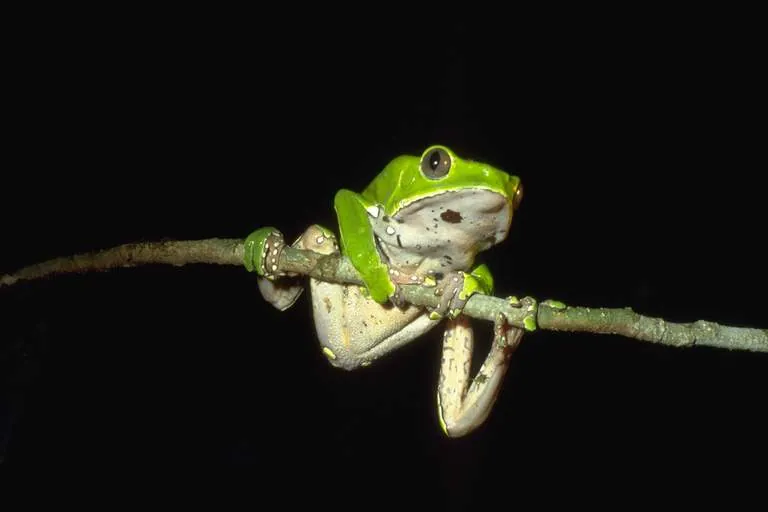
The giant leaf frog is a large tree frog with lime green skin and a white or cream belly. It lives in the rainforests of the Amazon basin in South America. Its skin releases chemicals that act as a defence against predators.1
 Ho e tseba jwang
- Lime green back with a white to yellow-white or cream belly1
- Sparse white spots with dark frames on the lower lips, chest and front legs, denser on the flanks and hind legs1
- Transparent brown fingers with large green adhesive discs1
- A prominent gland behind each eye, extending over the eardrum1
- Dark grey iris1
Matla a chefo
Letlalo la yona le a chefa. Ho kotsi ho e ama, ho e nyeka kapa ho e ja.
Chefo ya yona (e chefang ha o e ama kapa o e ja) e etsang?
The giant leaf frog's skin secretion contains opioid peptides, including deltorphin and dermorphin. Its skin peptides act as a chemical defence against predators. In kambo rituals, where the secretion is used, it induces intense vomiting.1
E kotsi hakae ho batho?
Kotsi ho batho: E bohlokoE ka utlwisa bohloko haholo, empa hoo e batlang e le kamehla ha e kotsi haholo.E etsang ha e tshohile?
When threatened, its skin produces peptides that act as a chemical defence against predators.1
 Haeba motho a e amme kapa a e jele
- Haeba motho a amme e nngwe: hlatswa matsoho hantle mme o se ke wa ama mahlo kapa molomo. Haeba ngwana kapa phoofolo ya lapeng e e nyeditse kapa e e jele: letsetsa setsi sa chefo (poison centre) kapa nomoro ya tshohanyetso.
Kamehla letsetsa nomoro ya tshohanyetso pele (112, 000, 911). Ena ke tataiso e akaretsang ya thuso ya pele, hase keletso ya bongaka. Metheo ya thuso ya pele
 Dula o bolokehile
- O se ke wa ama, wa tshwara kapa wa tena phoofolo ya naheng, leha e le e nyenyane, le leha e shebahala e robetse kapa e shwele.
- E fe sebaka. Ha o kopana le yona, dula o kgutsitse, kgutlela morao butle mme o e tlohele e tsamaye ka tsela ya yona.
- Haeba o e amme kapa o e jele: o se ke wa hohla mahlo kapa molomo, hlatswa matsoho mme o fumane thuso ya bongaka.
Ha e o batle. Chefo ya yona e teng feela hore ho se be le letho le e jang. Ho eketsehileng ka ho dula o bolokehile
Hokae lefatsheng?
E kgolo hakae?
E telele hakae?
 e telele jwaloka diboloko tsa ho bapala tse 4 moleng
 e ka matha metara e 100 ka metsotswana e 72 (motho ya potlakang ka ho fetisisa o hloka 9,6)
Giant leaf frog e kgolo hakae ha e bapiswa le WENA?
Ke dipalo feela ka hara sebatli sa hao. Ha ho letho le bolokwang kapa le romelwang kae kapa kae.
E potlaka hakae?


Dintlha
Its skin secretion is known as Vacina do sapo, or frog vaccine, and is used in a ritual called kambo or sapo.1
Up to 61% of the eggs of the giant leaf frog are eaten by predators.1
Males fight rivals for mating rights by using their heads to separate a rival male from a female, and by pushing with their hind legs.1
Males are more likely to be targeted by predators during mating season, because their loud fights can be heard easily.1
Eggs are eaten by rove beetles, phorid flies, possibly tufted capuchins and banded cat-eyed snakes, because they are a source of protein.1
Bakeng sa ditsebi tsa chefo
- Lebitso la saense
- Phyllomedusa bicolor
- Sehlopha
- Dihoho tse chefang, mampotsana le di-newt
- Lelapa
- Phyllomedusidae2
- Tatelano
- Anura
- Dikontinente
- Amerika Borwa
- Masea
- The female and male build a leaf-nest above forest pools and lay eggs in a gelatinous mass about 70 cm above the water. The eggs hatch in about 14 days, and the tadpoles fall into the water to develop into adult frogs.1
- Boemo ba yona naheng
- Least Concern1
- Kotsi ho batho
- 2 / 5: E bohloko3
Moo dintlha di tswang teng
- Phyllomedusa bicolor (Wikipedia (CC BY-SA 4.0))
- Phyllomedusa bicolor (iNaturalist): mabitso le tlhophiso.
- Venom Wiki: boemo ba kotsi, boholo bo tlwaelehileng le kakanyo ya lebelo ke tsa rona. Bona kamoo re di balang ka teng: Kamoo re lekanyang kotsi ka teng.
Taba e nngwe le e nngwe leqepheng lena e na le nomoro e bontshang mohlodi wa yona. Haeba re entse phoso, re kopa tshwarelo, re barati ba diphoofolo, hase makasine wa saense. Re bolelle ho [email protected] mme re tla e lokisa.
 Phepheng e lapile! Venom Wiki ke projeke ya motho a le mong: ke mahala, ha e na dipapatso ebile ha e na di-tracker. Thuso e nyenyane ya tjhelete e e boloka e ntse e le inthaneteng.Fepa phepheng
Tse ding tsa sehlopha se le seng: Dihoho tse chefang, mampotsana le di-newt
 Golden poison frogDihoho tse chefang, mampotsana le di-newtE a bolayaO se ke wa ama
 Cane toadDihoho tse chefang, mampotsana le di-newtE hloka ngakaO se ke wa ama
 Dyeing poison dart frogDihoho tse chefang, mampotsana le di-newtE utlwisa bohloko feelaO se ke wa ama
 Black-legged poison frogDihoho tse chefang, mampotsana le di-newtE ka bolayaO se ke wa ama
 Bruno's casque-headed frogDihoho tse chefang, mampotsana le di-newtE hloka ngakaO se ke wa ama
 Harlequin poison frogDihoho tse chefang, mampotsana le di-newtE hloka ngakaO se ke wa ama
 Terciopelo
 Brazilian wandering spider
 Eyelash viper
 Golden lancehead
 South American bushmaster
 Peruvian giant centipede