
 Afrika
 Asia
Asia Yuropa
 Amerika Borwa
 Australia le Oceania
 Antarctica
 Lewatle la Pacific
 Lewatle la Atlantic
 Lewatle la India
 Lewatle la Arctic
 Lewatle la Mediterranean
 Lewatle le Lefubedu
 Lewatle la Caribbean
 Lewatle la Coral
 Lewatle la China Borwa
 Lewatle la Philippine
 Lewatle la Andaman
 Lewatle la Leboya
 Lewatle la Timor le Arafura
 Kgwohlo ya Bengal
 Kgwohlo ya California
Redtail coral snake
 Ho loma
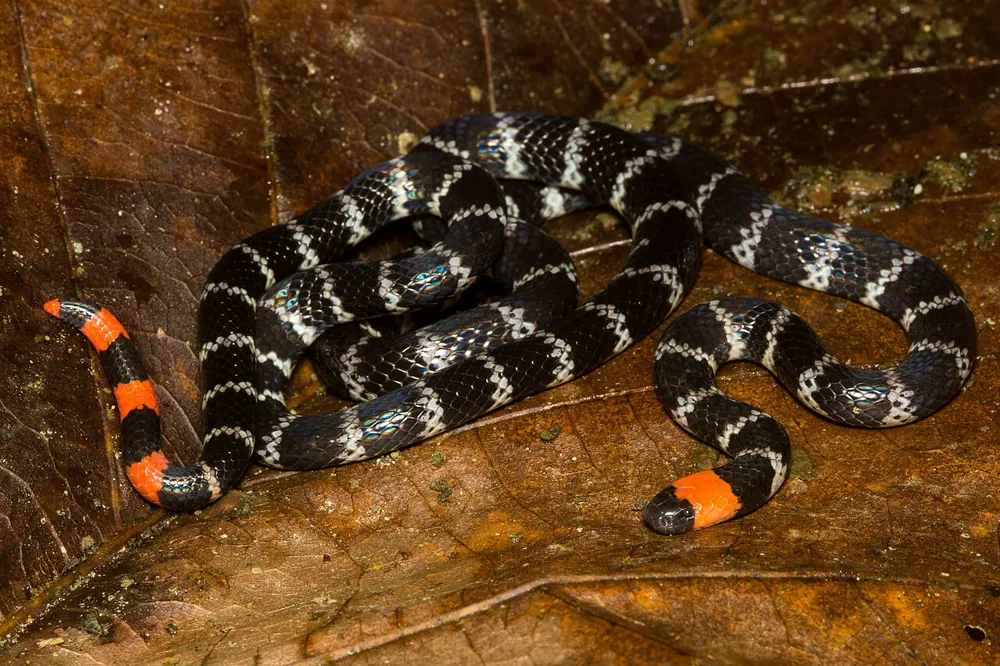
The red-tailed coral snake is a small venomous snake from Central and northern South America. It is common in farming areas of Colombia, so people living there may meet it. Its venom attacks the nerves and muscles, which makes it one of the more dangerous snakes in its region.1



 Ho e tseba jwang
- Has a cylindrical body and quite small eyes with a rounded head.1
- Black body rings, numbering from 34 to 84, are separated by narrow yellow or white rings.1
- The second ring on the head and 3 or 4 of the tail rings are red.1
- Can reach a total length of 140.6 cm, including the tail.1
- Mostly active at dusk and at night.1
Matla a chefo
Chefo e tswa ka meno a yona a chefo (fangs) kapa ka meno a mang ha e loma.
Chefo ya yona (eo e e kenyang ka ho loma kapa ho hlaba) e etsang?
Its venom is neurotoxic, which means it attacks the nerves. It blocks the signals that tell muscles to contract, which can lead to muscle weakness and paralysis. Local pain and tingling can appear within minutes of a bite. In severe cases, nerve symptoms such as drooping eyelids, slurred speech, drowsiness and weakness in the limbs can develop within 30 minutes to 1 to 2 hours, and breathing can stop.1
E kotsi hakae ho batho?
Kotsi ho batho: E kotsi haholoE ka bolaya motho ya sa fumaneng kalafo.Its venom is potentially deadly. Scientists milked an average of 7 mg of dry venom from this snake, which is more than the estimated lethal dose for an adult human of 4 to 6 mg.1
 Haeba e loma
- Boloka motho a sa sisinyehe ebile a kgutsitse mme o mo ise sepetlele kapele, leha moo e lomileng teng ho shebahala ho le honyenyane: matshwao a ka qala dihora hamorao.
Kamehla letsetsa nomoro ya tshohanyetso pele (112, 000, 911). Ena ke tataiso e akaretsang ya thuso ya pele, hase keletso ya bongaka. Metheo ya thuso ya pele
 Dula o bolokehile
- O se ke wa ama, wa tshwara kapa wa tena phoofolo ya naheng, leha e le e nyenyane, le leha e shebahala e robetse kapa e shwele.
- E fe sebaka. Ha o kopana le yona, dula o kgutsitse, kgutlela morao butle mme o e tlohele e tsamaye ka tsela ya yona.
- Haeba e nngwe e o loma: dula o kgutsitse, o se ke wa sisinyeha, letsetsa nomoro ya tshohanyetso (112, 000, 911) kapa o ye sepetlele kapele. Hopola hore e ne e shebahala jwang, foto e a thusa.
Ha e o batle. E sebedisa chefo ya yona ho tshwara dijo kapa ho itshireletsa, mme e kgetha ho ipata. Ho eketsehileng ka ho dula o bolokehile
Hokae lefatsheng?
E kgolo hakae?
E telele hakae?
 e telele jwaloka dikatse tsa lapeng tse 3 ho tloha nkong ho isa mohatleng
 e telele jwaloka dibanana tse 8 tse latellanang
 e ka matha metara e 100 ka metsotswana e 71 (motho ya potlakang ka ho fetisisa o hloka 9,6)
Redtail coral snake e kgolo hakae ha e bapiswa le WENA?
Ke dipalo feela ka hara sebatli sa hao. Ha ho letho le bolokwang kapa le romelwang kae kapa kae.
E potlaka hakae?


Dintlha
It has between 34 and 84 black body rings, so no two snakes look exactly the same in ring count.1
Its venom is about 60% three-finger toxins, about 30% phospholipase A2, and about 10% other toxins.1
In dry spells it may shelter several centimetres underground, and in heavy rain it comes to the surface or into thick leaf litter.1
The most abundant toxin in its venom is called mipartoxin-I.1
Bakeng sa ditsebi tsa chefo
Moo dintlha di tswang teng
- Micrurus mipartitus (Wikipedia (CC BY-SA 4.0))
- Micrurus mipartitus (iNaturalist): mabitso le tlhophiso.
- Venom Wiki: boemo ba kotsi, boholo bo tlwaelehileng le kakanyo ya lebelo ke tsa rona. Bona kamoo re di balang ka teng: Kamoo re lekanyang kotsi ka teng.
Taba e nngwe le e nngwe leqepheng lena e na le nomoro e bontshang mohlodi wa yona. Haeba re entse phoso, re kopa tshwarelo, re barati ba diphoofolo, hase makasine wa saense. Re bolelle ho [email protected] mme re tla e lokisa.
 Phepheng e lapile! Venom Wiki ke projeke ya motho a le mong: ke mahala, ha e na dipapatso ebile ha e na di-tracker. Thuso e nyenyane ya tjhelete e e boloka e ntse e le inthaneteng.Fepa phepheng
 Eastern coral snake
 Central American coral snake
 Texas coral snake
 Sonoran coral snake
 Allen's coral snake
 Amazonian coral snake
 Terciopelo
 Eastern diamondback rattlesnake
 Eyelash viper
 Timber rattlesnake
 Western diamondback rattlesnake
 Arizona bark scorpion