
 Afrika
 Asia
Asia Yuropa
 Amerika Borwa
 Australia le Oceania
 Antarctica
 Lewatle la Pacific
 Lewatle la Atlantic
 Lewatle la India
 Lewatle la Arctic
 Lewatle la Mediterranean
 Lewatle le Lefubedu
 Lewatle la Caribbean
 Lewatle la Coral
 Lewatle la China Borwa
 Lewatle la Philippine
 Lewatle la Andaman
 Lewatle la Leboya
 Lewatle la Timor le Arafura
 Kgwohlo ya Bengal
 Kgwohlo ya California
South American coral snake
 Ho loma
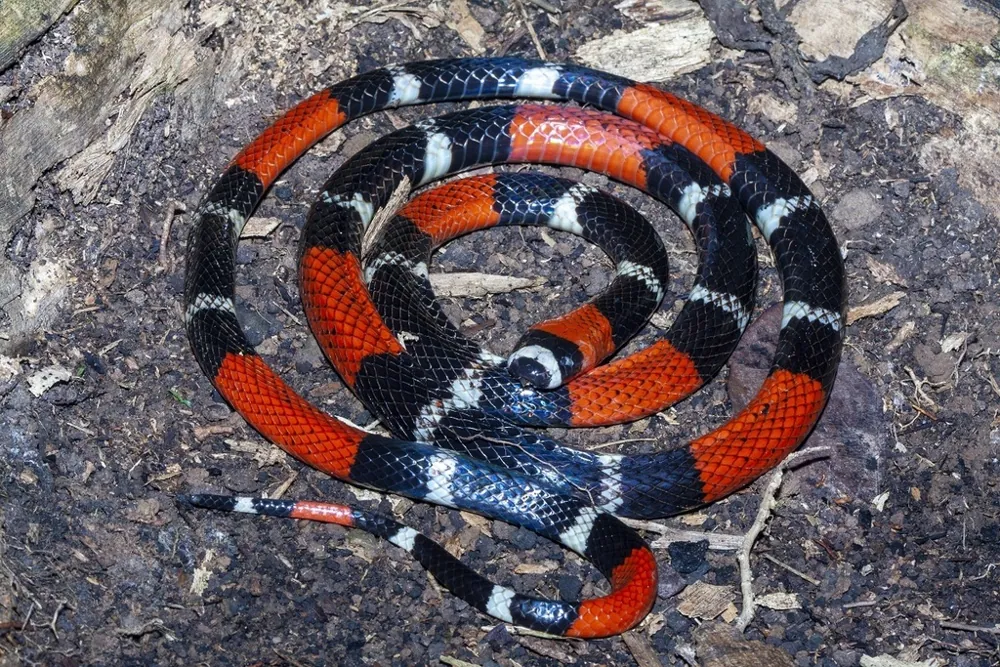
The South American coral snake is a thin, brightly coloured venomous snake. It lives only in South America, from Argentina to Venezuela. It is nocturnal, so it is most active at night, and its venom is strong enough to be dangerous to people.1



 Ho e tseba jwang
- The snout is black, followed by a narrow white band in front of the eyes and a wider black band across the eyes.1
- The rest of the head is red, and the body has broad red rings.1
- Between the red rings are 7 to 17 groups of three black and two white rings.1
- The tail has two of these black and white groups.1
- It is thin, and adults are usually 60 to 90 cm long, tail included.1
Matla a chefo
Chefo e tswa ka meno a yona a chefo (fangs) kapa ka meno a mang ha e loma.
Chefo ya yona (eo e e kenyang ka ho loma kapa ho hlaba) e etsang?
Its venom is a strong neurotoxin, which attacks the nerves. It acts both before and after the nerve connects to the muscle, and it causes a strong, permanent block of nerve signals to the muscles in vertebrates. A muscle-damaging toxin called lemnitoxin has also been isolated from the venom.1
E kotsi hakae ho batho?
Kotsi ho batho: E kotsi haholoE ka bolaya motho ya sa fumaneng kalafo.It is not aggressive towards people, but it can bite to defend itself. The estimated lethal dose for an adult human is 5 to 7 mg of venom (dry weight). In laboratory milking, the average venom yield was 8 to 10 mg and the largest was 27 mg.1
E etsang ha e tshohile?
It is not aggressive, but it can attack to defend itself when threatened.1
 Haeba e loma
- Boloka motho a sa sisinyehe ebile a kgutsitse mme o mo ise sepetlele kapele, leha moo e lomileng teng ho shebahala ho le honyenyane: matshwao a ka qala dihora hamorao.
Kamehla letsetsa nomoro ya tshohanyetso pele (112, 000, 911). Ena ke tataiso e akaretsang ya thuso ya pele, hase keletso ya bongaka. Metheo ya thuso ya pele
 Dula o bolokehile
- O se ke wa ama, wa tshwara kapa wa tena phoofolo ya naheng, leha e le e nyenyane, le leha e shebahala e robetse kapa e shwele.
- E fe sebaka. Ha o kopana le yona, dula o kgutsitse, kgutlela morao butle mme o e tlohele e tsamaye ka tsela ya yona.
- Haeba e nngwe e o loma: dula o kgutsitse, o se ke wa sisinyeha, letsetsa nomoro ya tshohanyetso (112, 000, 911) kapa o ye sepetlele kapele. Hopola hore e ne e shebahala jwang, foto e a thusa.
Ha e o batle. E sebedisa chefo ya yona ho tshwara dijo kapa ho itshireletsa, mme e kgetha ho ipata. Ho eketsehileng ka ho dula o bolokehile
Hokae lefatsheng?
E kgolo hakae?
E telele hakae?
 e telele jwaloka dikatse tsa lapeng tse 3 ho tloha nkong ho isa mohatleng
 e telele jwaloka dibanana tse 8 tse latellanang
 e ka matha metara e 100 ka metsotswana e 71 (motho ya potlakang ka ho fetisisa o hloka 9,6)
South American coral snake e kgolo hakae ha e bapiswa le WENA?
Ke dipalo feela ka hara sebatli sa hao. Ha ho letho le bolokwang kapa le romelwang kae kapa kae.
E potlaka hakae?


Dintlha
The venom of this snake is strong enough to cause paralysis, because it blocks nerve signals to the muscles.1
It is one of the few snakes whose diet includes freshwater eels and gymnotiform fishes.1
It is nocturnal and digs in loose soil or leaf litter, so it spends much of its time hidden underground.1
It can live in disturbed land and near human homes, not only in deep forest.1
Ho senya ditshomo
Tshomo: Coral snakes are aggressive and will attack people.
Nnete: This snake is not aggressive towards people. It only bites to defend itself.1
Moo dintlha di tswang teng
- Micrurus lemniscatus (Wikipedia (CC BY-SA 4.0))
- Micrurus lemniscatus (iNaturalist): mabitso le tlhophiso.
- Venom Wiki: boemo ba kotsi, boholo bo tlwaelehileng le kakanyo ya lebelo ke tsa rona. Bona kamoo re di balang ka teng: Kamoo re lekanyang kotsi ka teng.
Taba e nngwe le e nngwe leqepheng lena e na le nomoro e bontshang mohlodi wa yona. Haeba re entse phoso, re kopa tshwarelo, re barati ba diphoofolo, hase makasine wa saense. Re bolelle ho [email protected] mme re tla e lokisa.
 Phepheng e lapile! Venom Wiki ke projeke ya motho a le mong: ke mahala, ha e na dipapatso ebile ha e na di-tracker. Thuso e nyenyane ya tjhelete e e boloka e ntse e le inthaneteng.Fepa phepheng
 Central American coral snake
 Amazonian coral snake
 Aquatic coral snake
 Argentinian coral snake
 Caatinga coral snake
 Dumeril's coral snake
 Golden poison frog
 Terciopelo
 Brazilian wandering spider
 Eyelash viper
 Golden lancehead
 South American bushmaster