
 Afrika
 Asia
Asia Yuropa
 Amerika Borwa
 Australia le Oceania
 Antarctica
 Lewatle la Pacific
 Lewatle la Atlantic
 Lewatle la India
 Lewatle la Arctic
 Lewatle la Mediterranean
 Lewatle le Lefubedu
 Lewatle la Caribbean
 Lewatle la Coral
 Lewatle la China Borwa
 Lewatle la Philippine
 Lewatle la Andaman
 Lewatle la Leboya
 Lewatle la Timor le Arafura
 Kgwohlo ya Bengal
 Kgwohlo ya California
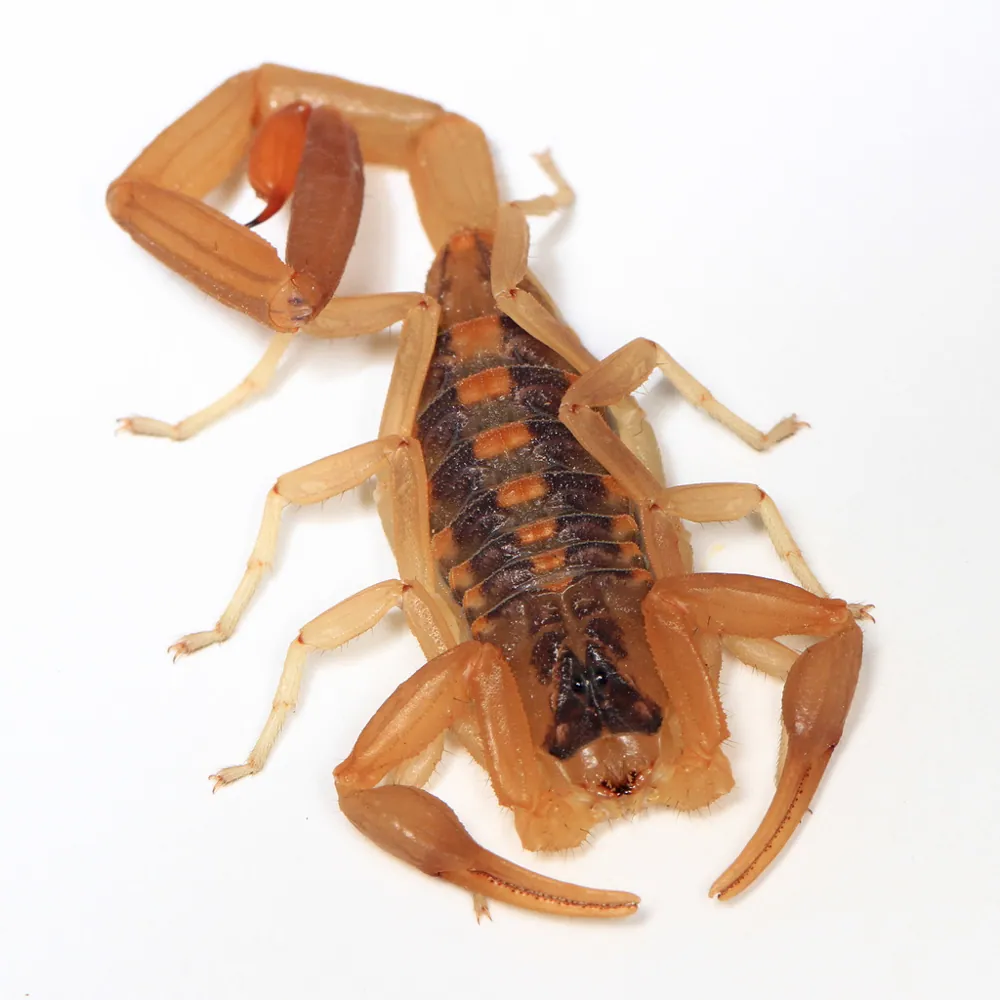
Striped bark scorpion
 Ho hlaba
The striped bark scorpion is a medium-sized, pale yellow scorpion with two dark stripes along its back. It lives across the middle of the United States and in northern Mexico, and it is perhaps the most often seen scorpion in the US. Its sting is painful, but it is very rarely deadly.1


 Ho e tseba jwang
Matla a chefo
Chefo e tswa ka lemao le hlabang.
Chefo ya yona (eo e e kenyang ka ho loma kapa ho hlaba) e etsang?
Its venom contains neurotoxins, which attack the nerves. These can cause tingling and numbness (paresthesia) and muscle spasms. One toxin keeps pain-sensing nerves firing for longer than normal, so the pain lasts. In rare severe cases, the venom can trigger a strong allergic-type reaction, with swelling, breathing trouble and, in the most severe cases, anaphylactic shock.1
E kotsi hakae ho batho?
Kotsi ho batho: E bohlokoE ka utlwisa bohloko haholo, empa hoo e batlang e le kamehla ha e kotsi haholo.Thousands of people are stung every year. The sting is painful and causes localised swelling, and it is very rarely deadly. Severe allergic-type reactions have occurred in some cases.1
 Haeba e hlaba
- Swelling can be treated with an ice pack. Get medical help straight away if symptoms are strong, because stings from some related bark scorpions can be deadly.1
- Pholisa moo e hlabileng teng ka pakete ya leqhwa mme o boloke motho a sa sisinyehe. Fumana thuso ya bongaka kapele, haholoholo bakeng sa bana: diphepheng tse ding di bolaya bana.
Kamehla letsetsa nomoro ya tshohanyetso pele (112, 000, 911). Ena ke tataiso e akaretsang ya thuso ya pele, hase keletso ya bongaka. Metheo ya thuso ya pele
 Dula o bolokehile
- O se ke wa ama, wa tshwara kapa wa tena phoofolo ya naheng, leha e le e nyenyane, le leha e shebahala e robetse kapa e shwele.
- E fe sebaka. Ha o kopana le yona, dula o kgutsitse, kgutlela morao butle mme o e tlohele e tsamaye ka tsela ya yona.
- Haeba e nngwe e o hlaba: dula o kgutsitse, o se ke wa sisinyeha, letsetsa nomoro ya tshohanyetso (112, 000, 911) kapa o ye sepetlele kapele. Hopola hore e ne e shebahala jwang, foto e a thusa.
Ha e o batle. E sebedisa chefo ya yona ho tshwara dijo kapa ho itshireletsa, mme e kgetha ho ipata. Ho eketsehileng ka ho dula o bolokehile
Hokae lefatsheng?
E kgolo hakae?
E telele hakae?
 e telele jwaloka diboloko tsa ho bapala tse 2 moleng
 e ka matha metara e 100 ka metsotswana e 260 (motho ya potlakang ka ho fetisisa o hloka 9,6)
Striped bark scorpion e kgolo hakae ha e bapiswa le WENA?
Ke dipalo feela ka hara sebatli sa hao. Ha ho letho le bolokwang kapa le romelwang kae kapa kae.
E potlaka hakae?


Dintlha
Before mating, males hold a showdown, waving their tails until one backs down. The winner then performs a courtship dance called the promenade a deux, in which larger males usually succeed.1
Unlike most scorpions, this species is social, so males and females have more chances to meet and compete for mates.1
In Colorado, people hunt for these scorpions with blacklights each late summer around the Cheyenne Mountain area.1
Populations have been found in some cities far outside its natural range, most likely brought there by human activity.1
Birds, reptiles, some mammals and larger arachnids prey on it, and juveniles spend much of their time in vegetation to avoid being eaten.1
Moo dintlha di tswang teng
- Striped bark scorpion (Wikipedia (CC BY-SA 4.0))
- Centruroides vittatus (iNaturalist): mabitso le tlhophiso.
- Venom Wiki: boemo ba kotsi, boholo bo tlwaelehileng le kakanyo ya lebelo ke tsa rona. Bona kamoo re di balang ka teng: Kamoo re lekanyang kotsi ka teng.
Taba e nngwe le e nngwe leqepheng lena e na le nomoro e bontshang mohlodi wa yona. Haeba re entse phoso, re kopa tshwarelo, re barati ba diphoofolo, hase makasine wa saense. Re bolelle ho [email protected] mme re tla e lokisa.
 Phepheng e lapile! Venom Wiki ke projeke ya motho a le mong: ke mahala, ha e na dipapatso ebile ha e na di-tracker. Thuso e nyenyane ya tjhelete e e boloka e ntse e le inthaneteng.Fepa phepheng
 Arizona bark scorpion
 Cuban blue scorpion
 Giant desert hairy scorpion
 Colima scorpion
 Durango scorpion
 Mexican bark scorpion
 Terciopelo
 Eastern coral snake
 Eastern diamondback rattlesnake
 Eyelash viper
 Timber rattlesnake
 Western diamondback rattlesnake