
 Afrika
 Asia
Asia Yuropa
 Amerika Borwa
 Australia le Oceania
 Antarctica
 Lewatle la Pacific
 Lewatle la Atlantic
 Lewatle la India
 Lewatle la Arctic
 Lewatle la Mediterranean
 Lewatle le Lefubedu
 Lewatle la Caribbean
 Lewatle la Coral
 Lewatle la China Borwa
 Lewatle la Philippine
 Lewatle la Andaman
 Lewatle la Leboya
 Lewatle la Timor le Arafura
 Kgwohlo ya Bengal
 Kgwohlo ya California
Texas lyre snake
 Ho loma
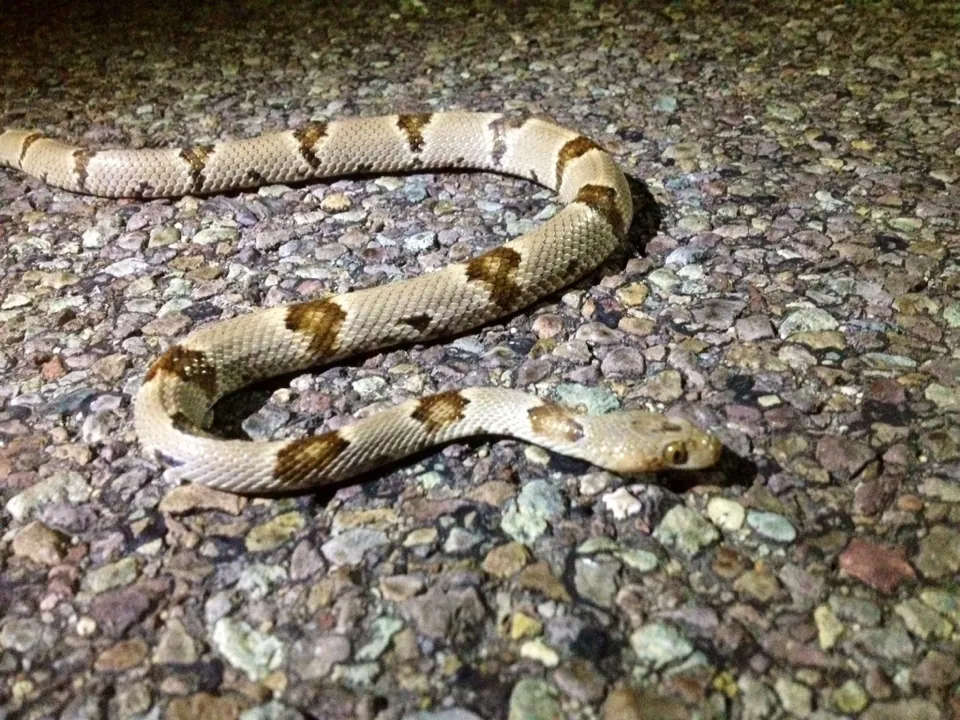
The Texas lyre snake is a medium-sized, mildly venomous snake that lives in deserts and rocky land in the south-western United States and northern Mexico. It is secretive and hides in rock crevices during the day, so it is often hard to spot.1



 Ho e tseba jwang
- Brown, tan or grey, with 17 to 24 dark brown blotches down the back1
- Large eyes with vertical pupils1
- Medium-sized, reaching about 1 metre in total length, including the tail1
- No V-shaped mark on the head, unlike other lyre snakes1
Hangata e ferekanngwa le: Other lyre snakes in the genus Trimorphodon have a V-shaped pattern on the head that looks like a lyre. This subspecies does not have that mark.1
Matla a chefo
Chefo e tswa ka meno a yona a chefo (fangs) kapa ka meno a mang ha e loma.
Chefo ya yona (eo e e kenyang ka ho loma kapa ho hlaba) e etsang?
This snake is mildly venomous and is rear-fanged, meaning its fangs are at the back of the mouth. Its venom is not considered harmful to humans.1
E kotsi hakae ho batho?
Kotsi ho batho: E bobebeJwaloka ho hlajwa ke notshi kapa ho fetang moo. Ha e na kotsi ho batho.Its venom is not considered harmful to people. The snake is secretive and often difficult to find.1
 Haeba e loma
- Hlatswa moo e lomileng teng, boloka motho a kgutsitse mme o fumane thuso ya bongaka. Mefuta e meng (jwaloka boomslang) e ka bolaya dihora hamorao.
Kamehla letsetsa nomoro ya tshohanyetso pele (112, 000, 911). Ena ke tataiso e akaretsang ya thuso ya pele, hase keletso ya bongaka. Metheo ya thuso ya pele
 Dula o bolokehile
- O se ke wa ama, wa tshwara kapa wa tena phoofolo ya naheng, leha e le e nyenyane, le leha e shebahala e robetse kapa e shwele.
- E fe sebaka. Ha o kopana le yona, dula o kgutsitse, kgutlela morao butle mme o e tlohele e tsamaye ka tsela ya yona.
- Haeba e nngwe e o loma: dula o kgutsitse, o se ke wa sisinyeha, letsetsa nomoro ya tshohanyetso (112, 000, 911) kapa o ye sepetlele kapele. Hopola hore e ne e shebahala jwang, foto e a thusa.
Ha e o batle. E sebedisa chefo ya yona ho tshwara dijo kapa ho itshireletsa, mme e kgetha ho ipata. Ho eketsehileng ka ho dula o bolokehile
Hokae lefatsheng?
E kgolo hakae?
E telele hakae?
 e telele jwaloka dikatse tsa lapeng tse 2 ho tloha nkong ho isa mohatleng
 e telele jwaloka dibanana tse 6 tse latellanang
 e ka matha metara e 100 ka metsotswana e 71 (motho ya potlakang ka ho fetisisa o hloka 9,6)
Texas lyre snake e kgolo hakae ha e bapiswa le WENA?
Ke dipalo feela ka hara sebatli sa hao. Ha ho letho le bolokwang kapa le romelwang kae kapa kae.
E potlaka hakae?


Dintlha
Despite its name, this subspecies has no V-shaped mark on its head, which is the pattern that gives lyre snakes their name.1
It is nocturnal, spending the day hidden in rock crevices and coming out to feed at night.1
It is seemingly common throughout its habitat, even though it is hard to find.1
It was once listed as Threatened in Texas, but it was removed from that list in 2020.1
Ho senya ditshomo
Tshomo: The name 'lyre snake' means every lyre snake has a lyre-shaped V mark on its head.
Nnete: This subspecies has no V mark on the head, even though the name refers to that pattern in other lyre snakes.1
Bakeng sa ditsebi tsa chefo
- Lebitso la saense
- Trimorphodon vilkinsonii
- Sehlopha
- Dinoha tse meno a ka morao
- Lelapa
- Colubridae2
- Tatelano
- Squamata
- Dikontinente
- Amerika Leboya
- Masea
- It lays eggs (it is oviparous), with about a dozen eggs per clutch.1
- Boemo ba yona naheng
- Removed from the Threatened list in Texas in 20201
- Kotsi ho batho
- 1 / 5: E bobebe3
Moo dintlha di tswang teng
- Texas lyre snake (Wikipedia (CC BY-SA 4.0))
- Trimorphodon vilkinsonii (iNaturalist): mabitso le tlhophiso.
- Venom Wiki: boemo ba kotsi, boholo bo tlwaelehileng le kakanyo ya lebelo ke tsa rona. Bona kamoo re di balang ka teng: Kamoo re lekanyang kotsi ka teng.
Taba e nngwe le e nngwe leqepheng lena e na le nomoro e bontshang mohlodi wa yona. Haeba re entse phoso, re kopa tshwarelo, re barati ba diphoofolo, hase makasine wa saense. Re bolelle ho [email protected] mme re tla e lokisa.
 Phepheng e lapile! Venom Wiki ke projeke ya motho a le mong: ke mahala, ha e na dipapatso ebile ha e na di-tracker. Thuso e nyenyane ya tjhelete e e boloka e ntse e le inthaneteng.Fepa phepheng
Tse ding tsa sehlopha se le seng: Dinoha tse meno a ka morao
 Western hognose snakeDinoha tse meno a ka moraoHa e na kotsi
 Brown vine snakeDinoha tse meno a ka moraoHa e na kotsi
 Eastern hognose snakeDinoha tse meno a ka moraoHa e na kotsi
 Green vine snakeDinoha tse meno a ka moraoHa e na kotsi
 Desert night snakeDinoha tse meno a ka moraoHa e na kotsi
 Night snakeDinoha tse meno a ka moraoHa e na kotsi
 Terciopelo
 Eastern coral snake
 Eastern diamondback rattlesnake
 Eyelash viper
 Timber rattlesnake
 Western diamondback rattlesnake