
 Afrika
 Asien
Asien Europa
 Sydamerika
 Australien och Oceanien
 Antarktis
 Stilla havet
 Atlanten
 Indiska oceanen
 Norra ishavet
 Medelhavet
 Röda havet
 Karibiska havet
 Korallhavet
 Sydkinesiska havet
 Filippinska havet
 Andamansjön
 Nordsjön
 Timorhavet och Arafurasjön
 Bengaliska viken
 Kaliforniska viken
Caspian cobra
 Bett
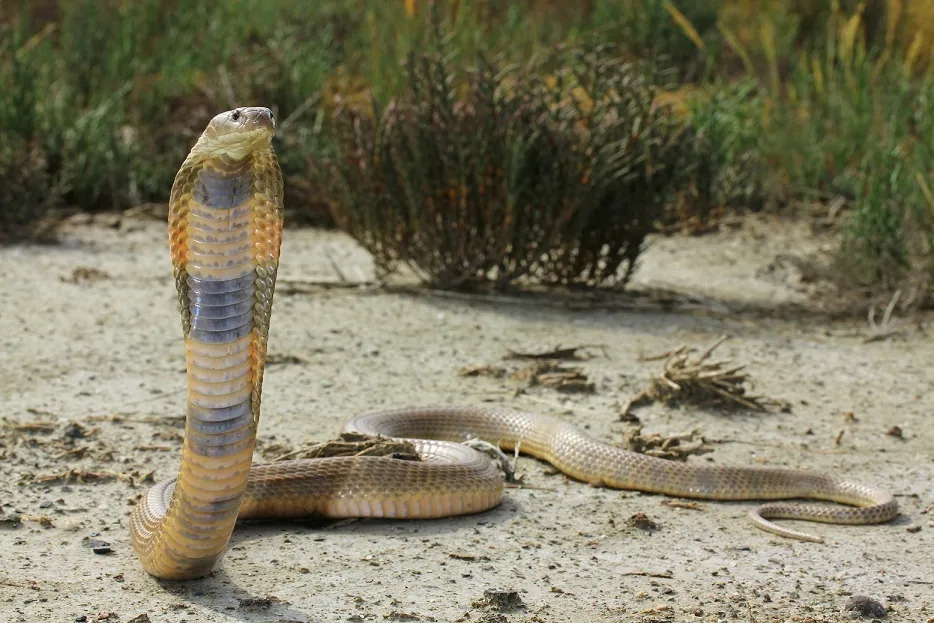
BettThe Caspian cobra is a highly venomous snake that lives in Central Asia, Afghanistan, Iran and Pakistan. Many scientists consider it the most venomous cobra in the world. It is also a strong swimmer and a good climber.1



 Så känner du igen den
- Adults are light to chocolate brown or yellowish, with no hood marks and no spots on the throat.1
- Juveniles are pale and faded, with dark and light cross-bands of about equal width around the body.1
- The hood is long and tapers gradually, unlike the rounder hood of some other cobras.1
- It has several dark bands under the throat.1
- It is never fully black, although some individuals can be quite dark.1
Förväxlas ofta med: The Caspian cobra is often confused with the Indian cobra, and the two live side by side in Pakistan and northern India. Indian cobras without a hood mark look similar. In the black form of the Indian cobra from Pakistan, almost the whole throat is black, while the Caspian cobra has several dark throat bands and is never fully black.1
Giftkraft
Giftet kommer ut genom gifttänderna eller tänderna när den biter.
Vad gör giftet när den biter eller sticker?
Its venom is mainly neurotoxic, meaning it attacks the nerves, and most of the venom is made of short neurotoxins. It also contains cytotoxins, which can kill cells, and enzymes called nucleases, which damage tissue at the bite. Severe pain and swelling appear quickly, and weakness, drowsiness and paralysis of the throat and limbs can appear within an hour. The venom can also affect the heart during the first few hours, and at least one heart attack after a bite has been recorded.1
Hur farlig är den för människor?
Fara för människor: DödligEtt av de farligaste djuren i världen.It is regarded as the most dangerous snake in Central Asia and has a high death rate. Between 1979 and 1987, 136 confirmed bites were attributed to it in the former Soviet Union. Of these, 8 people died after receiving antivenom, and 11 of the 15 who did not receive antivenom died. In Iran, it causes more deaths from snakebite than any other snake in the country. Without treatment, death can come in as little as 45 minutes or be delayed for up to 24 hours.1
 Goda nyheter: läkare har en medicin (motgift) eller en behandling för det här.1
Vad gör den när den är rädd?
It tends to avoid people, but when cornered or provoked it spreads its hood, hisses, sways from side to side and strikes repeatedly.1
 Om den biter
- Medical treatment with antivenom is essential, because untreated bites are often fatal. Symptoms can worsen rapidly without treatment, so urgent medical care is needed.1
- Håll personen stilla och lugn, ta av ringar och sådant som sitter åt och ta dig snabbt till ett sjukhus: motgift är behandlingen.
Ring alltid ditt larmnummer först (112, 000, 911). Det här är allmänna råd om första hjälpen, inte medicinsk rådgivning. Första hjälpen, grunderna
 Håll dig säker
- Rör aldrig, fånga aldrig och reta aldrig ett vilt djur, inte ens ett litet, och inte ens om det ser ut att sova eller vara dött.
- Håll avstånd. Om du möter en, var lugn, backa långsamt och låt den gå sin väg.
- Om en biter dig: var lugn, håll dig stilla, ring ditt larmnummer (112, 000, 911) eller ta dig snabbt till ett sjukhus. Kom ihåg hur den såg ut, ett foto hjälper.
Den är inte ute efter dig. Den använder sitt gift för att fånga mat eller skydda sig, och den gömmer sig mycket hellre. Mer om hur du håller dig säker
Hur stor är den?
Hur lång är den?
 lika lång som 3 huskatter från nos till svans
 lika lång som 9 bananer på rad
 skulle kunna springa 100 meter på 48 sekunder (den snabbaste människan behöver 9,6)
Hur stor är Caspian cobra jämfört med DIG?
Bara matematik i din webbläsare. Inget sparas eller skickas någonstans.
Hur snabb är den?


Fakta
Many toxinological studies suggest that the Caspian cobra is the most venomous cobra in the world.1
A ribonuclease called ribonuclease V1, purified from its venom, is used as a laboratory reagent in molecular biology because it can break down structured RNA.1
It cannot spit venom, but it is a good climber and an able swimmer.1
It is the westernmost species of Asiatic cobra, and it can be found at heights of up to about 3,000 m.1
For most of the twentieth century it was treated as a subspecies of the Indian cobra, until genetic analysis showed it was a separate species.1
Myt eller sanning
Myt: Caspian cobras are always black, like some Indian cobras.
Sanning: The Caspian cobra is never fully black. Adults are light to chocolate brown or yellowish, and it has several dark bands under the throat.1
Var fakta kommer ifrån
- Caspian cobra (Wikipedia (CC BY-SA 4.0))
- Naja oxiana (iNaturalist): namn och klassificering.
- Venom Wiki: farlighetsnivån, den typiska storleken och den gissade hastigheten är våra egna. Se hur vi räknar fram dem: Så bedömer vi faran.
Alla fakta på den här sidan har en siffra som visar var de kommer ifrån. Om vi har fått något fel, förlåt, vi är djurfans, inte en vetenskaplig tidskrift. Berätta för oss på [email protected] så rättar vi det.
 Skorpionen är hungrig! Venom Wiki är ett enmansprojekt: gratis, utan reklam och utan spårning. En liten dricks hjälper till att hålla den online.Mata skorpionen
 Glasögonorm
 Kungskobra
 Common krait
 Malayan krait
 Many-banded krait
 Monocled cobra
 Gul dödsskorpion
 Sandrasselorm
 Puffotter
 Russells huggorm
 Asian giant hornet
 Komodo dragon