
 Afrika
 Asien
Asien Europa
 Sydamerika
 Australien och Oceanien
 Antarktis
 Stilla havet
 Atlanten
 Indiska oceanen
 Norra ishavet
 Medelhavet
 Röda havet
 Karibiska havet
 Korallhavet
 Sydkinesiska havet
 Filippinska havet
 Andamansjön
 Nordsjön
 Timorhavet och Arafurasjön
 Bengaliska viken
 Kaliforniska viken
Turkish deathstalker
 Stick
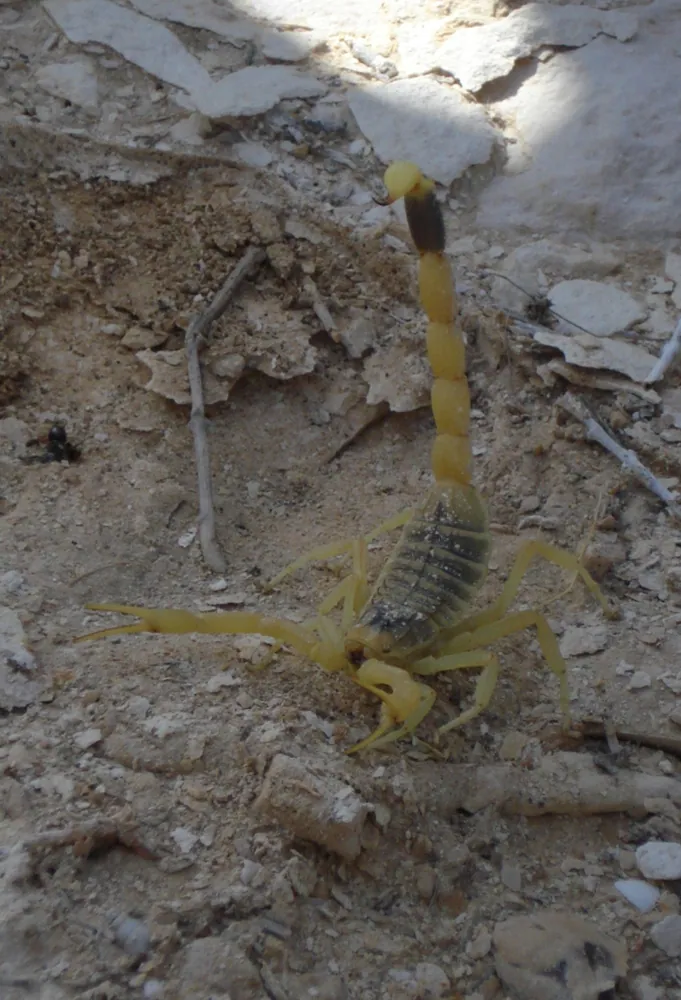
StickThe Turkish deathstalker is a scorpion from the family Buthidae. Its venom is highly toxic to humans, but scientists also use scorpion venom in medical research. It lives in dry, rocky places and usually keeps away from people.1


 Så känner du igen den
- Brown front body section (cephalothorax), with a yellow head, legs and tail.1
- The very last segment of the tail is brown instead of yellow.1
- Its pincers and other body parts are yellowish, against a mostly black background on the front body and tail.1
Förväxlas ofta med: It was once considered the same species as the deathstalker (L. quinquestriatus), but was reclassified as a separate species in 2009 based on mitochondrial DNA analysis. Its tail segments are shorter than those of the deathstalker.1
Giftkraft
Giftet kommer ut genom en gadd.
Vad gör giftet när den biter eller sticker?
Its venom comes from two venom glands and is mainly made of proteins. It stimulates voltage-gated sodium and potassium channels, which control the electrical signals in nerves and muscles. Symptoms can be severe: after a sting, pain can come in waves with seizures, and blisters can form at the site of the sting.1
Hur farlig är den för människor?
Fara för människor: Mycket farligDen kan döda en person som inte får behandling.Only a small portion of scorpions are harmful to humans, but this species' venom is very toxic and can cause severe symptoms from a single sting. The sting is much worse in children, and it may pose a serious health threat to infants because of their small body weight.1
Vad gör den när den är rädd?
Its venom is used for self-defence as well as for hunting.1
 Om den sticker
- Anyone who has been stung should have an early echocardiogram, which is a heart ultrasound, because the venom can affect the heart. In the case described, the patient was given sodium chloride (saline) and a local painkiller at hospital.1
- Kyl sticket med en ispåse och håll personen stilla. Sök snabbt vård, särskilt för barn: vissa skorpioner är dödliga för barn.
Ring alltid ditt larmnummer först (112, 000, 911). Det här är allmänna råd om första hjälpen, inte medicinsk rådgivning. Första hjälpen, grunderna
 Håll dig säker
- Rör aldrig, fånga aldrig och reta aldrig ett vilt djur, inte ens ett litet, och inte ens om det ser ut att sova eller vara dött.
- Håll avstånd. Om du möter en, var lugn, backa långsamt och låt den gå sin väg.
- Om en sticker dig: var lugn, håll dig stilla, ring ditt larmnummer (112, 000, 911) eller ta dig snabbt till ett sjukhus. Kom ihåg hur den såg ut, ett foto hjälper.
Den är inte ute efter dig. Den använder sitt gift för att fånga mat eller skydda sig, och den gömmer sig mycket hellre. Mer om hur du håller dig säker
Hur stor är den?
Hur lång är den?
 lika lång som 3 leksaksbyggklossar på rad
 skulle kunna springa 100 meter på 200 sekunder (den snabbaste människan behöver 9,6)
Hur stor är Turkish deathstalker jämfört med DIG?
Bara matematik i din webbläsare. Inget sparas eller skickas någonstans.
Hur snabb är den?


Fakta
In one recorded case, a sting on the thumb of a 30-year-old man caused pain, reddening, seizures and blisters, and he was unable to move his arm up for a time.1
When a male wants to mate, he injects a small dose of venom into the female to calm her before they move together in a dance-like pattern.1
In tests on rats, the venom of this species had a greater effect than the venom of the Arabian fat-tailed scorpion (Androctonus crassicauda).1
Its venom is studied for treating nervous, immune, infection, cardiovascular and cancer (neoplastic) diseases.1
Birds, bats and mice prey on scorpions, which is why they are more active on moonless nights.1
Var fakta kommer ifrån
- Leiurus abdullahbayrami (Wikipedia (CC BY-SA 4.0))
- Leiurus abdullahbayrami (iNaturalist): namn och klassificering.
- Venom Wiki: farlighetsnivån, den typiska storleken och den gissade hastigheten är våra egna. Se hur vi räknar fram dem: Så bedömer vi faran.
Alla fakta på den här sidan har en siffra som visar var de kommer ifrån. Om vi har fått något fel, förlåt, vi är djurfans, inte en vetenskaplig tidskrift. Berätta för oss på [email protected] så rättar vi det.
 Skorpionen är hungrig! Venom Wiki är ett enmansprojekt: gratis, utan reklam och utan spårning. En liten dricks hjälper till att hålla den online.Mata skorpionen
 Gul dödsskorpion
 Indian red scorpion
 Arabian fat-tailed scorpion
 Chinese scorpion
 Asian forest scorpion
 Giant forest scorpion
 Glasögonorm
 Sandrasselorm
 Kungskobra
 Puffotter
 Russells huggorm
 Asian giant hornet