
 Afrika
 Asia
Asia Ulaya
Ulaya Amerika Kusini
 Australia na Oceania
 Antaktika
 Bahari ya Pasifiki
 Bahari ya Atlantiki
 Bahari ya Hindi
 Bahari ya Aktiki
 Bahari ya Mediterania
 Bahari ya Shamu
 Bahari ya Karibi
 Bahari ya Matumbawe
 Bahari ya Kusini ya China
 Bahari ya Ufilipino
 Bahari ya Andaman
 Bahari ya Kaskazini
 Bahari ya Timor na Arafura
 Ghuba ya Bengal
 Ghuba ya California
Brazilian yellow scorpion
 Kudungwa
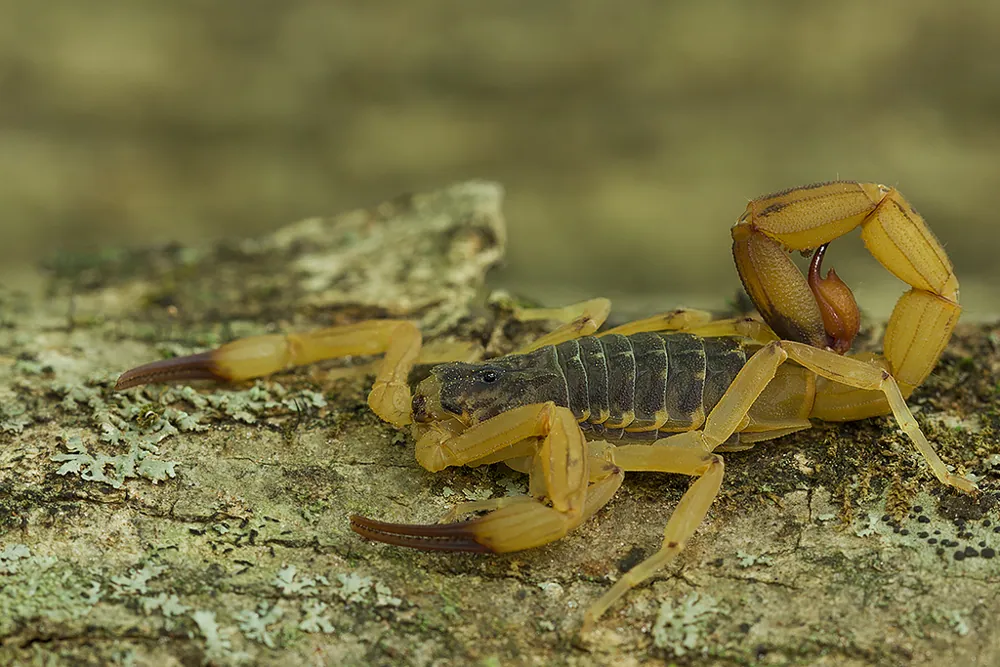
The Brazilian yellow scorpion is a small scorpion that lives in Brazil, often in towns and cities. Its venom is extremely toxic, and it is the most dangerous scorpion in South America.1

 Jinsi ya kumtambua
- Adults are usually 5 to 7 cm long.1
- Legs and pedipalps are pale yellow, while the body and the tip of the tail are a darker yellowish brown.1
- The tail is bulbous and segmented, with prominent ridges and serrations, and is often carried curved forward over the back.1
- The tail ends in a venom-injecting barb.1
Nguvu ya sumu
Sumu hutoka kupitia mdungo.
Sumu yake hufanya nini?
Its venom contains an excitatory neurotoxin, which attacks the nerves that control involuntary body functions and releases adrenaline and related chemicals. Mild cases cause mainly localised pain, while more serious cases can bring fever, sweating, tremors, vomiting, agitation, a fast heartbeat and inflammation of the pancreas. Deaths can occur within 1 to 6 hours, or 12 to 14 hours, depending on age, health and the amount of venom injected.1
Ana hatari gani kwa watu?
Hatari kwa watu: Hatari sanaAnaweza kumuua mtu asiyepata matibabu.It is responsible for more medically significant accidents than any other scorpion in Brazil, and most of the country's fatal scorpion cases. Mortality rates are 1.0 to 2.0% among children and elderly people. In a nationwide study from 2000 to 2012, Brazil recorded 482,616 scorpion accidents and 728 deaths, and this species was believed to cause most of those deaths.1
Hufanya nini akiogopa?
It uses its tail barb to deliver defensive strikes.1
 Akidunga
- Poza mahali palipodungwa kwa barafu na umweke mtu bila kutikisika. Tafuta msaada wa kitabibu haraka, hasa kwa watoto: baadhi ya nge ni hatari ya kifo kwa watoto.
Daima piga namba ya dharura kwanza (112, 000, 911). Huu ni mwongozo wa jumla wa huduma ya kwanza, si ushauri wa kitabibu. Misingi ya huduma ya kwanza
 Kaa salama
- Kamwe usimguse, kumkamata wala kumchokoza mnyama wa porini, hata akiwa mdogo, na hata akionekana amelala au amekufa.
- Mpe nafasi. Ukikutana naye, tulia, rudi nyuma polepole na umwache aende zake.
- Akikudunga: tulia, usitikisike, piga namba yako ya dharura (112, 000, 911) au nenda hospitali haraka. Kumbuka alivyoonekana, picha husaidia.
Hakuwindi wewe. Hutumia sumu yake kukamata chakula au kujilinda, na hupendelea zaidi kujificha. Zaidi kuhusu kukaa salama
Ana ukubwa gani?
Ana urefu gani?
 urefu sawa na matofali 2 ya kuchezea yaliyopangwa mstari
 angeweza kukimbia mita 100 kwa sekunde 260 (binadamu mwenye kasi zaidi anahitaji 9.6)
Brazilian yellow scorpion ana ukubwa gani ukilinganisha na WEWE?
Ni hesabu tu kwenye kivinjari chako. Hakuna kinachohifadhiwa wala kutumwa popote.
Ana kasi gani?


Ukweli
Reported scorpion stings in Brazil rose from 12,000 in 2000 to 140,000 by 2018.1
It has a low metabolic rate, so it can survive for months without eating.1
Scorpion numbers have grown in Brazilian cities, helped by plenty of cockroaches to eat and few predators.1
Its venom varies by region. Scorpions from Distrito Federal have an LD50 of 51.6 μg/kg, compared with 26 μg/kg for those from Minas Gerais. LD50 is the dose that kills half of the animals tested.1
Its tail is bulbous and segmented, with ridges and serrations, and it often curls forward over its back.1
Ukweli unatoka wapi
- Tityus serrulatus (Wikipedia (CC BY-SA 4.0))
- Tityus serrulatus (iNaturalist): majina na uainishaji.
- Venom Wiki: kiwango cha hatari, ukubwa wa kawaida na makadirio ya kasi ni yetu wenyewe. Ona jinsi tunavyovipata: Jinsi tunavyopima hatari.
Kila ukweli kwenye ukurasa huu una namba inayoonyesha chanzo chake. Kama tumekosea kitu, samahani, sisi ni wapenzi wa wanyama, si jarida la kisayansi. Tuambie kupitia [email protected] nasi tutarekebisha.
 Nge ana njaa! Venom Wiki ni mradi wa mtu mmoja: bure, bila matangazo na bila vifuatiliaji. Mchango mdogo husaidia kuiweka hewani.Mlishe nge
 Amazonian black scorpion
 Caracas scorpion
 Panamanian black scorpion
 Zulia scorpion
 Amazon forest scorpion
 Argentine striped scorpion
 Golden poison frog
 Terciopelo
 Brazilian wandering spider
 Eyelash viper
 Golden lancehead
 South American bushmaster