
 Aprika
 Asya
Asya Europa
 Timog Amerika
 Australia at Oceania
 Antarctica
 Karagatang Pasipiko
 Karagatang Atlantiko
 Karagatang Indiyano
 Karagatang Artiko
 Dagat Mediteraneo
 Dagat Pula
 Dagat Caribe
 Dagat Coral
 Dagat Timog Tsina
 Dagat Pilipinas
 Dagat Andaman
 Dagat Hilaga
 Dagat Timor at Arafura
 Look ng Bengal
 Golpo ng California
Baron's mantella
 May lason sa balat nitoKinakain: Mga insektoNakalalason, hindi makamandag
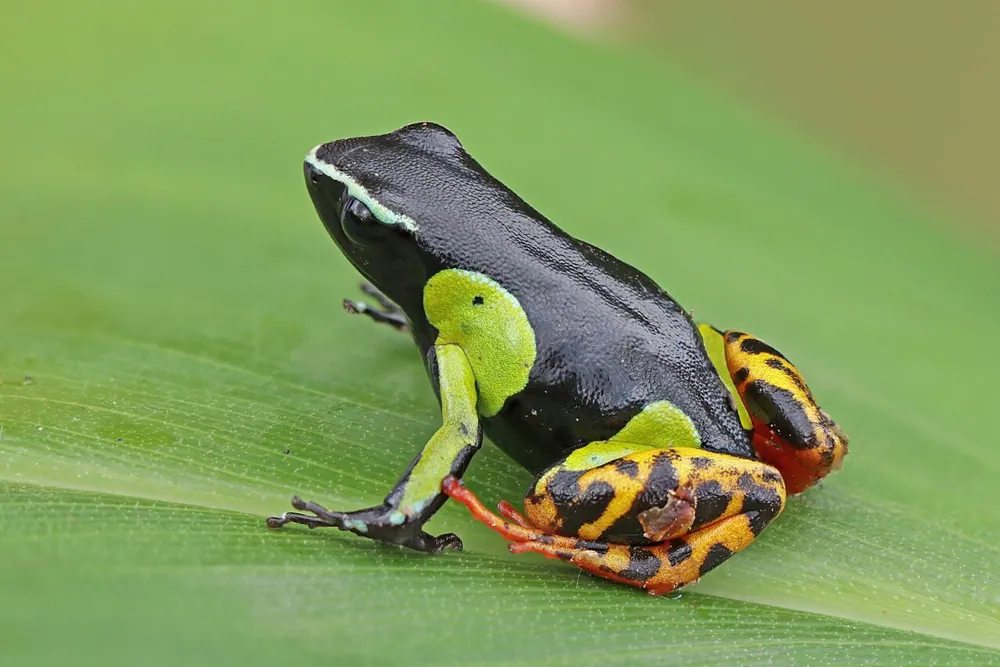
Baron's mantella is a small, brightly coloured frog that lives only on the island of Madagascar. Its skin contains toxic chemicals that make it harmful to predators, and its bright colours warn them to stay away.1



 Paano ito makikilala
- Has a light line above the eyes, called a rostral line.1
- Hind limbs are orange with irregular black stripes, giving a tiger-like pattern.1
- Front limbs range from light green to bright orange or yellow, with a large rounded flank blotch.1
- Adults are 2.4 to 3.2 cm long, and females are slightly larger than males.1
- Males call during the day, and it is an active hunter in daylight.1
Madalas mapagkamalang: It is often confused with the painted mantella (Mantella madagascariensis), which has a similar look. The painted mantella has a sky-blue, horseshoe-shaped marking on its throat. Baron's mantella does not have the flashmarks on its lower hind limbs.1
Lakas ng lason
Nakalalason ang balat nito. Delikado itong hawakan, dilaan o kainin.
Ano ang epekto ng lason nito?
It does not inject venom. Its skin contains alkaloids, which are toxic chemicals it gets from eating mites. These make it harmful to predators that eat it, and they can cause sickness. The strength of the toxin varies over time and by location, and frogs in remote populations may be more potent.1
Gaano ito kapanganib sa tao?
Panganib sa tao: BanayadParang kagat ng bubuyog o mas mahina. Halos hindi nakapipinsala sa tao.Its toxicity can vary, and careless handling is discouraged.1
Ano ang ginagawa nito kapag natatakot?
Its bright colours warn predators that eating it could be dangerous and cause sickness.1
 Kung may humawak o kumain nito
- Kung may humawak sa isa: hugasang mabuti ang mga kamay at huwag hawakan ang mata o bibig. Kung may batang o alagang hayop na dumila o kumain ng isa: tawagan ang poison control center o ang numero pang-emergency.
Laging tawagan muna ang numero pang-emergency (112, 000, 911). Ito ay pangkalahatang gabay sa pangunang lunas, hindi payong medikal. Mga batayan ng pangunang lunas
 Mag-ingat
- Huwag kailanman hawakan, hulihin o asarin ang ligaw na hayop, kahit maliit, at kahit mukha itong tulog o patay.
- Bigyan ito ng espasyo. Kung makasalubong ka ng isa, manatiling kalmado, dahan-dahang umatras at hayaan itong umalis.
- Kung nahawakan o nakain mo ito: huwag kuskusin ang mata o bibig mo, hugasan ang mga kamay mo at kumuha ng tulong medikal.
Hindi ka nito hinahabol. Ang lason nito ay para lang walang kumain dito. Higit pa tungkol sa pag-iingat
Gaano ito kalaki?
Gaano ito kahaba?
 halos kasinghaba ng paper clip
 kayang tapusin ang 100 metro sa loob ng 100 segundo (9.6 ang kailangan ng pinakamabilis na tao)
Gaano kalaki si Baron's mantella kumpara sa IYO?
Math lang sa browser mo. Walang sine-save o ipinapadala kahit saan.
Gaano ito kabilis?


Mga fact
Its toxicity comes from the mites it eats, so its poison depends on its diet.1
Mantella frogs look like poison dart frogs from Latin America, but they are only distant relatives. The likeness is an example of convergent evolution.1
Unlike most frogs, which are active at night, it hunts during the day.1
Its bright colours and its toxins are a warning system, a pattern called aposematism.1
Its family arrived on Madagascar an estimated 76 to 87 million years ago.1
It is one of the largest species in the Mantella genus, with only some Mantella viridis individuals reaching a similar size.1
Myth buster
Mito: Baron's mantella is the same as the painted mantella, and is sometimes called a painted mantella.
Totoo: The two are distinct species. They look alike, but the painted mantella has a sky-blue throat marking that Baron's mantella lacks.1
Para sa mga eksperto sa kamandag
- Pangalang siyentipiko
- Mantella baroni
- Grupo
- Mga poison frog, palaka at newt
- Pamilya
- Mantellidae2
- Ayos
- Anura
- Mga kontinente
- Aprika
- Mga sanggol
- Females can lay up to 130 eggs in a single clutch, usually near water. Rain washes the tadpoles into the water.1
- Kalagayan nito sa ligaw
- Least Concern (IUCN, 2016). It appears in CITES Appendix II.1
- Panganib sa tao
- 1 / 5: Banayad3
Saan galing ang mga fact
- Mantella baroni (Wikipedia (CC BY-SA 4.0))
- Mantella baroni (iNaturalist): mga pangalan at klasipikasyon.
- Venom Wiki: sarili naming tantiya ang antas ng panganib, karaniwang laki at hula sa bilis. Tingnan kung paano namin ito kinukuwenta: Paano namin sinusukat ang panganib.
Bawat fact sa pahinang ito ay may numerong tumuturo sa pinagmulan nito. Kung may mali kami, pasensya na, mahilig lang kami sa hayop, hindi kami science journal. Sabihin sa amin sa [email protected] at aayusin namin.
 Gutom ang alakdan! Ang Venom Wiki ay proyekto ng iisang tao: libre, walang ads at walang trackers. Nakatutulong ang maliit na tip para manatili itong online.Pakainin ang alakdan
Higit pa mula sa parehong grupo: Mga poison frog, palaka at newt
 Golden mantellaMga poison frog, palaka at newtHindi nakapipinsala
 Iberian ribbed newtMga poison frog, palaka at newtHindi nakapipinsala
 Tomato frogMga poison frog, palaka at newtHindi nakapipinsala
 African common toadMga poison frog, palaka at newtMasakit langHuwag hawakan
 Blue-legged mantellaMga poison frog, palaka at newtHindi nakapipinsala
 Climbing mantellaMga poison frog, palaka at newtHindi nakapipinsala
 Itim na mamba
 Alakdang deathstalker
 Kobrang Ehipsiyo
 Puff adder
 Boomslang
 Fat-tailed scorpion
_Ranomafana.jpg)