
 Aprika
 Asya
Asya Europa
 Timog Amerika
 Australia at Oceania
 Antarctica
 Karagatang Pasipiko
 Karagatang Atlantiko
 Karagatang Indiyano
 Karagatang Artiko
 Dagat Mediteraneo
 Dagat Pula
 Dagat Caribe
 Dagat Coral
 Dagat Timog Tsina
 Dagat Pilipinas
 Dagat Andaman
 Dagat Hilaga
 Dagat Timor at Arafura
 Look ng Bengal
 Golpo ng California
Climbing mantella
 May lason sa balat nitoKinakain: Mga insektoNakalalason, hindi makamandag
The climbing mantella is a small, brightly coloured frog that lives in the lowland rainforests of northeast Madagascar. It is a poison frog, so its skin holds chemicals that can harm predators. It is special because it is one of the few frogs whose parents care for their tadpoles by feeding them eggs.1



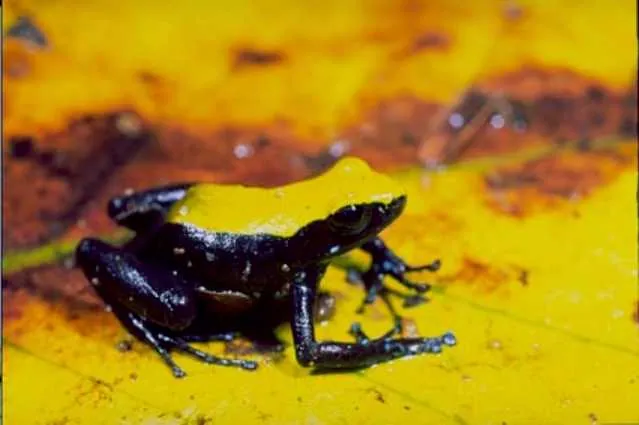
 Paano ito makikilala
- Adults are 24–30 mm long and weigh 1.2–2.0 g1
- Front of the back is bright yellow or pale green1
- Arms, legs, belly and rear are black, with blue spots on the limbs1
- Eyes are completely black1
- Has discs at the tips of its fingers and toes, and the toes are webbed1
Madalas mapagkamalang: M. betsileo, M. viridis and M. expectata look similar but are differently coloured. They often have blue spots on the throat rather than the limbs, and they have a faint line along the upper lip, which the climbing mantella lacks.1
Lakas ng lason
Nakalalason ang balat nito. Delikado itong hawakan, dilaan o kainin.
Ano ang epekto ng lason nito?
This frog is poisonous rather than venomous. Its skin glands contain lipophilic alkaloids, the chemicals that make up its poison, which it gets from the arthropods it eats. Researchers have found 41 different potent alkaloids in its skin. Captive frogs lose their toxicity over time.1
Gaano ito kapanganib sa tao?
Panganib sa tao: BanayadParang kagat ng bubuyog o mas mahina. Halos hindi nakapipinsala sa tao.Ano ang ginagawa nito kapag natatakot?
Its bright colours warn predators that its skin is toxic.1
 Kung may humawak o kumain nito
- Kung may humawak sa isa: hugasang mabuti ang mga kamay at huwag hawakan ang mata o bibig. Kung may batang o alagang hayop na dumila o kumain ng isa: tawagan ang poison control center o ang numero pang-emergency.
Laging tawagan muna ang numero pang-emergency (112, 000, 911). Ito ay pangkalahatang gabay sa pangunang lunas, hindi payong medikal. Mga batayan ng pangunang lunas
 Mag-ingat
- Huwag kailanman hawakan, hulihin o asarin ang ligaw na hayop, kahit maliit, at kahit mukha itong tulog o patay.
- Bigyan ito ng espasyo. Kung makasalubong ka ng isa, manatiling kalmado, dahan-dahang umatras at hayaan itong umalis.
- Kung nahawakan o nakain mo ito: huwag kuskusin ang mata o bibig mo, hugasan ang mga kamay mo at kumuha ng tulong medikal.
Hindi ka nito hinahabol. Ang lason nito ay para lang walang kumain dito. Higit pa tungkol sa pag-iingat
Gaano ito kalaki?
Gaano ito kahaba?
Gaano ito kabigat?
 halos kasinghaba ng paper clip
 sobrang gaan na hindi mo ito mararamdaman sa kamay mo
 kayang tapusin ang 100 metro sa loob ng 100 segundo (9.6 ang kailangan ng pinakamabilis na tao)
Gaano kalaki si Climbing mantella kumpara sa IYO?
Math lang sa browser mo. Walang sine-save o ipinapadala kahit saan.
Gaano ito kabilis?


Mga fact
Its tadpoles eat only the eggs of their own species, and the parents feed them unfertilized eggs.1
Males defend territories of about 2 square metres and fight by wrestling, chasing and leaping, sometimes for over 1.5 hours.1
Female frogs choose a mate based on the quality of the male's well, not on his call.1
The climbing mantella is the only member of the Mantella genus that breeds in water-filled wells in trees, tree holes or broken bamboo stalks.1
Its chemical defence has developed in a similar way to that of the dart frogs of Dendrobatidae, although the two families are only distantly related.1
Para sa mga eksperto sa kamandag
- Pangalang siyentipiko
- Mantella laevigata
- Grupo
- Mga poison frog, palaka at newt
- Pamilya
- Mantellidae2
- Ayos
- Anura
- Mga kontinente
- Aprika
- Mga sanggol
- Usually lays only one large egg, 3–3.5 mm across, at the side of a water-filled well or above the water line. The parents feed tadpoles unfertilized eggs.1
- Kalagayan nito sa ligaw
- Least Concern (IUCN Red List, 2016), though its population is suspected to be decreasing1
- Panganib sa tao
- 1 / 5: Banayad3
Saan galing ang mga fact
- Climbing mantella (Wikipedia (CC BY-SA 4.0))
- Mantella laevigata (iNaturalist): mga pangalan at klasipikasyon.
- Venom Wiki: sarili naming tantiya ang antas ng panganib, karaniwang laki at hula sa bilis. Tingnan kung paano namin ito kinukuwenta: Paano namin sinusukat ang panganib.
Bawat fact sa pahinang ito ay may numerong tumuturo sa pinagmulan nito. Kung may mali kami, pasensya na, mahilig lang kami sa hayop, hindi kami science journal. Sabihin sa amin sa [email protected] at aayusin namin.
 Gutom ang alakdan! Ang Venom Wiki ay proyekto ng iisang tao: libre, walang ads at walang trackers. Nakatutulong ang maliit na tip para manatili itong online.Pakainin ang alakdan
Higit pa mula sa parehong grupo: Mga poison frog, palaka at newt
 Golden mantellaMga poison frog, palaka at newtHindi nakapipinsala
 Iberian ribbed newtMga poison frog, palaka at newtHindi nakapipinsala
 Tomato frogMga poison frog, palaka at newtHindi nakapipinsala
 African common toadMga poison frog, palaka at newtMasakit langHuwag hawakan
 Baron's mantellaMga poison frog, palaka at newtHindi nakapipinsala
 Blue-legged mantellaMga poison frog, palaka at newtHindi nakapipinsala
 Itim na mamba
 Alakdang deathstalker
 Kobrang Ehipsiyo
 Puff adder
 Boomslang
 Fat-tailed scorpion