
 Aprika
 Asya
Asya Europa
 Timog Amerika
 Australia at Oceania
 Antarctica
 Karagatang Pasipiko
 Karagatang Atlantiko
 Karagatang Indiyano
 Karagatang Artiko
 Dagat Mediteraneo
 Dagat Pula
 Dagat Caribe
 Dagat Coral
 Dagat Timog Tsina
 Dagat Pilipinas
 Dagat Andaman
 Dagat Hilaga
 Dagat Timor at Arafura
 Look ng Bengal
 Golpo ng California
Bat ray
 Mga tusok
The bat ray is a flat, diamond-shaped fish related to sharks, with wing-like fins that it flaps to swim. It lives in shallow coastal waters from central Oregon in the USA down to the Gulf of California in Mexico, and around the Galápagos Islands. It has a venomous spine near the base of its tail, but it uses it only when it feels threatened.1
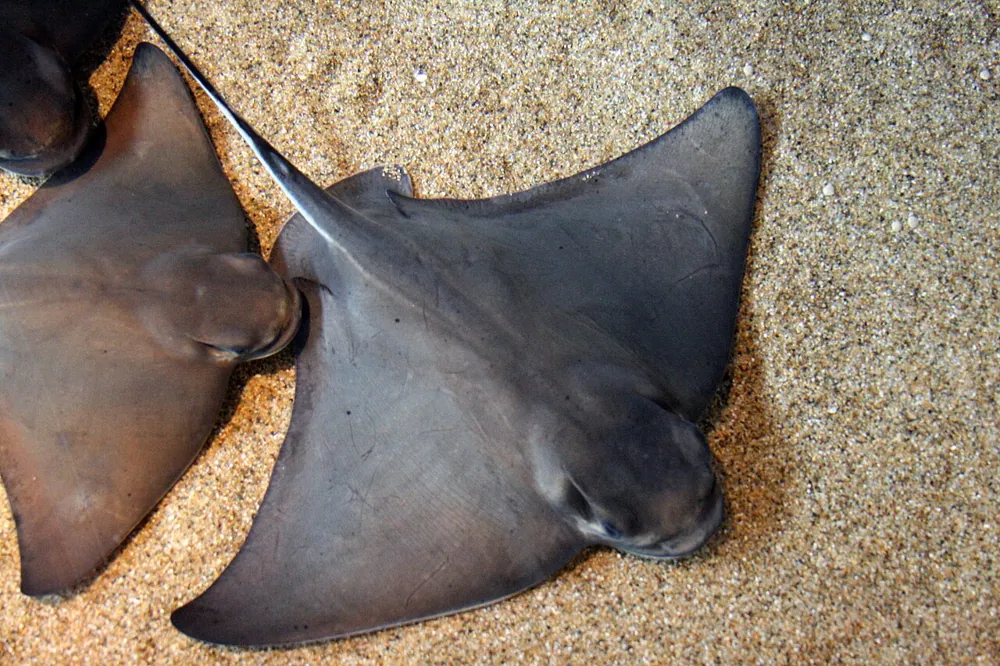
 Paano ito makikilala
- Diamond-shaped body, with wing-like pectoral fins that end in blunt points1
- Broad head raised higher than the fins, with eyes set on the sides of the head1
- Dark back, black or dark brown, with a white underside1
- Whip-like tail with at least one venomous spine at its base1
- Usually two small cephalic horns (projections from the front of the head) used for pushing food into the mouth1
Lakas ng kamandag
Lumalabas ang kamandag sa pamamagitan ng pantusok.
Gaano ito kapanganib sa tao?
Panganib sa tao: MasakitTalagang masakit, pero halos hindi kailanman malala.The bat ray is not considered dangerous to people. It uses its venomous tail spine only when it is attacked or frightened.1
Ano ang ginagawa nito kapag natatakot?
The bat ray camouflages itself in the sand and uses its tail spine only when attacked or frightened.1
 Kung tumusok ito
- Ilubog ang sugat sa mainit na tubig, kasing-init ng kayang tiisin ng tao nang hindi napapaso (subukan muna gamit ang sarili mong kamay), sa loob ng 30 hanggang 90 minuto. Kumuha ng tulong medikal, lalo na para sa stonefish at pagi.
Laging tawagan muna ang numero pang-emergency (112, 000, 911). Ito ay pangkalahatang gabay sa pangunang lunas, hindi payong medikal. Mga batayan ng pangunang lunas
 Mag-ingat
- Huwag kailanman hawakan, hulihin o asarin ang ligaw na hayop, kahit maliit, at kahit mukha itong tulog o patay.
- Bigyan ito ng espasyo. Kung makasalubong ka ng isa, manatiling kalmado, dahan-dahang umatras at hayaan itong umalis.
- Kung tusukin ka ng isa: manatiling kalmado, huwag gumalaw, tawagan ang numero pang-emergency (112, 000, 911) o pumunta agad sa ospital. Tandaan ang itsura nito, makakatulong ang litrato.
Hindi ka nito hinahabol. Ginagamit nito ang kamandag para manghuli ng pagkain o ipagtanggol ang sarili, at mas gusto pa nitong magtago. Higit pa tungkol sa pag-iingat
Saan sa mundo?
Gaano ito kalaki?
Gaano ito kahaba?
Gaano ito kabigat?

 kasinghaba ng 4 pusang bahay mula ilong hanggang buntot
 kasinghaba ng 10 saging na magkakadugtong
 kayang languyin ang haba ng malaking swimming pool (50 m) sa loob ng 8.2 segundo
Gaano kalaki si Bat ray kumpara sa IYO?
Math lang sa browser mo. Walang sine-save o ipinapadala kahit saan.
Gaano ito kabilis?


Mga fact
Bat rays dig pits in the seabed that can be up to 4 m long, and small fish gather to eat the creatures the rays expose.1
The bat ray's young are born with the spine's sheath, which falls off within hours of birth.1
Bat rays can grow to a wingspan of 1.8 m, and the largest individuals weigh about 91 kg.1
Some bat rays live alone, while others form schools of thousands.1
Bat rays have teeth that are replaced continuously, as is the case with all elasmobranchs (sharks, rays and their relatives).1
Myth buster
Mito: Bat rays are dangerous to people because of their venomous spine.
Totoo: Bat rays are not considered dangerous. They use the spine only when attacked or frightened, and people can avoid it by shuffling their feet when walking through shallow sand.1
Para sa mga eksperto sa kamandag
- Pangalang siyentipiko
- Myliobatis californica
- Grupo
- Mga makamandag na isda
- Pamilya
- Myliobatidae2
- Ayos
- Myliobatiformes
- Mga kontinente
- Karagatang Pasipiko, Golpo ng California, Ang mga karagatan
- Mga sanggol
- Bat rays are ovoviviparous, so the eggs hatch inside the mother and the young are born live. A litter has two to ten pups, which are born tail first with their fins wrapped around their bodies.1
- Haba ng buhay
- mga 23 taon1
- Kalagayan nito sa ligaw
- Least Concern1
- Panganib sa tao
- 2 / 5: Masakit3
Saan galing ang mga fact
- Bat ray (Wikipedia (CC BY-SA 4.0))
- Myliobatis californica (iNaturalist): mga pangalan at klasipikasyon.
- Venom Wiki: sarili naming tantiya ang antas ng panganib, karaniwang laki at hula sa bilis. Tingnan kung paano namin ito kinukuwenta: Paano namin sinusukat ang panganib.
Bawat fact sa pahinang ito ay may numerong tumuturo sa pinagmulan nito. Kung may mali kami, pasensya na, mahilig lang kami sa hayop, hindi kami science journal. Sabihin sa amin sa [email protected] at aayusin namin.
 Gutom ang alakdan! Ang Venom Wiki ay proyekto ng iisang tao: libre, walang ads at walang trackers. Nakatutulong ang maliit na tip para manatili itong online.Pakainin ang alakdan
Higit pa mula sa parehong grupo: Mga makamandag na isda
 Reef stonefishMga makamandag na isdaPuwedeng pumatayHuwag hawakan
 Red lionfishMga makamandag na isdaKailangan ng doktorHuwag hawakan
 Estuarine stonefishMga makamandag na isdaPuwedeng pumatayHuwag hawakan
 Short-tail stingrayMga makamandag na isdaPuwedeng pumatay
 Striped eel catfishMga makamandag na isdaPuwedeng pumatayHuwag hawakan
 Bluespotted ribbontail rayMga makamandag na isdaKailangan ng doktor
Nakatira rin sa: Karagatang Pasipiko
 Australian box jellyfishMga dikya at nanunusok sa dagatNakamamatayHuwag hawakan
 Geography coneMga cone snail at pugitaNakamamatay
 Greater blue-ringed octopusMga cone snail at pugitaNakamamatay
 Japanese pufferfishIba pang nakalalasong hayopNakamamatay
 Southern blue-ringed octopusMga cone snail at pugitaNakamamatay
 Hawksbill sea turtleIba pang nakalalasong hayopPuwedeng pumatay