
 Aprika
 Asya
Asya Europa
 Timog Amerika
 Australia at Oceania
 Antarctica
 Karagatang Pasipiko
 Karagatang Atlantiko
 Karagatang Indiyano
 Karagatang Artiko
 Dagat Mediteraneo
 Dagat Pula
 Dagat Caribe
 Dagat Coral
 Dagat Timog Tsina
 Dagat Pilipinas
 Dagat Andaman
 Dagat Hilaga
 Dagat Timor at Arafura
 Look ng Bengal
 Golpo ng California
Black long-spined urchin
 Makamandag na tinik
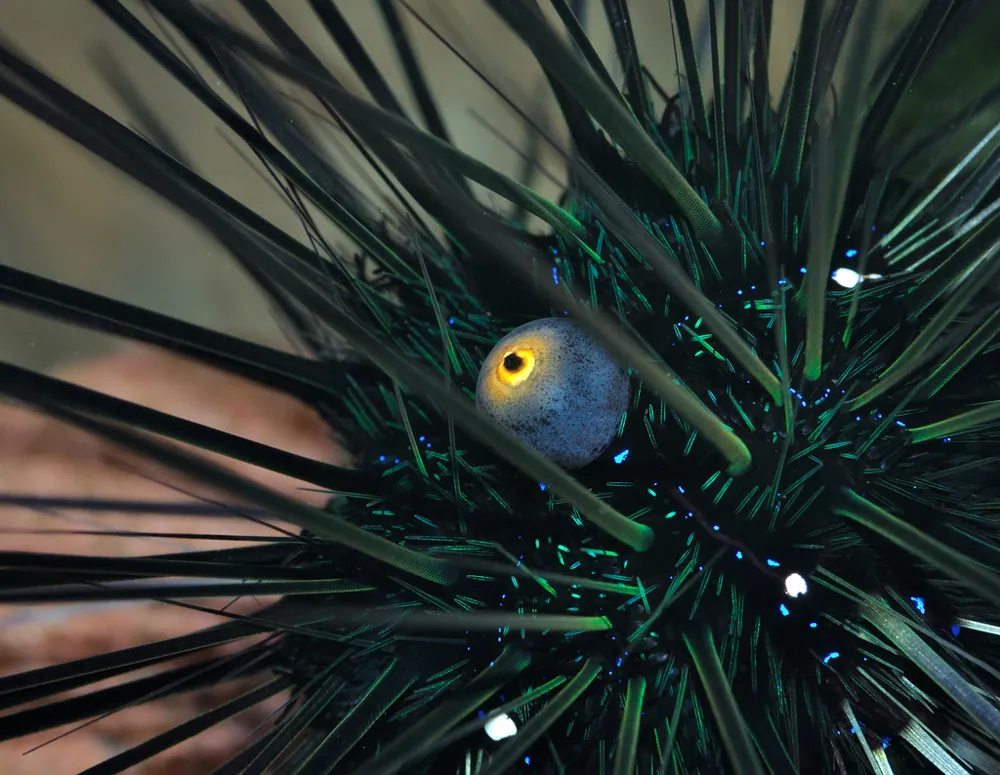
The black long-spined urchin is a sea urchin with very long, hollow spines. It lives on coral reefs, sand flats and seagrass beds across the Indo-Pacific, and it is one of the most widespread sea urchins in that region. Its spines can deliver a mild venom, so it is best to watch where you put your feet.1


 Paano ito makikilala
- Black, near-spherical body (test) with extremely long, narrow, hollow spines, often black but sometimes brown-banded1
- Five white spots on the body, which separate it from other Diadema species1
- A bright orange ring around the periproctal cone (the 'anal cone'), which is often mistaken for an eye1
- Bluish spots on the genital plates and a line of blue spots along the body1
- Adults are no more than 70 mm across the body and about 40 mm high1
Madalas mapagkamalang: Other Diadema species are similar in shape and spines, but they lack the five white spots that mark this species. Its orange ring and blue spots also help to tell it apart.1
Lakas ng kamandag
May dalang kamandag ang matatalim na tinik. Masakit kapag naapakan o nahawakan ito.
Ano ang epekto ng kamandag nito?
The spines are hollow and contain a mild venom. The toxin mostly causes swelling and pain, which spreads gradually over several hours. The venom is not fatal to humans. The spines themselves are a bigger problem, because they are brittle and needle-like, break off in flesh and are difficult to remove.1
Gaano ito kapanganib sa tao?
Panganib sa tao: MasakitTalagang masakit, pero halos hindi kailanman malala.The venom is only mild, and the species is not considered a serious threat to humans. Stepping on it can cause painful stings.1
Ano ang ginagawa nito kapag natatakot?
When threatened by a sudden impact or by spines snapping, it rapidly flips its body over and 'runs' on the tips of its longest spines.1
 Kung matusok ka ng mga tinik nito
- Ilubog ang sugat sa mainit na tubig, kasing-init ng kayang tiisin ng tao nang hindi napapaso, at kumuha ng tulong medikal para maalis ang mga tinik. Huwag mo itong hukayin nang mag-isa.
Laging tawagan muna ang numero pang-emergency (112, 000, 911). Ito ay pangkalahatang gabay sa pangunang lunas, hindi payong medikal. Mga batayan ng pangunang lunas
 Mag-ingat
- Huwag kailanman hawakan, hulihin o asarin ang ligaw na hayop, kahit maliit, at kahit mukha itong tulog o patay.
- Bigyan ito ng espasyo. Kung makasalubong ka ng isa, manatiling kalmado, dahan-dahang umatras at hayaan itong umalis.
- Kung matusok ka ng mga tinik nito: manatiling kalmado, huwag gumalaw, tawagan ang numero pang-emergency (112, 000, 911) o pumunta agad sa ospital. Tandaan ang itsura nito, makakatulong ang litrato.
Hindi ka nito hinahabol. Ginagamit nito ang kamandag para manghuli ng pagkain o ipagtanggol ang sarili, at mas gusto pa nitong magtago. Higit pa tungkol sa pag-iingat
Saan sa mundo?
Gaano ito kalaki?
Gaano ito kahaba?
Gaano ito kabigat?

 kasinghaba ng 2 laruang building brick na magkakasunod
 mas mabagal kaysa sa suso sa hardin
Gaano kalaki si Black long-spined urchin kumpara sa IYO?
Math lang sa browser mo. Walang sine-save o ipinapadala kahit saan.
Gaano ito kabilis?

Mga fact
It can move 760 mm in just 7 seconds by rolling and walking on the tips of its spines.1
It has no eye, but it has a diffuse light-sensing system that lets it detect light levels and the size and colour of objects.1
In 2006, living specimens were found off Turkey, making it the first invasive Erythrean sea urchin recorded in the Mediterranean.1
Goose barnacles of the genus Microlepas are known to live on it as parasites.1
It is considered one of the oldest living species in its genus, Diadema.1
Myth buster
Mito: Black long-spined urchins are deadly and their stings can kill people.
Totoo: Their venom is mild and is not fatal to humans. The main problems are pain, swelling and spines that break off in the skin.1
Para sa mga eksperto sa kamandag
- Pangalang siyentipiko
- Diadema setosum
- Grupo
- Sea urchin, sea star at bulate
- Pamilya
- Diadematidae2
- Ayos
- Diadematoida
- Mga kontinente
- Karagatang Indiyano, Karagatang Pasipiko, Dagat Pula, Dagat Coral, Dagat Pilipinas, Dagat Arabo at Golpo ng Persia, Dagat Timor at Arafura, Look ng Bengal, Ang mga karagatan
- Mga sanggol
- It is a broadcast spawner, releasing eggs and sperm into the water. Spawning happens seasonally or year-round depending on the location, and in some places it follows the full moon.1
- Panganib sa tao
- 2 / 5: Masakit3
Saan galing ang mga fact
- Diadema setosum (Wikipedia (CC BY-SA 4.0))
- Diadema setosum (iNaturalist): mga pangalan at klasipikasyon.
- Venom Wiki: sarili naming tantiya ang antas ng panganib, karaniwang laki at hula sa bilis. Tingnan kung paano namin ito kinukuwenta: Paano namin sinusukat ang panganib.
Bawat fact sa pahinang ito ay may numerong tumuturo sa pinagmulan nito. Kung may mali kami, pasensya na, mahilig lang kami sa hayop, hindi kami science journal. Sabihin sa amin sa [email protected] at aayusin namin.
 Gutom ang alakdan! Ang Venom Wiki ay proyekto ng iisang tao: libre, walang ads at walang trackers. Nakatutulong ang maliit na tip para manatili itong online.Pakainin ang alakdan
Higit pa mula sa parehong grupo: Sea urchin, sea star at bulate
 Crown-of-thorns starfishSea urchin, sea star at bulateKailangan ng doktorHuwag hawakan
 Flower urchinSea urchin, sea star at bulatePuwedeng pumatay
 Fire urchinSea urchin, sea star at bulateKailangan ng doktorHuwag hawakan
 Bearded firewormSea urchin, sea star at bulateMasakit langHuwag hawakan
 BloodwormSea urchin, sea star at bulateMasakit lang
 Bobbit wormSea urchin, sea star at bulateMasakit lang
Nakatira rin sa: Karagatang Indiyano
 Australian box jellyfishMga dikya at nanunusok sa dagatNakamamatayHuwag hawakan
 Geography cone snailMga cone snail at pugitaNakamamatay
 Malaking blue-ringed octopusMga cone snail at pugitaNakamamatay
 Katimugang blue-ringed octopusMga cone snail at pugitaNakamamatay
 Hawksbill sea turtleIba pang nakalalasong hayopPuwedeng pumatay
 Irukandji jellyfishMga dikya at nanunusok sa dagatPuwedeng pumatayHuwag hawakan