
 Aprika
 Asya
Asya Europa
 Timog Amerika
 Australia at Oceania
 Antarctica
 Karagatang Pasipiko
 Karagatang Atlantiko
 Karagatang Indiyano
 Karagatang Artiko
 Dagat Mediteraneo
 Dagat Pula
 Dagat Caribe
 Dagat Coral
 Dagat Timog Tsina
 Dagat Pilipinas
 Dagat Andaman
 Dagat Hilaga
 Dagat Timor at Arafura
 Look ng Bengal
 Golpo ng California
Chinese black earth tiger tarantula
 Mga kagat
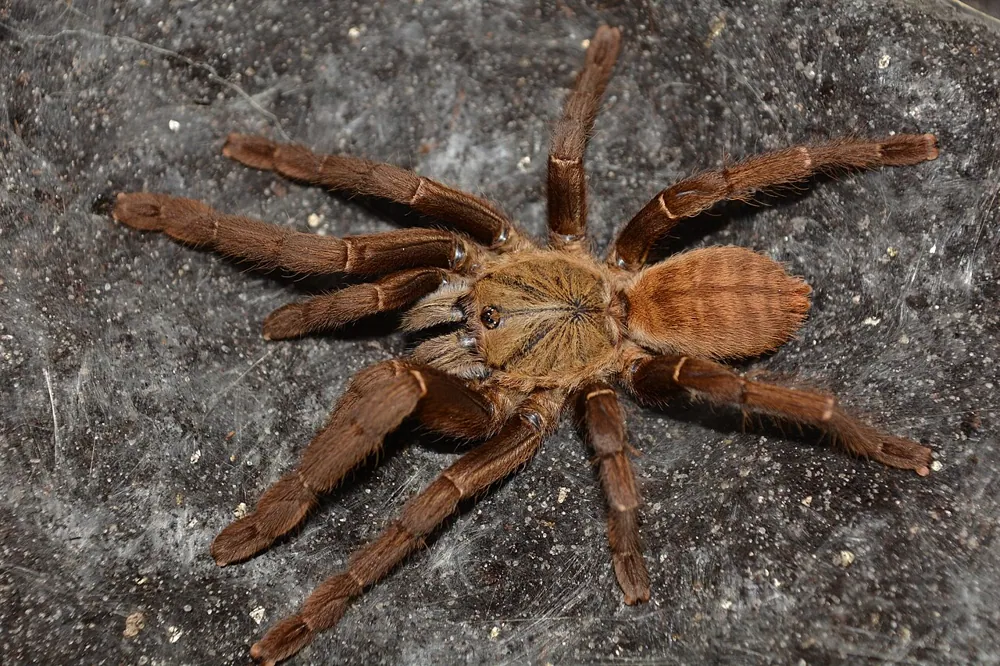
The Chinese black earth tiger tarantula is a large, dark spider that lives in burrows on the island of Hainan, off southern China. It is one of several spiders from China and Vietnam known as the Chinese bird spider. Scientists study its venom because it is considered highly venomous.1

 Paano ito makikilala
- Dark black-brown body1
- Abdomen (rear body) is dark brown with six black stripes running across it and a black stripe down the centre of the upper surface1
- Carapace (upper front body) is black-brown, and the underside of the front body is red-brown1
- Females are about 60 mm long (body plus chelicerae, the fang-bearing mouthparts), with longer legs than males1
- Males are smaller, about 34 mm long, but have legs of a similar length to the female's1
Madalas mapagkamalang: It resembles Cyriopagopus schmidti. The Chinese black earth tiger tarantula can be told apart by its dark black-brown body and by the longer thorns on the forward-facing side of the maxillae (the mouthparts that hold the fangs).1
Lakas ng kamandag
Lumalabas ang kamandag sa pangil o ngipin nito kapag nangangagat ito.
Ano ang epekto ng kamandag nito?
Its venom is a complex neurotoxin, meaning it attacks the nervous system. It contains many compounds that block neurotransmitters, the chemical messengers that carry signals between nerves, including neurotoxic peptides called hainantoxins. The effects of its bite on humans are not well documented.1
Gaano ito kapanganib sa tao?
Panganib sa tao: MalalaKailangang magpatingin sa doktor kapag nakagat. Napakabihira ng namamatay.The effects of its bite on people are not well documented. In laboratory tests, its venom is often lethal to mice and rats in small doses, so it is generally regarded as a highly venomous species.1
Ano ang ginagawa nito kapag natatakot?
It stays hidden in its silk-lined burrow during the day, and its silk alarm lines radiate from the burrow mouth.1
 Kung kumagat ito
- Hugasan ang kagat at palamigin ito. Kumuha ng tulong medikal kung matindi ang sakit o masama ang pakiramdam ng tao.
Laging tawagan muna ang numero pang-emergency (112, 000, 911). Ito ay pangkalahatang gabay sa pangunang lunas, hindi payong medikal. Mga batayan ng pangunang lunas
 Mag-ingat
- Huwag kailanman hawakan, hulihin o asarin ang ligaw na hayop, kahit maliit, at kahit mukha itong tulog o patay.
- Bigyan ito ng espasyo. Kung makasalubong ka ng isa, manatiling kalmado, dahan-dahang umatras at hayaan itong umalis.
- Kung kagatin ka ng isa: manatiling kalmado, huwag gumalaw, tawagan ang numero pang-emergency (112, 000, 911) o pumunta agad sa ospital. Tandaan ang itsura nito, makakatulong ang litrato.
Hindi ka nito hinahabol. Ginagamit nito ang kamandag para manghuli ng pagkain o ipagtanggol ang sarili, at mas gusto pa nitong magtago. Higit pa tungkol sa pag-iingat
Gaano ito kalaki?
Gaano ito kahaba?
 kasinghaba ng 2 laruang building brick na magkakasunod
 kayang tapusin ang 100 metro sa loob ng 200 segundo (9.6 ang kailangan ng pinakamabilis na tao)
Gaano kalaki si Chinese black earth tiger tarantula kumpara sa IYO?
Math lang sa browser mo. Walang sine-save o ipinapadala kahit saan.
Gaano ito kabilis?


Mga fact
Although the effects of its bite on humans are poorly recorded, its venom is often lethal to laboratory mice and rats in small doses.1
Its venom contains neurotoxic peptides called hainantoxins, which block the chemical signals that nerves use to communicate.1
It lives on very steep, south-facing mountain slopes, at angles of 75 to 85 degrees.1
Despite the male being much smaller than the female, his legs are nearly as long as hers.1
Saan galing ang mga fact
- Cyriopagopus hainanus (Wikipedia (CC BY-SA 4.0))
- Cyriopagopus hainanus (iNaturalist): mga pangalan at klasipikasyon.
- Venom Wiki: sarili naming tantiya ang antas ng panganib, karaniwang laki at hula sa bilis. Tingnan kung paano namin ito kinukuwenta: Paano namin sinusukat ang panganib.
Bawat fact sa pahinang ito ay may numerong tumuturo sa pinagmulan nito. Kung may mali kami, pasensya na, mahilig lang kami sa hayop, hindi kami science journal. Sabihin sa amin sa [email protected] at aayusin namin.
 Gutom ang alakdan! Ang Venom Wiki ay proyekto ng iisang tao: libre, walang ads at walang trackers. Nakatutulong ang maliit na tip para manatili itong online.Pakainin ang alakdan
Higit pa mula sa parehong grupo: Mga tarantula at funnel-web
 Gooty sapphire tarantulaMga tarantula at funnel-webKailangan ng doktor
 Indian ornamental tarantulaMga tarantula at funnel-webKailangan ng doktor
 Cobalt blue tarantulaMga tarantula at funnel-webMasakit lang
 Chinese bird spiderMga tarantula at funnel-webKailangan ng doktor
 Fringed ornamental tarantulaMga tarantula at funnel-webKailangan ng doktor
 Japanese funnel-web spiderMga tarantula at funnel-webKailangan ng doktor
 Alakdang deathstalker
 Kobrang Indiyano
 Indian saw-scaled viper
 King cobra
 Puff adder
 Ulupong ni Russell