
 Aprika
 Asya
Asya Europa
 Timog Amerika
 Australia at Oceania
 Antarctica
 Karagatang Pasipiko
 Karagatang Atlantiko
 Karagatang Indiyano
 Karagatang Artiko
 Dagat Mediteraneo
 Dagat Pula
 Dagat Caribe
 Dagat Coral
 Dagat Timog Tsina
 Dagat Pilipinas
 Dagat Andaman
 Dagat Hilaga
 Dagat Timor at Arafura
 Look ng Bengal
 Golpo ng California
Flamboyant cuttlefish
 Nakalalason kapag kinain
The flamboyant cuttlefish is a small sea creature that can change its colours and patterns in a flash. It lives in shallow tropical waters around northern Australia, New Guinea, the Philippines, Indonesia and Malaysia. It is special because its flesh is poisonous to eat, and it walks along the sea floor instead of swimming.1


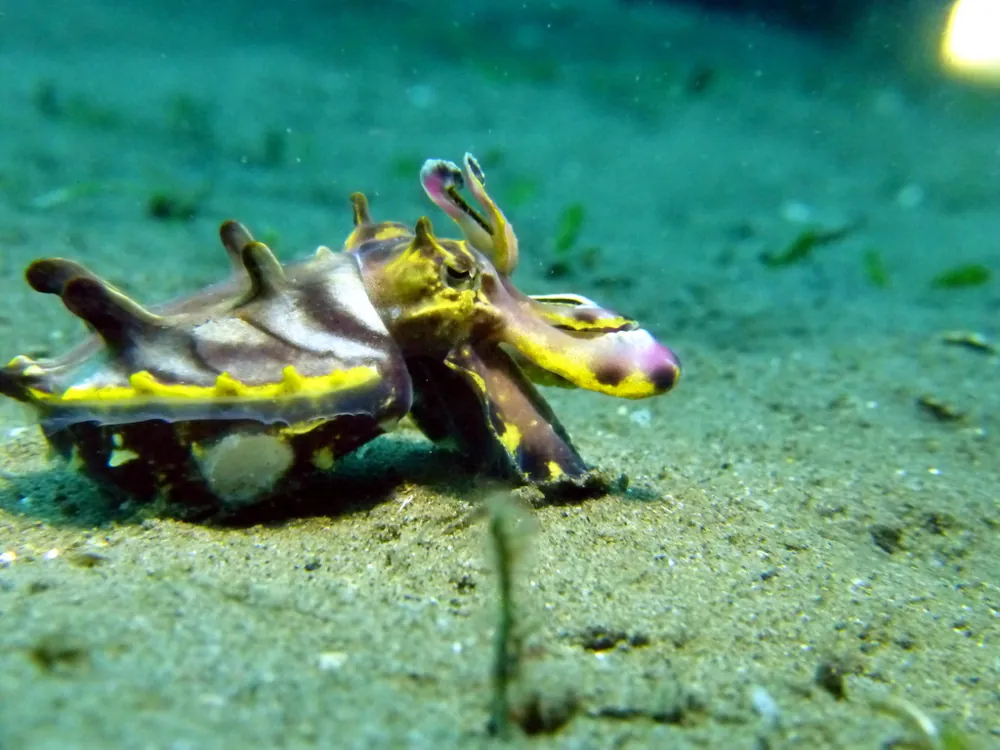
 Paano ito makikilala
- Has a very broad, oval body (mantle) and small, flat, fin-like flaps on the back1
- Broad, blade-like arms with four rows of suckers1
- Normal base colour is dark brown1
- When disturbed, it quickly turns black, dark brown and white, with yellow patches around the body, arms and eyes1
- Arm tips often flash bright red as a warning1
Lakas ng lason
Nakapipinsala lang ito kung may kumain dito.
Gaano ito kapanganib sa tao?
Panganib sa tao: MasakitTalagang masakit, pero halos hindi kailanman malala.Its muscle tissue is highly toxic, so eating it can be dangerous.1
Ano ang ginagawa nito kapag natatakot?
When disturbed or attacked, it changes colour to a dark, high-contrast pattern and shows bright red arm tips to warn off predators. It also walks along the sea floor while waving the wide membranes on its arms.1
 Kung may humawak o kumain nito
- Pressure immobilisation: balutin nang mahigpit ng elastic bandage ang kagat at pataas sa buong braso o binti, lagyan ng splint, at panatilihing ganap na hindi gumagalaw ang tao hanggang dumating ang tulong.
- Ang blue-ringed octopus o cone snail ay puwedeng magpahinto sa paghinga ng tao habang gising pa siya: tumawag ng tulong at maging handang magbigay ng rescue breaths hanggang pumalit ang ambulansya.
Laging tawagan muna ang numero pang-emergency (112, 000, 911). Ito ay pangkalahatang gabay sa pangunang lunas, hindi payong medikal. Mga batayan ng pangunang lunas
 Mag-ingat
- Huwag kailanman hawakan, hulihin o asarin ang ligaw na hayop, kahit maliit, at kahit mukha itong tulog o patay.
- Bigyan ito ng espasyo. Kung makasalubong ka ng isa, manatiling kalmado, dahan-dahang umatras at hayaan itong umalis.
- Kung nahawakan o nakain mo ito: huwag kuskusin ang mata o bibig mo, hugasan ang mga kamay mo at kumuha ng tulong medikal.
Hindi ka nito hinahabol. Ang lason nito ay para lang walang kumain dito. Higit pa tungkol sa pag-iingat
Saan sa mundo?
Gaano ito kalaki?
Gaano ito kahaba?
 kasinghaba ng 2.5 laruang building brick na magkakasunod
 kayang languyin ang haba ng malaking swimming pool (50 m) sa loob ng 12 segundo
Gaano kalaki si Flamboyant cuttlefish kumpara sa IYO?
Math lang sa browser mo. Walang sine-save o ipinapadala kahit saan.
Gaano ito kabilis?

Mga fact
A toxicology report found its muscle tissue highly toxic, making it only the third cephalopod known to be poisonous.1
It is one of the only cuttlefish known to walk on the sea floor. This is because its cuttlebone lacks an outer cone, the part most other cuttlefish use to float.1
A female once laid about a dozen eggs inside an overturned half coconut husk, which kept them safe from fish.1
Its toxin has been compared with that of the blue-ringed octopus, but the strength of that link is disputed.1
Myth buster
Mito: Its bright arm display means it is a dangerous, deadly poisonous animal.
Totoo: The display is thought to warn predators that its flesh is poisonous. However, significant amounts of toxin have not yet been isolated from this species, and preliminary tests found only trace amounts of tetrodotoxin.1
Para sa mga eksperto sa kamandag
- Pangalang siyentipiko
- Metasepia pfefferi
- Grupo
- Mga cone snail at pugita
- Pamilya
- Sepiidae2
- Ayos
- Sepiida
- Mga kontinente
- Karagatang Indiyano, Karagatang Pasipiko, Dagat Coral, Dagat Pilipinas, Dagat Timor at Arafura, Ang mga karagatan
- Mga sanggol
- Eggs are laid one at a time in crevices or on ledges in coral, rock or wood. Hatchlings look like adults and can copy the same camouflage patterns. They receive no care from their parents.1
- Panganib sa tao
- 2 / 5: Masakit3
Saan galing ang mga fact
- Ascarosepion pfefferi (Wikipedia (CC BY-SA 4.0))
- Metasepia pfefferi (iNaturalist): mga pangalan at klasipikasyon.
- Venom Wiki: sarili naming tantiya ang antas ng panganib, karaniwang laki at hula sa bilis. Tingnan kung paano namin ito kinukuwenta: Paano namin sinusukat ang panganib.
Bawat fact sa pahinang ito ay may numerong tumuturo sa pinagmulan nito. Kung may mali kami, pasensya na, mahilig lang kami sa hayop, hindi kami science journal. Sabihin sa amin sa [email protected] at aayusin namin.
 Gutom ang alakdan! Ang Venom Wiki ay proyekto ng iisang tao: libre, walang ads at walang trackers. Nakatutulong ang maliit na tip para manatili itong online.Pakainin ang alakdan
Higit pa mula sa parehong grupo: Mga cone snail at pugita
 Geography coneMga cone snail at pugitaNakamamatay
 Greater blue-ringed octopusMga cone snail at pugitaNakamamatay
 Southern blue-ringed octopusMga cone snail at pugitaNakamamatay
 Blue sea dragonMga cone snail at pugitaMasakit lang
 Common octopusMga cone snail at pugitaHindi nakapipinsala
 Giant Pacific octopusMga cone snail at pugitaHindi nakapipinsala
Nakatira rin sa: Karagatang Indiyano
 Australian box jellyfishMga dikya at nanunusok sa dagatNakamamatayHuwag hawakan
 Hawksbill sea turtleIba pang nakalalasong hayopPuwedeng pumatay
 Irukandji jellyfishMga dikya at nanunusok sa dagatPuwedeng pumatayHuwag hawakan
 Reef stonefishMga makamandag na isdaPuwedeng pumatayHuwag hawakan
 Crown-of-thorns starfishSea urchin, sea star at bulateKailangan ng doktorHuwag hawakan
 Portuguese man o' warMga dikya at nanunusok sa dagatKailangan ng doktorHuwag hawakan