
 Aprika
 Asya
Asya Europa
 Timog Amerika
 Australia at Oceania
 Antarctica
 Karagatang Pasipiko
 Karagatang Atlantiko
 Karagatang Indiyano
 Karagatang Artiko
 Dagat Mediteraneo
 Dagat Pula
 Dagat Caribe
 Dagat Coral
 Dagat Timog Tsina
 Dagat Pilipinas
 Dagat Andaman
 Dagat Hilaga
 Dagat Timor at Arafura
 Look ng Bengal
 Golpo ng California
Green and black poison dart frog
 May lason sa balat nitoKinakain: Mga insektoNakalalason, hindi makamandag
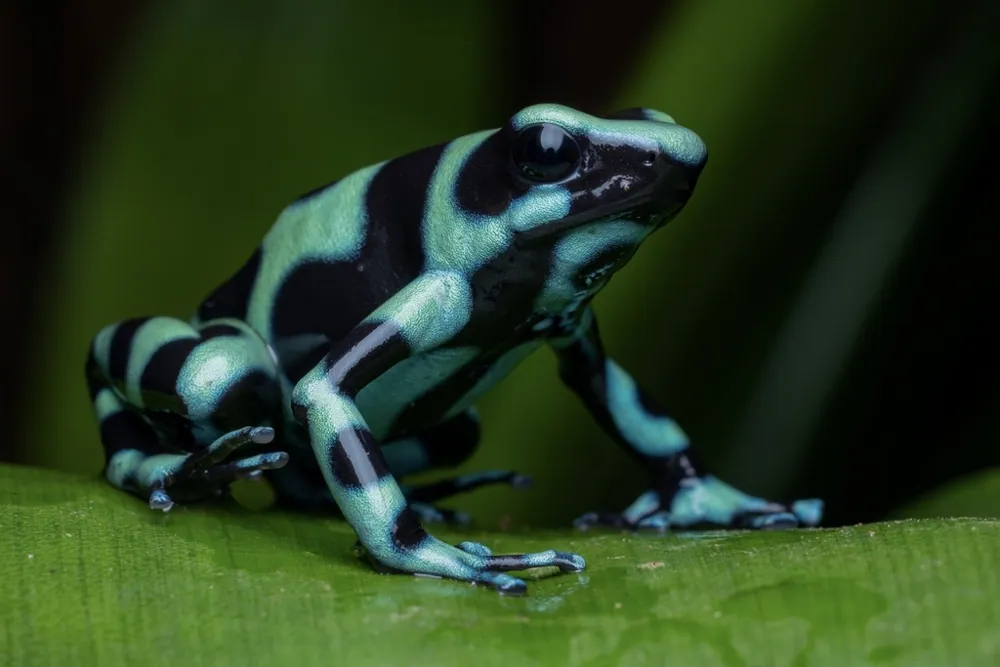
The green-and-black poison dart frog is a small, brightly coloured frog from the forests of southern Central America and north-western Colombia. It is poisonous, not venomous: it gets its toxins from the tiny insects it eats. It is also one of the most variable poison frogs in colour and pattern.1

 Paano ito makikilala
- Usually a mint-green background with a spotted or banded pattern1
- Dark or dull splotches, most often blackish, that can look like large spots, blotches or a splashed pattern1
- Colour varies a lot: some are darker green, lime, emerald, turquoise, blue, whitish or pale yellow, and some have no green or no black1
- Some variants are entirely black, or dark with only a few small green spots or streaks1
- Small adults: males about 1.9 cm, females about 2.5 cm or longer1
Lakas ng lason
Nakalalason ang balat nito. Delikado itong hawakan, dilaan o kainin.
Ano ang epekto ng lason nito?
Its skin holds alkaloid poisons, which are not venom injected by a bite. These poisons interfere with the ion channels and nicotinic acetylcholine receptors that nerves and muscles rely on. In extreme cases, this can cause numbness, loss of muscle control, convulsions, cardiac arrest and death.1
Gaano ito kapanganib sa tao?
Panganib sa tao: MasakitTalagang masakit, pero halos hindi kailanman malala.Its poisons can cause serious effects, including death, in cases of extreme poisoning.1
 Kung may humawak o kumain nito
- Kung may humawak sa isa: hugasang mabuti ang mga kamay at huwag hawakan ang mata o bibig. Kung may batang o alagang hayop na dumila o kumain ng isa: tawagan ang poison control center o ang numero pang-emergency.
Laging tawagan muna ang numero pang-emergency (112, 000, 911). Ito ay pangkalahatang gabay sa pangunang lunas, hindi payong medikal. Mga batayan ng pangunang lunas
 Mag-ingat
- Huwag kailanman hawakan, hulihin o asarin ang ligaw na hayop, kahit maliit, at kahit mukha itong tulog o patay.
- Bigyan ito ng espasyo. Kung makasalubong ka ng isa, manatiling kalmado, dahan-dahang umatras at hayaan itong umalis.
- Kung nahawakan o nakain mo ito: huwag kuskusin ang mata o bibig mo, hugasan ang mga kamay mo at kumuha ng tulong medikal.
Hindi ka nito hinahabol. Ang lason nito ay para lang walang kumain dito. Higit pa tungkol sa pag-iingat
Gaano ito kalaki?
Gaano ito kahaba?
 halos kasinghaba ng paper clip
 kayang tapusin ang 100 metro sa loob ng 97 segundo (9.6 ang kailangan ng pinakamabilis na tao)
Gaano kalaki si Green and black poison dart frog kumpara sa IYO?
Math lang sa browser mo. Walang sine-save o ipinapadala kahit saan.
Gaano ito kabilis?


Mga fact
Hundreds of different alkaloid poisons have been identified in this frog.1
Parents carry tadpoles into the treetops and place them in bromeliad pools, where the tadpoles sometimes eat each other because food is scarce.1
Unlike other poison frogs, it gathers in large groups before mating, and males fight over small patches of ground.1
It was intentionally introduced to Oahu, Hawaii, in 1932 to help control mosquitoes.1
Its toe pads have small sucker-like discs that give it a mildly sticky grip when climbing.1
Myth buster
Mito: Poison dart frogs are poisonous in every case, because of their own nature.
Totoo: They are not poisonous by nature. They become poisonous from the alkaloids in their diet of ants and mites. Captive frogs fed on crickets and fruit flies are non-toxic.1
Para sa mga eksperto sa kamandag
- Pangalang siyentipiko
- Dendrobates auratus
- Grupo
- Mga poison frog, palaka at newt
- Pamilya
- Dendrobatidae2
- Ayos
- Anura
- Mga kontinente
- Hilagang Amerika, Timog Amerika
- Mga sanggol
- The female lays eggs at a site chosen by the male, and he fertilises them. The eggs hatch into tadpoles in about 14 days, and the parent, typically the male, carries them up into the canopy.1
- Kalagayan nito sa ligaw
- Least Concern (IUCN)1
- Panganib sa tao
- 2 / 5: Masakit3
Saan galing ang mga fact
- Green and black poison dart frog (Wikipedia (CC BY-SA 4.0))
- Dendrobates auratus (iNaturalist): mga pangalan at klasipikasyon.
- Venom Wiki: sarili naming tantiya ang antas ng panganib, karaniwang laki at hula sa bilis. Tingnan kung paano namin ito kinukuwenta: Paano namin sinusukat ang panganib.
Bawat fact sa pahinang ito ay may numerong tumuturo sa pinagmulan nito. Kung may mali kami, pasensya na, mahilig lang kami sa hayop, hindi kami science journal. Sabihin sa amin sa [email protected] at aayusin namin.
 Gutom ang alakdan! Ang Venom Wiki ay proyekto ng iisang tao: libre, walang ads at walang trackers. Nakatutulong ang maliit na tip para manatili itong online.Pakainin ang alakdan
Higit pa mula sa parehong grupo: Mga poison frog, palaka at newt
 Gintong poison frogMga poison frog, palaka at newtNakamamatayHuwag hawakan
 Cane toadMga poison frog, palaka at newtKailangan ng doktorHuwag hawakan
 Dyeing poison dart frogMga poison frog, palaka at newtMasakit langHuwag hawakan
 Strawberry poison-dart frogMga poison frog, palaka at newtMasakit langHuwag hawakan
 Black-legged poison frogMga poison frog, palaka at newtPuwedeng pumatayHuwag hawakan
 California newtMga poison frog, palaka at newtPuwedeng pumatayHuwag hawakan
 Terciopelo
 Eastern coral snake
 Eastern diamondback rattlesnake
 Eyelash viper
 Timber rattlesnake
 Western diamondback rattlesnake