
 Aprika
 Asya
Asya Europa
 Timog Amerika
 Australia at Oceania
 Antarctica
 Karagatang Pasipiko
 Karagatang Atlantiko
 Karagatang Indiyano
 Karagatang Artiko
 Dagat Mediteraneo
 Dagat Pula
 Dagat Caribe
 Dagat Coral
 Dagat Timog Tsina
 Dagat Pilipinas
 Dagat Andaman
 Dagat Hilaga
 Dagat Timor at Arafura
 Look ng Bengal
 Golpo ng California
Kokoe poison frog
 May lason sa balat nitoKinakain: Mga insektoNakalalason, hindi makamandag
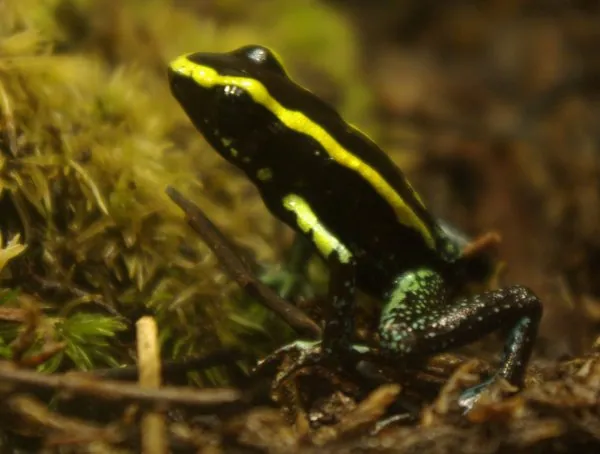
The Kokoe poison frog is a small, brightly striped frog that lives on the forest floor of western Colombia. It is one of the most poisonous frogs in the world. Its skin holds a toxin that can be deadly, so it should never be handled.1



 Paano ito makikilala
- Black back, sometimes with orange patches.1
- Green, yellow, orange or brownish gold stripes along each side of the body.1
- Black belly with blue or green dots.1
- The smallest of the poison dart frogs in its genus, Phyllobates.1
- Two forms exist: a smaller form with large stripes and a larger form with small stripes.1
Lakas ng lason
Nakalalason ang balat nito. Delikado itong hawakan, dilaan o kainin.
Ano ang epekto ng lason nito?
This frog is poisonous rather than venomous, because its toxin is held in its skin and does not come from a bite or sting. The toxin, batrachotoxin, is a steroidal alkaloid. It keeps the sodium channels in nerve and muscle cells permanently open, which stops the cells from resetting. The result is paralysis, and often death, as affected muscles stay locked in a contracted state.1
Gaano ito kapanganib sa tao?
Panganib sa tao: NapakapanganibKaya nitong pumatay ng taong hindi nagamot.Wild frogs are extremely deadly to humans, and the toxin can be fatal in doses as small as 100 μg. Frogs raised in captivity are generally non-toxic.1
Ano ang ginagawa nito kapag natatakot?
It releases its toxin from skin glands only when under stress.1
 Kung may humawak o kumain nito
- Kung may humawak sa isa: hugasang mabuti ang mga kamay at huwag hawakan ang mata o bibig. Kung may batang o alagang hayop na dumila o kumain ng isa: tawagan ang poison control center o ang numero pang-emergency.
Laging tawagan muna ang numero pang-emergency (112, 000, 911). Ito ay pangkalahatang gabay sa pangunang lunas, hindi payong medikal. Mga batayan ng pangunang lunas
 Mag-ingat
- Huwag kailanman hawakan, hulihin o asarin ang ligaw na hayop, kahit maliit, at kahit mukha itong tulog o patay.
- Bigyan ito ng espasyo. Kung makasalubong ka ng isa, manatiling kalmado, dahan-dahang umatras at hayaan itong umalis.
- Kung nahawakan o nakain mo ito: huwag kuskusin ang mata o bibig mo, hugasan ang mga kamay mo at kumuha ng tulong medikal.
Hindi ka nito hinahabol. Ang lason nito ay para lang walang kumain dito. Higit pa tungkol sa pag-iingat
Gaano ito kalaki?
Gaano ito kahaba?
 halos kasinghaba ng paper clip
 kayang tapusin ang 100 metro sa loob ng 100 segundo (9.6 ang kailangan ng pinakamabilis na tao)
Gaano kalaki si Kokoe poison frog kumpara sa IYO?
Math lang sa browser mo. Walang sine-save o ipinapadala kahit saan.
Gaano ito kabilis?


Mga fact
It is known as the third most poisonous frog in the world.1
Indigenous peoples of Colombia have used its poison on hunting darts.1
Unlike many other dart frogs, males do not wrestle. Rivals face off and call loudly until one backs down.1
Its mating calls are a loud, bird-like whirring twitter, which can last up to 45 seconds.1
Unlike other Phyllobates species, it does not breed in coconut shells. It lays its eggs in narrow tubes on the ground instead.1
Myth buster
Mito: All poison frogs make their own poison.
Totoo: These frogs probably do not make batrachotoxin themselves. They take it in from their diet of beetles, millipedes and flies, and from the leaf litter. That is why captive frogs are generally non-toxic.1
Para sa mga eksperto sa kamandag
- Pangalang siyentipiko
- Phyllobates aurotaenia
- Grupo
- Mga poison frog, palaka at newt
- Pamilya
- Dendrobatidae2
- Ayos
- Anura
- Mga kontinente
- Timog Amerika
- Mga sanggol
- The female lays a clutch of eggs in leaf litter, averaging 15 to 20. After the eggs hatch, the male carries the tadpoles to slow-flowing water.1
- Kalagayan nito sa ligaw
- Least Concern (IUCN), although its numbers and range are declining, mainly due to habitat loss1
- Panganib sa tao
- 4 / 5: Napakapanganib3
Saan galing ang mga fact
- Phyllobates aurotaenia (Wikipedia (CC BY-SA 4.0))
- Phyllobates aurotaenia (iNaturalist): mga pangalan at klasipikasyon.
- Venom Wiki: sarili naming tantiya ang antas ng panganib, karaniwang laki at hula sa bilis. Tingnan kung paano namin ito kinukuwenta: Paano namin sinusukat ang panganib.
Bawat fact sa pahinang ito ay may numerong tumuturo sa pinagmulan nito. Kung may mali kami, pasensya na, mahilig lang kami sa hayop, hindi kami science journal. Sabihin sa amin sa [email protected] at aayusin namin.
 Gutom ang alakdan! Ang Venom Wiki ay proyekto ng iisang tao: libre, walang ads at walang trackers. Nakatutulong ang maliit na tip para manatili itong online.Pakainin ang alakdan
Higit pa mula sa parehong grupo: Mga poison frog, palaka at newt
 Gintong poison frogMga poison frog, palaka at newtNakamamatayHuwag hawakan
 Cane toadMga poison frog, palaka at newtKailangan ng doktorHuwag hawakan
 Dyeing poison dart frogMga poison frog, palaka at newtMasakit langHuwag hawakan
 Black-legged poison frogMga poison frog, palaka at newtPuwedeng pumatayHuwag hawakan
 Bruno's casque-headed frogMga poison frog, palaka at newtKailangan ng doktorHuwag hawakan
 Harlequin poison frogMga poison frog, palaka at newtKailangan ng doktorHuwag hawakan
 Terciopelo
 Brazilian wandering spider
 Eyelash viper
 Golden lancehead
 South American bushmaster
 Peruvian giant centipede