
 Aprika
 Asya
Asya Europa
 Timog Amerika
 Australia at Oceania
 Antarctica
 Karagatang Pasipiko
 Karagatang Atlantiko
 Karagatang Indiyano
 Karagatang Artiko
 Dagat Mediteraneo
 Dagat Pula
 Dagat Caribe
 Dagat Coral
 Dagat Timog Tsina
 Dagat Pilipinas
 Dagat Andaman
 Dagat Hilaga
 Dagat Timor at Arafura
 Look ng Bengal
 Golpo ng California
Mediterranean box jellyfish
 Nanunusok na galamay
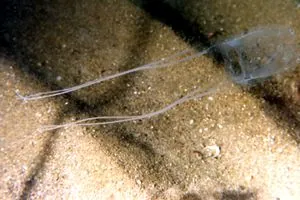
The Mediterranean box jellyfish is a small, see-through jellyfish with a box-shaped body about 3 cm across. It lives only in the Mediterranean Sea, where it is the only box jellyfish, and its sting can hurt people who swim in shallow water.1


 Paano ito makikilala
- Transparent, box-shaped bell about 3 cm across1
- Four long tentacles at the lower corners of the bell, up to 30 cm long1
- Red banding on the tentacles1
- Small white or yellowish warts on the bell that carry stinging cells1
- Often found in small groups1
Madalas mapagkamalang: Other box jellyfish of the genus Carybdea look similar, but they live in warm oceans elsewhere. The red banding on the tentacles is the feature that separates this species from them.1
Lakas ng kamandag
Libu-libong maliliit na selulang pantusok ang pumuputok kapag may humawak sa kanila.
Ano ang epekto ng kamandag nito?
Its sting is venomous to humans, but some swimmers feel no painful sensation at all. In severe cases the symptoms spread through the body, with pain at the sting site and elsewhere, paresthesia (abnormal prickling or tingling sensations), hyperesthesia (over-sensitive skin) and skin lesions. These symptoms can take a few months to fully disappear.1
Gaano ito kapanganib sa tao?
Panganib sa tao: MasakitTalagang masakit, pero halos hindi kailanman malala.It is far less dangerous than some box jellyfish species from other parts of the world. It is still considered the second-most significant stinging jellyfish in the Mediterranean, after Pelagia noctiluca.1
 Kung tumusok ito
- Umahon sa tubig at tanggalin ang anumang galamay (gamit ang guwantes o tela).
- Para sa tropikal na box jellyfish: buhusan ng suka ang mga tusok nang hindi bababa sa 30 segundo, tumawag ng tulong at maging handang mag-CPR. Para sa bluebottle at karamihan sa iba: banlawan ng tubig-dagat, pagkatapos ay mainit na tubig para sa sakit.
Laging tawagan muna ang numero pang-emergency (112, 000, 911). Ito ay pangkalahatang gabay sa pangunang lunas, hindi payong medikal. Mga batayan ng pangunang lunas
 Mag-ingat
- Huwag kailanman hawakan, hulihin o asarin ang ligaw na hayop, kahit maliit, at kahit mukha itong tulog o patay.
- Bigyan ito ng espasyo. Kung makasalubong ka ng isa, manatiling kalmado, dahan-dahang umatras at hayaan itong umalis.
- Kung tusukin ka ng isa: manatiling kalmado, huwag gumalaw, tawagan ang numero pang-emergency (112, 000, 911) o pumunta agad sa ospital. Tandaan ang itsura nito, makakatulong ang litrato.
Hindi ka nito hinahabol. Ginagamit nito ang kamandag para manghuli ng pagkain o ipagtanggol ang sarili, at mas gusto pa nitong magtago. Higit pa tungkol sa pag-iingat
Saan sa mundo?
Gaano ito kalaki?
Gaano ito kahaba?
 halos kasinghaba ng paper clip
 kayang languyin ang haba ng malaking swimming pool (50 m) sa loob ng 36 segundo
Gaano kalaki si Mediterranean box jellyfish kumpara sa IYO?
Math lang sa browser mo. Walang sine-save o ipinapadala kahit saan.
Gaano ito kabilis?
Mga fact
It has comparatively sophisticated eyes with lenses, which help it detect and avoid obstacles such as posts or a ship's rudder.1
After a free-swimming larva forms, it develops into a polyp that can reproduce by budding, and it can regenerate missing parts within 72 hours.1
It swims by making rapid contractions of its bell, moving between 3 and 6 metres per minute.1
Its tentacles can grow up to 30 cm long, many times the width of its box-shaped bell.1
It is the only box jellyfish found in the Mediterranean Sea.1
Para sa mga eksperto sa kamandag
- Pangalang siyentipiko
- Carybdea marsupialis
- Grupo
- Mga dikya at nanunusok sa dagat
- Pamilya
- Carybdeidae2
- Ayos
- Carybdeida
- Mga kontinente
- Karagatang Atlantiko, Dagat Mediteraneo, Ang mga karagatan
- Mga sanggol
- The sexes are separate, and eggs and sperm (gametes) are released into the open water to fuse; the young develop into a free-swimming larva and then a small polyp stage before becoming jellyfish.1
- Panganib sa tao
- 2 / 5: Masakit3
Saan galing ang mga fact
- Carybdea marsupialis (Wikipedia (CC BY-SA 4.0))
- Carybdea marsupialis (iNaturalist): mga pangalan at klasipikasyon.
- Venom Wiki: sarili naming tantiya ang antas ng panganib, karaniwang laki at hula sa bilis. Tingnan kung paano namin ito kinukuwenta: Paano namin sinusukat ang panganib.
Bawat fact sa pahinang ito ay may numerong tumuturo sa pinagmulan nito. Kung may mali kami, pasensya na, mahilig lang kami sa hayop, hindi kami science journal. Sabihin sa amin sa [email protected] at aayusin namin.
 Gutom ang alakdan! Ang Venom Wiki ay proyekto ng iisang tao: libre, walang ads at walang trackers. Nakatutulong ang maliit na tip para manatili itong online.Pakainin ang alakdan
Higit pa mula sa parehong grupo: Mga dikya at nanunusok sa dagat
 Australian box jellyfishMga dikya at nanunusok sa dagatNakamamatayHuwag hawakan
 Irukandji jellyfishMga dikya at nanunusok sa dagatPuwedeng pumatayHuwag hawakan
 Portuguese man o' warMga dikya at nanunusok sa dagatKailangan ng doktorHuwag hawakan
 Lion's mane jellyfishMga dikya at nanunusok sa dagatMasakit langHuwag hawakan
 Moon jellyfishMga dikya at nanunusok sa dagatHindi nakapipinsala
 Common kingslayerMga dikya at nanunusok sa dagatPuwedeng pumatayHuwag hawakan
Nakatira rin sa: Karagatang Atlantiko
 Hawksbill sea turtleIba pang nakalalasong hayopPuwedeng pumatay
 Blue sea dragonMga cone snail at pugitaMasakit lang
 Greenland sharkIba pang nakalalasong hayopMasakit lang
 Common octopusMga cone snail at pugitaHindi nakapipinsala
 Common stingrayMga makamandag na isdaKailangan ng doktor
 Greater weeverMga makamandag na isdaKailangan ng doktorHuwag hawakan