
 Aprika
 Asya
Asya Europa
 Timog Amerika
 Australia at Oceania
 Antarctica
 Karagatang Pasipiko
 Karagatang Atlantiko
 Karagatang Indiyano
 Karagatang Artiko
 Dagat Mediteraneo
 Dagat Pula
 Dagat Caribe
 Dagat Coral
 Dagat Timog Tsina
 Dagat Pilipinas
 Dagat Andaman
 Dagat Hilaga
 Dagat Timor at Arafura
 Look ng Bengal
 Golpo ng California
Yellow-bellied sea snake
 Mga kagat
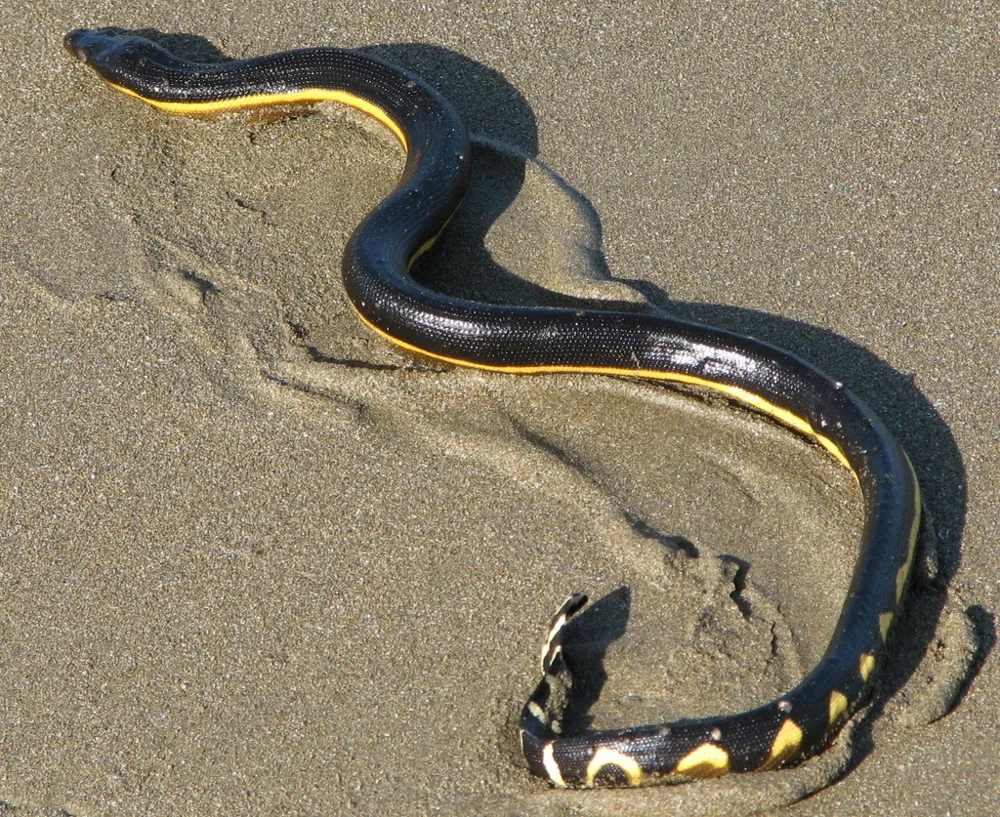
The yellow-bellied sea snake is a sea snake with a strongly venomous bite. It lives in warm tropical oceans and spends its whole life at sea, floating on the surface. Its yellow belly and brown back make it easy to tell apart from most other sea snakes.1

 Paano ito makikilala
- Sharply bicoloured: black or dark brown on the back, with a yellow or brown underside.1
- The yellow belly may have black spots, bars or crossbars, or a narrow black stripe along the back.1
- Has a flattened, paddle-shaped tail for swimming.1
- Adults are usually up to about 72 cm (males) or 88 cm (females) long.1
Lakas ng kamandag
Lumalabas ang kamandag sa pangil o ngipin nito kapag nangangagat ito.
Ano ang epekto ng kamandag nito?
The venom is highly potent and contains several different neurotoxins, which attack the nerves, along with two other isotoxins. Sea snake venom can damage skeletal muscle, which may release myoglobin into the urine (myoglobinuria), and can cause neuromuscular paralysis or direct kidney damage. Juvenile venom is on average less concentrated than adult venom.1
Gaano ito kapanganib sa tao?
Panganib sa tao: MalalaKailangang magpatingin sa doktor kapag nakagat. Napakabihira ng namamatay.Bites are rare. The most common victims are fishermen who try to remove the snakes from fishing nets. No deaths have been recorded from bites in Australian waters.1
 Magandang balita: may gamot (antivenom) o gamutan ang mga doktor para dito.1
Ano ang ginagawa nito kapag natatakot?
It is not considered aggressive but will defend itself if threatened.1
 Kung kumagat ito
- The venom is neutralised with sea snake antivenom (Enhydrina schistosa). If that is not available, tiger snake or polyvalent antivenom should be used.1
- Pressure immobilisation: balutin nang mahigpit ng elastic bandage ang kagat at pataas sa buong braso o binti, lagyan ng splint, at panatilihing ganap na hindi gumagalaw ang tao hanggang dumating ang tulong.
- Iahon ang tao sa tubig at dalhin agad sa ospital.
Laging tawagan muna ang numero pang-emergency (112, 000, 911). Ito ay pangkalahatang gabay sa pangunang lunas, hindi payong medikal. Mga batayan ng pangunang lunas
 Mag-ingat
- Huwag kailanman hawakan, hulihin o asarin ang ligaw na hayop, kahit maliit, at kahit mukha itong tulog o patay.
- Bigyan ito ng espasyo. Kung makasalubong ka ng isa, manatiling kalmado, dahan-dahang umatras at hayaan itong umalis.
- Kung kagatin ka ng isa: manatiling kalmado, huwag gumalaw, tawagan ang numero pang-emergency (112, 000, 911) o pumunta agad sa ospital. Tandaan ang itsura nito, makakatulong ang litrato.
Hindi ka nito hinahabol. Ginagamit nito ang kamandag para manghuli ng pagkain o ipagtanggol ang sarili, at mas gusto pa nitong magtago. Higit pa tungkol sa pag-iingat
Saan sa mundo?
Gaano ito kalaki?
Gaano ito kahaba?
 kasinghaba ng 2 pusang bahay mula ilong hanggang buntot
 kasinghaba ng 5 saging na magkakadugtong
 kayang languyin ang haba ng malaking swimming pool (50 m) sa loob ng 49 segundo
Gaano kalaki si Yellow-bellied sea snake kumpara sa IYO?
Math lang sa browser mo. Walang sine-save o ipinapadala kahit saan.
Gaano ito kabilis?
Mga fact
It can swim backwards, which is an unusual ability and a distinguishing feature of this species.1
It breathes partly through its skin, taking oxygen from seawater while diving and swimming at the surface.1
It can survive severe dehydration for up to 7 months during seasonal drought.1
Large groups of thousands have been seen floating together on the surface in oceanic drift lines.1
It is the only sea snake known to have reached the Hawaiian Islands.1
Strays wash up so often on New Zealand's coasts that it is considered native to the country and protected under the Wildlife Act 1953.1
Myth buster
Mito: Sea snakes drink seawater and filter out the salt through a special salt gland in the lower jaw.
Totoo: Sea snakes drink only fresh water. The salt gland was once thought to filter salt, but it is not used for that purpose. The yellow-bellied sea snake likely drinks from freshwater lenses that form on the sea surface after heavy rain.1
Para sa mga eksperto sa kamandag
- Pangalang siyentipiko
- Hydrophis platurus
- Grupo
- Mga ahas-dagat
- Pamilya
- Elapidae2
- Ayos
- Squamata
- Mga kontinente
- Karagatang Pasipiko, Karagatang Indiyano, Dagat Coral, Dagat Timog Tsina, Dagat Pilipinas, Dagat Andaman, Dagat Arabo at Golpo ng Persia, Dagat Timor at Arafura, Look ng Bengal, Golpo ng California, Ang mga karagatan
- Mga sanggol
- It gives birth to live young (ovoviviparous) after a gestation period of around 6 months, and females bear them in tidal pools.1
- Panganib sa tao
- 3 / 5: Malala3
Saan galing ang mga fact
- Yellow-bellied sea snake (Wikipedia (CC BY-SA 4.0))
- Hydrophis platurus (iNaturalist): mga pangalan at klasipikasyon.
- Venom Wiki: sarili naming tantiya ang antas ng panganib, karaniwang laki at hula sa bilis. Tingnan kung paano namin ito kinukuwenta: Paano namin sinusukat ang panganib.
Bawat fact sa pahinang ito ay may numerong tumuturo sa pinagmulan nito. Kung may mali kami, pasensya na, mahilig lang kami sa hayop, hindi kami science journal. Sabihin sa amin sa [email protected] at aayusin namin.
 Gutom ang alakdan! Ang Venom Wiki ay proyekto ng iisang tao: libre, walang ads at walang trackers. Nakatutulong ang maliit na tip para manatili itong online.Pakainin ang alakdan
Higit pa mula sa parehong grupo: Mga ahas-dagat
 Beaked sea snake
 Belcher's sea snake
 Black-banded sea krait
 Blue-lipped sea krait
 Dubois' sea snake
 Olive sea snake
Nakatira rin sa: Karagatang Pasipiko
 Australian box jellyfishMga dikya at nanunusok sa dagatNakamamatayHuwag hawakan
 Geography cone snailMga cone snail at pugitaNakamamatay
 Malaking blue-ringed octopusMga cone snail at pugitaNakamamatay
 Butete ng HaponIba pang nakalalasong hayopNakamamatay
 Katimugang blue-ringed octopusMga cone snail at pugitaNakamamatay
 Hawksbill sea turtleIba pang nakalalasong hayopPuwedeng pumatay