
 Aforika
 Asia
Asia Yuropa
 Amerika Borwa
 Australia le Oceania
 Antarctica
 Lewatle la Pacific
 Lewatle la Atlantic
 Lewatle la India
 Lewatle la Arctic
 Lewatle la Mediterranean
 Lewatle le Lehibidu
 Lewatle la Caribbean
 Lewatle la Coral
 Lewatle la China Borwa
 Lewatle la Philippines
 Lewatle la Andaman
 Lewatle la Bokone
 Lewatle la Timor le la Arafura
 Kou ya Bengal
 Gulf ya California
Giant desert hairy scorpion
 Go tlhaba
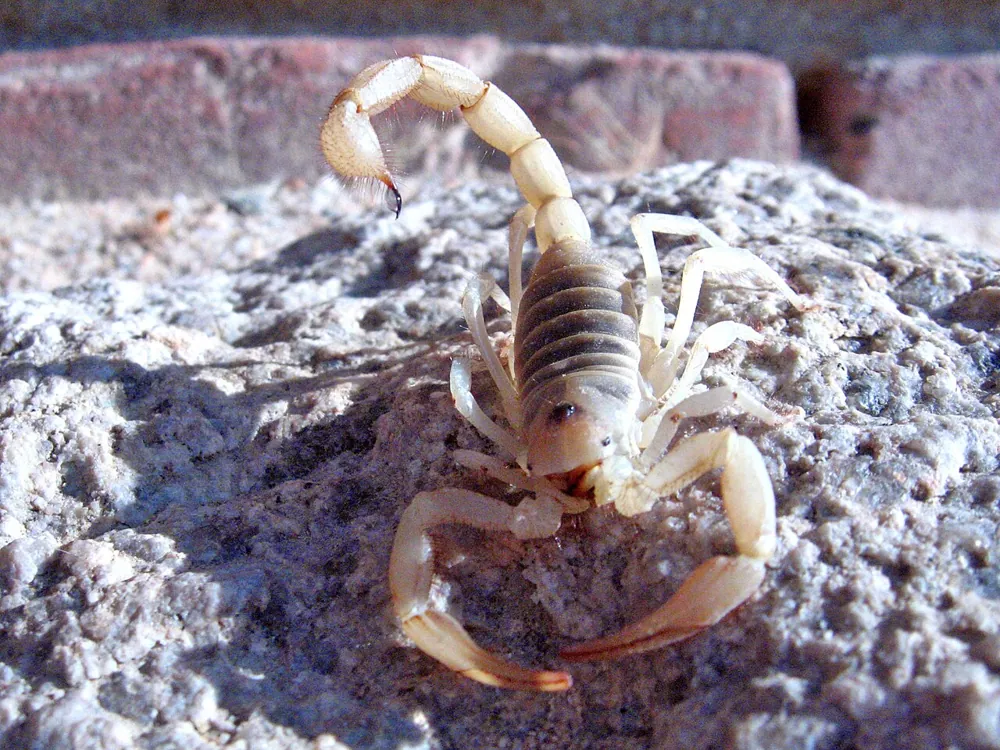
The giant desert hairy scorpion is the largest scorpion in North America. It lives in the hot deserts of the southwest United States and northwest Mexico. Its sting is painful, but its venom is not strong enough to be fatal.1


 Tsela ya go e lemoga
- Usually tan to olive-green, with a darker back and yellow pedipalps, legs and tail1
- Body covered in brown hairs, which give it its common name1
- Crab-like pincers1
- Length of 10 to 18 cm, with an average of 15 cm1
- Females have wider, stockier bodies; males have larger pincers1
Gantsi e tlhakanngwa le: A similar species is Hadrurus spadix. Hadrurus is a genus of large hairy scorpions found in the United States.1
Maatla a botlhole
Botlhole bo tswa ka lemao le le tlhabang.
Botlhole jo e bo tsenyang bo dira eng?
Its venom is not very potent, but the sting is commonly compared in pain to a honeybee sting. The venom is used to immobilise prey. Allergic reactions are uncommon, but they can cause difficulty breathing, excessive swelling and prolonged pain.1
E kotsi go le kae go batho?
Kotsi go batho: Kotsi e nnyeJaaka go tlhabiwa ke notshe kgotsa go le kwa tlase. Ga e na kotsi go batho.Its venom is not potent enough to be fatal. Most stings are compared to a honeybee sting in pain. Serious allergic reactions are uncommon but possible.1
E dira eng fa e tshogile?
When provoked, it is active and aggressive, and it stings more often when it senses a predator such as a Norway rat by smell.1
 Fa e tlhaba
- Tsidifatsa fa go tlhabilweng ka pakana ya aese mme o dire gore motho a nne a sa tshikinyege. Batla thuso ya bongaka ka bonako, bogolo jang go bana: diphepheng dingwe di bolaya bana.
Ka gale leletsa nomoro ya gago ya tshoganyetso pele (112, 000, 911). Se ke kaelo e e akaretsang ya thuso ya ntlha, ga se kgakololo ya bongaka. Motheo wa thuso ya ntlha
 Nna o babalesegile
- O se ka wa ama, wa tshwara kgotsa wa tshwenya phologolo ya naga, le fa e le e nnye, le fa e lebega e robetse kgotsa e sule.
- E fe sebaka. Fa o kopana le yone, ritibala, boela morago ka bonya mme o e tlogele e tsamaye ka tsela ya yone.
- Fa e nngwe e go tlhaba: ritibala, o se ka wa tshikinyega, leletsa nomoro ya gago ya tshoganyetso (112, 000, 911) kgotsa o ye bookelong ka bonako. Gopola gore e ne e lebega jang, setshwantsho se a thusa.
Ga e go batle. E dirisa botlhole jwa yone go tshwara dijo kgotsa go itshireletsa, mme e rata go iphitlha go feta. Go le gontsi ka go nna o babalesegile
Kae mo lefatsheng?
E kgolo go le kae?
E telele go le kae?
E kima go le kae?

 boleele jo bo lekanang le diboloko tsa go aga tsa ditshamekisi di le 6 mo moleng
 bofefo mo o ka se e utlweng mo seatleng sa gago
 e ka taboga dimetara di le 100 ka metsotswana e le 140 (motho yo o bonako go gaisa o tlhoka 9,6)
Giant desert hairy scorpion e kgolo go le kae fa e bapisiwa le WENA?
Ke dipalo fela mo sefetleng sa gago (browser). Ga go sepe se se bolokwang kgotsa se se romelwang gope.
E bonako go le kae?


Dintlha
Small snakes may make up to 10% of its diet, according to field observations.1
Its blood-like fluid, called hemolymph, can kill some bacteria within 1 to 2 minutes in favourable conditions, according to a 2021 study.1
It is the largest scorpion in North America.1
It digs deep burrows, up to 2.5 m long, and comes out at night to hunt and find mates.1
It can sense vibrations in the soil through its brown hairs.1
Mosenyi wa ditlhamane
Tlhamane: Big scorpions have dangerous venom.
Nnete: Although this scorpion is big, its venom is not very potent and is not fatal.1
Kwa dintlha di tswang teng
- Hadrurus arizonensis (Wikipedia (CC BY-SA 4.0))
- Hadrurus arizonensis (iNaturalist): maina le thulaganyo ya mefuta.
- Venom Wiki: seelo sa kotsi, bogolo jo bo tlwaelegileng le kakanyo ya lebelo ke tsa rona. Bona kafa re di balang ka teng: Kafa re lekanyang kotsi ka teng.
Ntlha nngwe le nngwe mo tsebeng e e na le nomoro e e supang motswedi wa yone. Fa re dirile phoso, maitshwarelo, re barati ba diphologolo, e seng kgatiso ya saense. Re bolelele kwa [email protected] mme re tla e baakanya.
 Phepheng e tshwerwe ke tlala! Venom Wiki ke porojeke ya motho a le mongwe: ke mahala, ga e na dipapatso le ditraka. Mpho e nnye e thusa go e tshegetsa mo inthaneteng.Fepa phepheng
Tse dingwe tsa setlhopha se se tshwanang: Diphepheng
 Arizona bark scorpion
 Cuban blue scorpion
 Striped bark scorpion
 Colima scorpion
 Durango scorpion
 Mexican bark scorpion
E tshela gape kwa: Amerika Bokone
 TerciopeloDivaepara tsa mesima (pit vipers)E a bolaya
 Eastern coral snakeDinoga tsa khoraleE ka bolaya
 Eastern diamondback rattlesnakeDinoga tsa ratheleE ka bolaya
 Eyelash viperDivaepara tsa mesima (pit vipers)E ka bolaya
 Timber rattlesnakeDinoga tsa ratheleE ka bolaya
 Western diamondback rattlesnakeDinoga tsa ratheleE ka bolaya