
 Aforika
 Asia
Asia Yuropa
 Amerika Borwa
 Australia le Oceania
 Antarctica
 Lewatle la Pacific
 Lewatle la Atlantic
 Lewatle la India
 Lewatle la Arctic
 Lewatle la Mediterranean
 Lewatle le Lehibidu
 Lewatle la Caribbean
 Lewatle la Coral
 Lewatle la China Borwa
 Lewatle la Philippines
 Lewatle la Andaman
 Lewatle la Bokone
 Lewatle la Timor le la Arafura
 Kou ya Bengal
 Gulf ya California
Timber rattlesnake
 Go loma
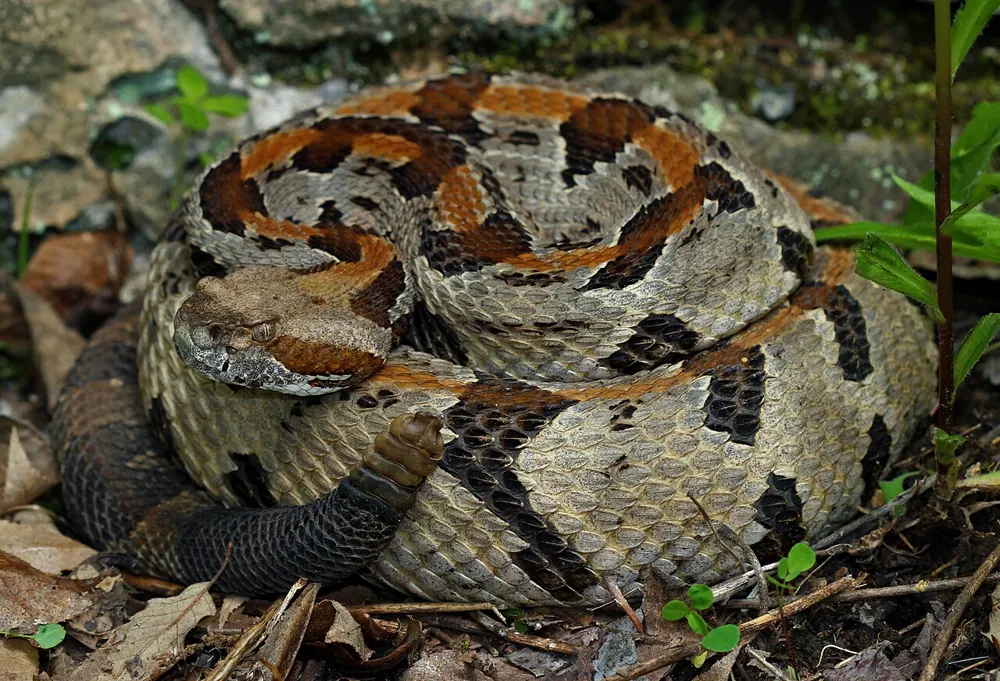
The timber rattlesnake is a venomous pit viper that lives in forests and rocky land in the eastern United States. It is the only rattlesnake in most of the crowded northeastern states, and it is one of the most northerly venomous snakes in North America.1



 Tsela ya go e lemoga
- Dark brown or black crossbands on a yellowish-brown or greyish background1
- The crossbands have irregular zig-zag edges and may be V- or M-shaped1
- A rust-coloured stripe often runs down the middle of the back1
- The tail is black and looks 'velvety'1
- Melanism (very dark colouring) is common, and some individuals are almost solid black1
Maatla a botlhole
Botlhole bo tswa ka meno a yone fa e loma.
Botlhole jo e bo tsenyang bo dira eng?
Its venom is extremely potent and can be haemorrhagic (damaging blood vessels and causing bleeding) or neurotoxic (attacking the nerves), depending on the population and location. Its long fangs, large size and high venom yield make it potentially one of North America's most dangerous snakes. Venom-induced incapacitation can progress rapidly.1
E kotsi go le kae go batho?
Kotsi go batho: E kotsi thataE ka bolaya motho yo o sa alafiweng.It is potentially one of North America's most dangerous snakes, but it is usually shy and calm. It will retreat if it can and attacks mainly when cornered. Over many years in western Pennsylvania, one naturalist heard of only one death from its bite. Bites are widespread in some areas of Iowa's forests. Its remote, wooded habitat can make emergency medical care difficult or even impossible.1
E dira eng fa e tshogile?
It rattles and feints a good deal before striking, and it will try to retreat first if it feels threatened.1
 Fa e loma
- Dira gore motho a nne a sa tshikinyege a ritibetse, tshegetsa setho se se lomilweng mo boemong jwa pelo, tlosa direng le dilo tse di tiileng, mme o mo ise bookelong ka bonako.
Ka gale leletsa nomoro ya gago ya tshoganyetso pele (112, 000, 911). Se ke kaelo e e akaretsang ya thuso ya ntlha, ga se kgakololo ya bongaka. Motheo wa thuso ya ntlha
 Nna o babalesegile
- O se ka wa ama, wa tshwara kgotsa wa tshwenya phologolo ya naga, le fa e le e nnye, le fa e lebega e robetse kgotsa e sule.
- E fe sebaka. Fa o kopana le yone, ritibala, boela morago ka bonya mme o e tlogele e tsamaye ka tsela ya yone.
- Fa e nngwe e go loma: ritibala, o se ka wa tshikinyega, leletsa nomoro ya gago ya tshoganyetso (112, 000, 911) kgotsa o ye bookelong ka bonako. Gopola gore e ne e lebega jang, setshwantsho se a thusa.
Ga e go batle. E dirisa botlhole jwa yone go tshwara dijo kgotsa go itshireletsa, mme e rata go iphitlha go feta. Go le gontsi ka go nna o babalesegile
Kae mo lefatsheng?
E kgolo go le kae?
E telele go le kae?
E kima go le kae?
 boleele jo bo lekanang le dikatse tsa ntlo di le 4 go tloga kwa nkong go ya mogatleng
 boleele jo bo lekanang le dipanana di le 11 di latelanae ka nna bokima jo bo lekanang le jwa katse ya ntlo
 e ka taboga dimetara di le 100 ka metsotswana e le 95 (motho yo o bonako go gaisa o tlhoka 9,6)
Timber rattlesnake e kgolo go le kae fa e bapisiwa le WENA?
Ke dipalo fela mo sefetleng sa gago (browser). Ga go sepe se se bolokwang kgotsa se se romelwang gope.
E bonako go le kae?


_-_Flickr_-_2ndPeter.jpg)
Dintlha
Timber rattlesnakes return to the same winter den each year, and juveniles can track chemical cues to find relatives in it.1
Female timber rattlesnakes bask in the sun on open rocky areas called basking knolls before they give birth.1
They share winter dens with copperheads and rat snakes.1
It is the only rattlesnake in most of the populous Northeastern United States, and one of the most northerly venomous snakes in North America.1
Males often mate farther from the winter dens than females do.1
Mosenyi wa ditlhamane
Tlhamane: Rattlesnakes attack people as soon as they see them.
Nnete: Timber rattlesnakes are shy and will try to retreat from danger first. They attack mainly when they are cornered, so leaving them alone keeps people safe.1
Ya baitseanape ba botlhole
- Leina la saense
- Crotalus horridus
- Setlhopha
- Dinoga tsa rathele
- Lelapa
- Viperidae2
- Lekoko
- Squamata
- Dikontinente
- Amerika Bokone
- Masea
- Females first reproduce at a mean age of 9.6 years and average 7.7 offspring per litter. Most females reproduce only once in their lifetime.1
- Seemo sa yone kwa nageng
- Extirpated in Canada, as listed under the Canadian Species at Risk Act in May 2001.1
- Kotsi go batho
- 4 / 5: E kotsi thata3
Kwa dintlha di tswang teng
- Timber rattlesnake (Wikipedia (CC BY-SA 4.0))
- Crotalus horridus (iNaturalist): maina le thulaganyo ya mefuta.
- Venom Wiki: seelo sa kotsi, bogolo jo bo tlwaelegileng le kakanyo ya lebelo ke tsa rona. Bona kafa re di balang ka teng: Kafa re lekanyang kotsi ka teng.
Ntlha nngwe le nngwe mo tsebeng e e na le nomoro e e supang motswedi wa yone. Fa re dirile phoso, maitshwarelo, re barati ba diphologolo, e seng kgatiso ya saense. Re bolelele kwa [email protected] mme re tla e baakanya.
 Phepheng e tshwerwe ke tlala! Venom Wiki ke porojeke ya motho a le mongwe: ke mahala, ga e na dipapatso le ditraka. Mpho e nnye e thusa go e tshegetsa mo inthaneteng.Fepa phepheng
Tse dingwe tsa setlhopha se se tshwanang: Dinoga tsa rathele
 Eastern diamondback rattlesnakeDinoga tsa ratheleE ka bolaya
 Western diamondback rattlesnakeDinoga tsa ratheleE ka bolaya
 SidewinderDinoga tsa ratheleE tlhoka ngaka
 Mojave rattlesnakeDinoga tsa ratheleE ka bolaya
 Aruba rattlesnakeDinoga tsa ratheleE tlhoka ngaka
 Black-tailed rattlesnakeDinoga tsa ratheleE tlhoka ngaka
E tshela gape kwa: Amerika Bokone
 TerciopeloDivaepara tsa mesima (pit vipers)E a bolaya
 Eastern coral snakeDinoga tsa khoraleE ka bolaya
 Eyelash viperDivaepara tsa mesima (pit vipers)E ka bolaya
 Arizona bark scorpionDiphephengE tlhoka ngaka
 Brown recluseDigokgoE tlhoka ngaka
 Cane toadDigwagwa tsa botlhole, digwagwa tse dingwe le dinewtE tlhoka ngakaO se ka wa ama