
 Aforika
 Asia
Asia Yuropa
 Amerika Borwa
 Australia le Oceania
 Antarctica
 Lewatle la Pacific
 Lewatle la Atlantic
 Lewatle la India
 Lewatle la Arctic
 Lewatle la Mediterranean
 Lewatle le Lehibidu
 Lewatle la Caribbean
 Lewatle la Coral
 Lewatle la China Borwa
 Lewatle la Philippines
 Lewatle la Andaman
 Lewatle la Bokone
 Lewatle la Timor le la Arafura
 Kou ya Bengal
 Gulf ya California
Io moth
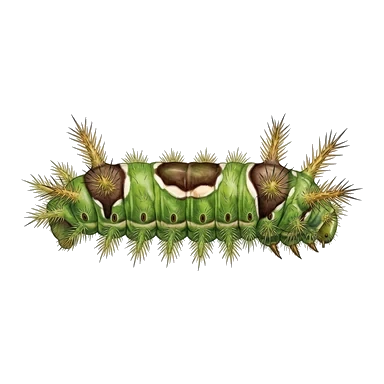 Meriri e e tlhabang
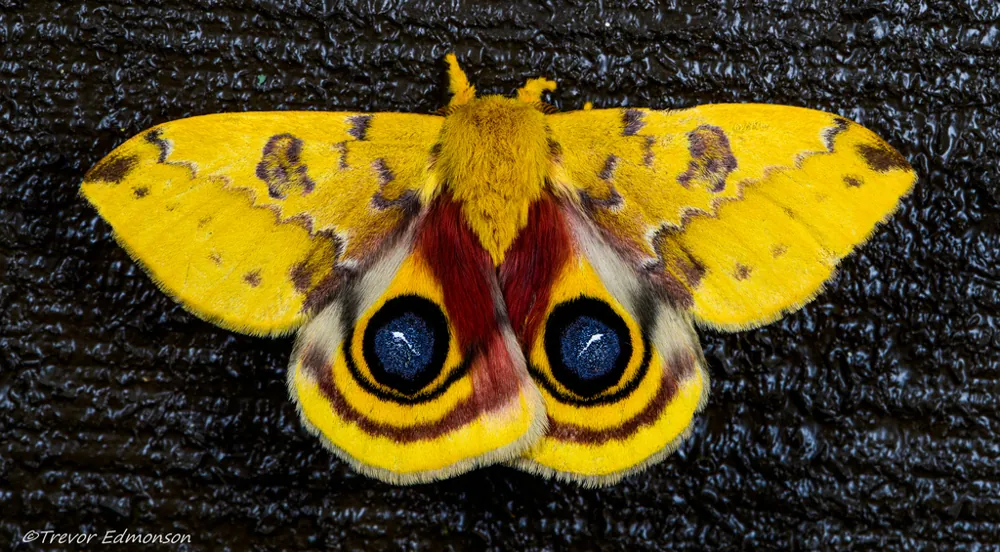
The Io moth is a colourful moth from North America. Its adults are striking, with large eyespots on their wings. Its green caterpillars carry spines that release a very painful venom, so they should be left alone.1
 Tsela ya go e lemoga
- Males have bright yellow forewings, body and legs, and much bigger feathery antennae than females.1
- Females have reddish-brown to purple forewings, body and legs.1
- Both sexes have one large black to bluish eyespot with some white in the centre on each hindwing.1
- Mature caterpillars are bright green and covered in spines, with two lateral stripes: the upper one bright red and the lower one white.1
- Adults have a wingspan of 6.3 to 8.8 cm.1
Maatla a botlhole
Meriri e mennye kgotsa ditlhaka di robegela mo letlalong mme di tlhabe.
Botlhole jo e bo tsenyang bo dira eng?
The spines of the green caterpillars release a very painful venom at the slightest touch. Contact is not life-threatening to humans, but it irritates the skin and causes an acute skin inflammation called erucism.1
E kotsi go le kae go batho?
Kotsi go batho: E botlhokoE ka utlwisa botlhoko tota, mme go seoka thata gore e nne masisi.Contact with the spines is not life-threatening to humans, but it causes painful skin irritation.1
E dira eng fa e tshogile?
When sitting head-down or when touched, adults shake and expose their hindwing eyespots. Caterpillars defend themselves with stinging spines.1
 Fa o ama meriri ya yone
- Ya meriri e e tlhabang ya diboko: e tlose ka theipi e e kgomarelang, morago o tlhatswe letlalo. O se ka wa gotlha.
- Fa e lomile: tlhatswa le go tsidifatsa. Batla thuso ya bongaka fa motho a ikutlwa a sa siama kgotsa a tswa madi bonolo.
Ka gale leletsa nomoro ya gago ya tshoganyetso pele (112, 000, 911). Se ke kaelo e e akaretsang ya thuso ya ntlha, ga se kgakololo ya bongaka. Motheo wa thuso ya ntlha
 Nna o babalesegile
- O se ka wa ama, wa tshwara kgotsa wa tshwenya phologolo ya naga, le fa e le e nnye, le fa e lebega e robetse kgotsa e sule.
- E fe sebaka. Fa o kopana le yone, ritibala, boela morago ka bonya mme o e tlogele e tsamaye ka tsela ya yone.
- Fa o ama meriri ya yone: ritibala, o se ka wa tshikinyega, leletsa nomoro ya gago ya tshoganyetso (112, 000, 911) kgotsa o ye bookelong ka bonako. Gopola gore e ne e lebega jang, setshwantsho se a thusa.
Ga e go batle. E dirisa botlhole jwa yone go tshwara dijo kgotsa go itshireletsa, mme e rata go iphitlha go feta. Go le gontsi ka go nna o babalesegile
Kae mo lefatsheng?
E kgolo go le kae?
E telele go le kae?
 boleele jo bo lekanang le diboloko tsa go aga tsa ditshamekisi di le 3 mo moleng
 bonya go feta kgopa ya tshingwana
Io moth e kgolo go le kae fa e bapisiwa le WENA?
Ke dipalo fela mo sefetleng sa gago (browser). Ga go sepe se se bolokwang kgotsa se se romelwang gope.
E bonako go le kae?

Dintlha
The caterpillars' spines are urticating, meaning they can cause a stinging reaction on contact.1
Adults live only 1 to 2 weeks and do not eat during this stage.1
After emerging from the cocoon, adults inflate their furled wings with fluid pumped from the body, which takes about twenty minutes.1
Females attract males by releasing wind-borne scent chemicals (pheromones) from a gland at the end of the abdomen.1
Many flies and wasps are parasitoids of this moth, laying their eggs in or on it.1
Ya baitseanape ba botlhole
- Leina la saense
- Automeris io
- Setlhopha
- Diboko le dikhukhwane
- Lelapa
- Saturniidae2
- Lekoko
- Lepidoptera
- Dikontinente
- Amerika Bokone
- Masea
- Females lay clusters of more than twenty small white eggs on leaves. The eggs hatch within 8 to 11 days.1
- Seemo sa yone kwa nageng
- Not evaluated by the IUCN Red List and has no special status on the US Federal List. Populations in the eastern US are declining and becoming more localised.1
- Kotsi go batho
- 2 / 5: E botlhoko3
Kwa dintlha di tswang teng
- Automeris io (Wikipedia (CC BY-SA 4.0))
- Automeris io (iNaturalist): maina le thulaganyo ya mefuta.
- Venom Wiki: seelo sa kotsi, bogolo jo bo tlwaelegileng le kakanyo ya lebelo ke tsa rona. Bona kafa re di balang ka teng: Kafa re lekanyang kotsi ka teng.
Ntlha nngwe le nngwe mo tsebeng e e na le nomoro e e supang motswedi wa yone. Fa re dirile phoso, maitshwarelo, re barati ba diphologolo, e seng kgatiso ya saense. Re bolelele kwa [email protected] mme re tla e baakanya.
 Phepheng e tshwerwe ke tlala! Venom Wiki ke porojeke ya motho a le mongwe: ke mahala, ga e na dipapatso le ditraka. Mpho e nnye e thusa go e tshegetsa mo inthaneteng.Fepa phepheng
Tse dingwe tsa setlhopha se se tshwanang: Diboko le dikhukhwane
 Giant water bugDiboko le dikhukhwaneE utlwisa botlhoko fela
 Puss caterpillarDiboko le dikhukhwaneE utlwisa botlhoko felaO se ka wa ama
 Saddleback caterpillarDiboko le dikhukhwaneE utlwisa botlhoko felaO se ka wa ama
 Wheel bugDiboko le dikhukhwaneE utlwisa botlhoko fela
 Giant vinegaroonDiboko le dikhukhwaneGa e na kotsi
 Rhodnius kissing bugDiboko le dikhukhwaneE tlhoka ngaka
E tshela gape kwa: Amerika Bokone
 TerciopeloDivaepara tsa mesima (pit vipers)E a bolaya
 Eastern coral snakeDinoga tsa khoraleE ka bolaya
 Eastern diamondback rattlesnakeDinoga tsa ratheleE ka bolaya
 Eyelash viperDivaepara tsa mesima (pit vipers)E ka bolaya
 Timber rattlesnakeDinoga tsa ratheleE ka bolaya
 Western diamondback rattlesnakeDinoga tsa ratheleE ka bolaya