
 Aforika
 Asia
Asia Yuropa
 Amerika Borwa
 Australia le Oceania
 Antarctica
 Lewatle la Pacific
 Lewatle la Atlantic
 Lewatle la India
 Lewatle la Arctic
 Lewatle la Mediterranean
 Lewatle le Lehibidu
 Lewatle la Caribbean
 Lewatle la Coral
 Lewatle la China Borwa
 Lewatle la Philippines
 Lewatle la Andaman
 Lewatle la Bokone
 Lewatle la Timor le la Arafura
 Kou ya Bengal
 Gulf ya California
Transvaal thick-tailed scorpion
 Go tlhaba
The Transvaal thick-tailed scorpion is a dark brown or black scorpion with a thick tail. It lives in dry, semi-arid parts of southern Africa. It matters because it is a medically significant scorpion that can sting and can also spray venom.1
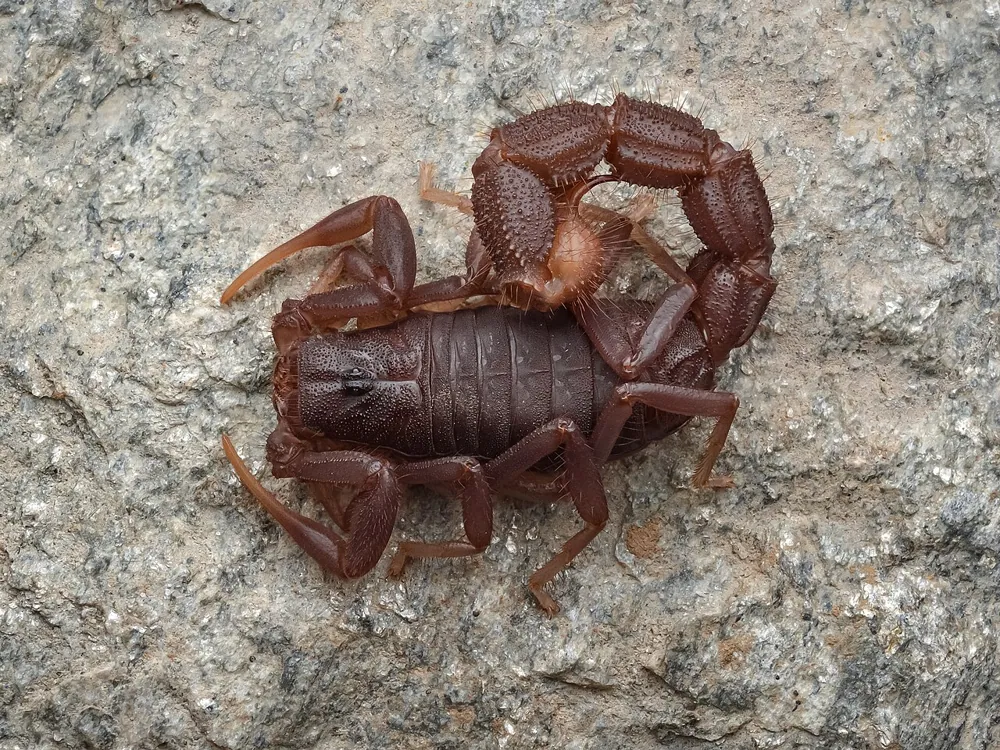
 Tsela ya go e lemoga
- Dark brown or black in colour1
- Grows to 90–110 mm long1
- Thin pincers and a thickened tail1
- The sting segment is as wide as the rest of the tail1
- Mostly active at night1
Gantsi e tlhakanngwa le: It resembles P. villosus, its close relative. P. villosus is hairier, is less strictly nocturnal and lives further west.1
Maatla a botlhole
Botlhole bo tswa ka lemao le le tlhabang.
Botlhole jo e bo tsenyang bo dira eng?
Its venom contains kurtoxin, and a related toxin called parabutoxin has been isolated from it. Parabutoxin is a potassium channel inhibitor, which means it blocks channels that the body uses to control nerve and muscle signals. The first droplet of venom is different from the rest and is called "pre-venom".1
E kotsi go le kae go batho?
Kotsi go batho: E kotsi thataE ka bolaya motho yo o sa alafiweng.It is described as a dangerous, medically significant scorpion. It can both sting and spray its venom.1
E dira eng fa e tshogile?
It can sting and spray its venom when threatened.1
 Fa e tlhaba
- Tsidifatsa fa go tlhabilweng ka pakana ya aese mme o dire gore motho a nne a sa tshikinyege. Batla thuso ya bongaka ka bonako, bogolo jang go bana: diphepheng dingwe di bolaya bana.
Ka gale leletsa nomoro ya gago ya tshoganyetso pele (112, 000, 911). Se ke kaelo e e akaretsang ya thuso ya ntlha, ga se kgakololo ya bongaka. Motheo wa thuso ya ntlha
 Nna o babalesegile
- O se ka wa ama, wa tshwara kgotsa wa tshwenya phologolo ya naga, le fa e le e nnye, le fa e lebega e robetse kgotsa e sule.
- E fe sebaka. Fa o kopana le yone, ritibala, boela morago ka bonya mme o e tlogele e tsamaye ka tsela ya yone.
- Fa e nngwe e go tlhaba: ritibala, o se ka wa tshikinyega, leletsa nomoro ya gago ya tshoganyetso (112, 000, 911) kgotsa o ye bookelong ka bonako. Gopola gore e ne e lebega jang, setshwantsho se a thusa.
Ga e go batle. E dirisa botlhole jwa yone go tshwara dijo kgotsa go itshireletsa, mme e rata go iphitlha go feta. Go le gontsi ka go nna o babalesegile
Kae mo lefatsheng?
E kgolo go le kae?
E telele go le kae?
 boleele jo bo lekanang le diboloko tsa go aga tsa ditshamekisi di le 3 mo moleng
 e ka taboga dimetara di le 100 ka metsotswana e le 160 (motho yo o bonako go gaisa o tlhoka 9,6)
Transvaal thick-tailed scorpion e kgolo go le kae fa e bapisiwa le WENA?
Ke dipalo fela mo sefetleng sa gago (browser). Ga go sepe se se bolokwang kgotsa se se romelwang gope.
E bonako go le kae?


Dintlha
It can spray its venom as well as sting.1
The first droplet of its venom is different from the rest and is called "pre-venom".1
A toxin called parabutoxin has been isolated from its venom.1
Its tail is thickened, and the sting segment is as wide as the rest of the tail.1
It is nocturnal and rests in a shallow burrow under rocks during the day.1
Kwa dintlha di tswang teng
- Parabuthus transvaalicus (Wikipedia (CC BY-SA 4.0))
- Parabuthus transvaalicus (iNaturalist): maina le thulaganyo ya mefuta.
- Venom Wiki: seelo sa kotsi, bogolo jo bo tlwaelegileng le kakanyo ya lebelo ke tsa rona. Bona kafa re di balang ka teng: Kafa re lekanyang kotsi ka teng.
Ntlha nngwe le nngwe mo tsebeng e e na le nomoro e e supang motswedi wa yone. Fa re dirile phoso, maitshwarelo, re barati ba diphologolo, e seng kgatiso ya saense. Re bolelele kwa [email protected] mme re tla e baakanya.
 Phepheng e tshwerwe ke tlala! Venom Wiki ke porojeke ya motho a le mongwe: ke mahala, ga e na dipapatso le ditraka. Mpho e nnye e thusa go e tshegetsa mo inthaneteng.Fepa phepheng
Tse dingwe tsa setlhopha se se tshwanang: Diphepheng
 Deathstalker
 Fat-tailed scorpion
 Emperor scorpion
 Arabian fat-tailed scorpion
 European yellow-tailed scorpion
 Flat rock scorpion
E tshela gape kwa: Aforika
 Black mambaDikobra, dimamba le dikraitE a bolaya
 Egyptian cobraDikobra, dimamba le dikraitE a bolaya
 Puff adderDivaepara le diboloboloE a bolaya
 BoomslangDinoga tse di nang le meno a botlhole kwa moragoE ka bolaya
 Gaboon viperDivaepara le diboloboloE ka bolaya
 Western honey beeDinotshe, diwasepe le dihoneteE utlwisa botlhoko fela