
 Aforika
 Asia
Asia Yuropa
 Amerika Borwa
 Australia le Oceania
 Antarctica
 Lewatle la Pacific
 Lewatle la Atlantic
 Lewatle la India
 Lewatle la Arctic
 Lewatle la Mediterranean
 Lewatle le Lehibidu
 Lewatle la Caribbean
 Lewatle la Coral
 Lewatle la China Borwa
 Lewatle la Philippines
 Lewatle la Andaman
 Lewatle la Bokone
 Lewatle la Timor le la Arafura
 Kou ya Bengal
 Gulf ya California
West African carpet viper
 Go loma
The West African carpet viper is a small, highly venomous snake that lives in the savanna of West Africa. Its bite is one of the most dangerous of any snake in Africa. It is known for its row of eye-spots and its aggressive, alarm-like behaviour when threatened.1



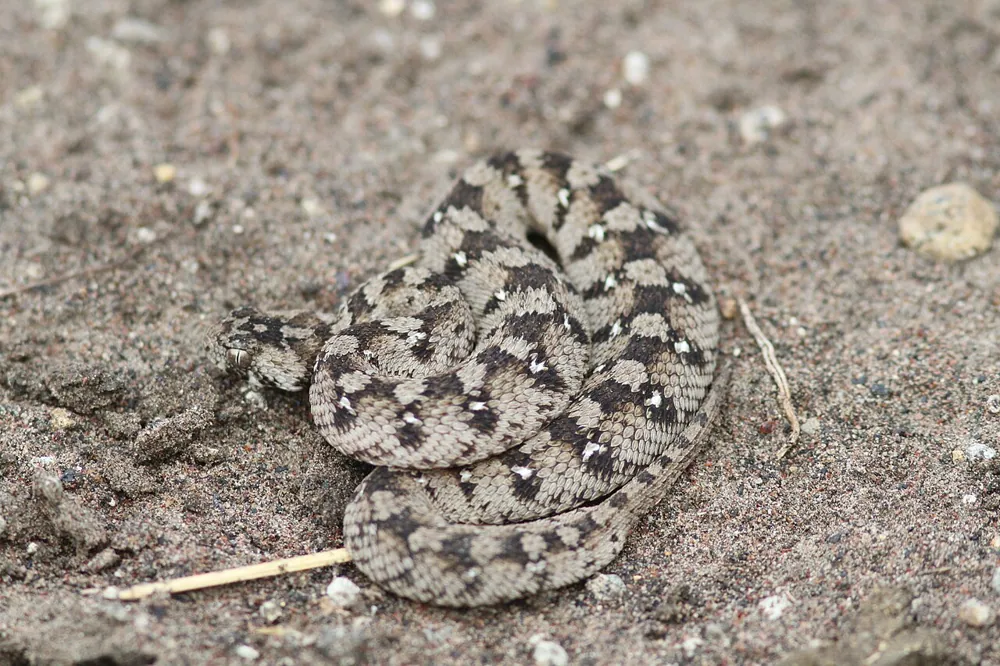
 Tsela ya go e lemoga
- It has bulging eyes and a short snout, typical of vipers in the genus Echis.1
- A distinctive series of eye-spots, called ocelli, runs the length of its body.1
- It is terrestrial, so it lives on the ground rather than in trees.1
- It is mostly active at night and at dusk (nocturnal and crepuscular).1
Gantsi e tlhakanngwa le: Older records from Senegal, Guinea-Bissau and Guinea refer to Echis jogeri, and those from eastern Nigeria, Cameroon and southern Chad refer to Echis romani. These are now recognised as separate species. Echis leucogaster is more common north of the 15th parallel, where this snake is rarely found.1
Maatla a botlhole
Botlhole bo tswa ka meno a yone fa e loma.
Botlhole jo e bo tsenyang bo dira eng?
Its venom is a mix of procoagulants, anticoagulants, haemorrhagins, nephrotoxins and necrotoxins. Procoagulants make blood clot, while anticoagulants stop it clotting, so bleeding can occur. Nephrotoxins damage the kidneys, and necrotoxins kill tissue around the bite. Local symptoms include pain, swelling, bleeding, tissue death (necrosis) and disfigurement, which may lead to amputation. Whole-body symptoms include coagulopathy (blood clotting problems), haemorrhages, shock, kidney failure and blindness.1
E kotsi go le kae go batho?
Kotsi go batho: E a bolayaNngwe ya diphologolo tse di kotsi go gaisa mo lefatsheng.The West African carpet viper causes more human deaths from snakebite than all other African snakes combined. The envenoming rate is 80%, and the lethality rate is 10–20%.1
 Dikgang tse di molemo: dingaka di na le molemo (antivenom) kgotsa kalafi ya se.1
E dira eng fa e tshogile?
When threatened, it forms its body into an S shape and rubs its scales together to make an alert sound.1
 Fa e loma
- Dira gore motho a nne a sa tshikinyege a ritibetse, tshegetsa setho se se lomilweng mo boemong jwa pelo, tlosa direng le dilo tse di tiileng, mme o mo ise bookelong ka bonako.
Ka gale leletsa nomoro ya gago ya tshoganyetso pele (112, 000, 911). Se ke kaelo e e akaretsang ya thuso ya ntlha, ga se kgakololo ya bongaka. Motheo wa thuso ya ntlha
 Nna o babalesegile
- O se ka wa ama, wa tshwara kgotsa wa tshwenya phologolo ya naga, le fa e le e nnye, le fa e lebega e robetse kgotsa e sule.
- E fe sebaka. Fa o kopana le yone, ritibala, boela morago ka bonya mme o e tlogele e tsamaye ka tsela ya yone.
- Fa e nngwe e go loma: ritibala, o se ka wa tshikinyega, leletsa nomoro ya gago ya tshoganyetso (112, 000, 911) kgotsa o ye bookelong ka bonako. Gopola gore e ne e lebega jang, setshwantsho se a thusa.
Ga e go batle. E dirisa botlhole jwa yone go tshwara dijo kgotsa go itshireletsa, mme e rata go iphitlha go feta. Go le gontsi ka go nna o babalesegile
Kae mo lefatsheng?
E kgolo go le kae?
E telele go le kae?
 boleele jo bo lekanang le dipanana di le 4 di latelana
 e ka taboga dimetara di le 100 ka metsotswana e le 110 (motho yo o bonako go gaisa o tlhoka 9,6)
West African carpet viper e kgolo go le kae fa e bapisiwa le WENA?
Ke dipalo fela mo sefetleng sa gago (browser). Ga go sepe se se bolokwang kgotsa se se romelwang gope.
E bonako go le kae?


Dintlha
It makes an alert sound by rubbing its scales together while in an S-shaped posture.1
Hatchlings are already 10–12 cm long, which is a sizeable fraction of an adult's average length.1
Its scientific name, ocellatus, comes from the row of eye-spots, called ocelli, that runs along its body.1
Some individual snakes have been found far from its main range, including in the Central African Republic and central Sudan.1
Ya baitseanape ba botlhole
Kwa dintlha di tswang teng
- Echis ocellatus (Wikipedia (CC BY-SA 4.0))
- Echis ocellatus (iNaturalist): maina le thulaganyo ya mefuta.
- Venom Wiki: seelo sa kotsi, bogolo jo bo tlwaelegileng le kakanyo ya lebelo ke tsa rona. Bona kafa re di balang ka teng: Kafa re lekanyang kotsi ka teng.
Ntlha nngwe le nngwe mo tsebeng e e na le nomoro e e supang motswedi wa yone. Fa re dirile phoso, maitshwarelo, re barati ba diphologolo, e seng kgatiso ya saense. Re bolelele kwa [email protected] mme re tla e baakanya.
 Phepheng e tshwerwe ke tlala! Venom Wiki ke porojeke ya motho a le mongwe: ke mahala, ga e na dipapatso le ditraka. Mpho e nnye e thusa go e tshegetsa mo inthaneteng.Fepa phepheng
Tse dingwe tsa setlhopha se se tshwanang: Divaepara le dibolobolo
 Puff adderDivaepara le diboloboloE a bolaya
 Gaboon viperDivaepara le diboloboloE ka bolaya
 Northeast African carpet viperDivaepara le diboloboloE a bolaya
 Rhinoceros viperDivaepara le diboloboloE ka bolaya
 West African Gaboon viperDivaepara le diboloboloE ka bolaya
 Horned adderDivaepara le diboloboloE tlhoka ngaka
E tshela gape kwa: Aforika
 Black mambaDikobra, dimamba le dikraitE a bolaya
 DeathstalkerDiphephengE a bolaya
 Egyptian cobraDikobra, dimamba le dikraitE a bolaya
 BoomslangDinoga tse di nang le meno a botlhole kwa moragoE ka bolaya
 Fat-tailed scorpionDiphephengE ka bolaya
 Western honey beeDinotshe, diwasepe le dihoneteE utlwisa botlhoko fela