
 Aforika
 Asia
Asia Yuropa
 Amerika Borwa
 Australia le Oceania
 Antarctica
 Lewatle la Pacific
 Lewatle la Atlantic
 Lewatle la India
 Lewatle la Arctic
 Lewatle la Mediterranean
 Lewatle le Lehibidu
 Lewatle la Caribbean
 Lewatle la Coral
 Lewatle la China Borwa
 Lewatle la Philippines
 Lewatle la Andaman
 Lewatle la Bokone
 Lewatle la Timor le la Arafura
 Kou ya Bengal
 Gulf ya California
Western green mamba
 Go loma
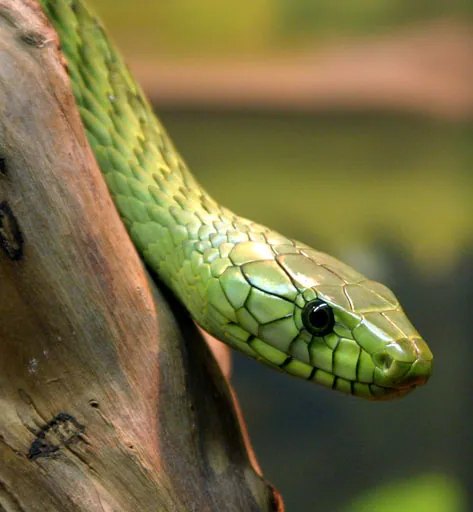
The western green mamba is a long, thin and highly venomous snake. It lives in forests, thickets and woodland along the coast of West Africa, and it spends most of its time high in the trees. Its venom is fast-acting, so any bite needs urgent medical care.1


 Tsela ya go e lemoga
- Bright green, fading to yellow or orange towards the tail.1
- Scales have prominent black edges, which give a networked pattern.1
- Long, slender body with a long tapering tail.1
- Long, thin head with medium-sized eyes that have round pupils and yellowish brown irises.1
- Typical adult length is 1.4 to 2.1 metres.1
Gantsi e tlhakanngwa le: It can be mistaken for green bushsnakes of the genus Philothamnus, and for the boomslang. Counting scales is a key way to identify snakes to species level, and the western green mamba has 13 rows of dorsal scales at midbody, fewer than any similar species.1
Maatla a botlhole
Botlhole bo tswa ka meno a yone fa e loma.
Botlhole jo e bo tsenyang bo dira eng?
Its venom contains neurotoxins (which attack the nerves), cardiotoxins (which harm the heart) and fasciculins. Symptoms usually start within about 15 minutes and can include pain and swelling, headache, drowsiness, difficulty breathing, vertigo, low blood pressure and paralysis. Without treatment, the victim can die when paralysis stops the breathing muscles, and a bite can be fatal in as little as 30 minutes.1
E kotsi go le kae go batho?
Kotsi go batho: E a bolayaNngwe ya diphologolo tse di kotsi go gaisa mo lefatsheng.Bites to people are uncommon because the snake is rarely encountered and conflict with humans is low compared with some other species in the region. However, many recorded bites have been fatal, and the World Health Organization lists it as a snake of medical importance in western sub-Saharan Africa.1
 Dikgang tse di molemo: dingaka di na le molemo (antivenom) kgotsa kalafi ya se.1
E dira eng fa e tshogile?
When threatened, it can flatten its neck into a slight hood, and it usually retreats if it is encountered.1
 Fa e loma
- Apply a pressure bandage, keep the victim as still as possible and take them quickly to a hospital or clinic. An arterial tourniquet may help because of the venom's neurotoxic effects. Antivenom is the main treatment, and tetanus toxoid is sometimes given.1
- Dira gore motho a nne a sa tshikinyege a ritibetse, tlosa direng le dilo tse di tiileng, mme o mo ise bookelong ka bonako: antivenom ke yone kalafi.
Ka gale leletsa nomoro ya gago ya tshoganyetso pele (112, 000, 911). Se ke kaelo e e akaretsang ya thuso ya ntlha, ga se kgakololo ya bongaka. Motheo wa thuso ya ntlha
 Nna o babalesegile
- O se ka wa ama, wa tshwara kgotsa wa tshwenya phologolo ya naga, le fa e le e nnye, le fa e lebega e robetse kgotsa e sule.
- E fe sebaka. Fa o kopana le yone, ritibala, boela morago ka bonya mme o e tlogele e tsamaye ka tsela ya yone.
- Fa e nngwe e go loma: ritibala, o se ka wa tshikinyega, leletsa nomoro ya gago ya tshoganyetso (112, 000, 911) kgotsa o ye bookelong ka bonako. Gopola gore e ne e lebega jang, setshwantsho se a thusa.
Ga e go batle. E dirisa botlhole jwa yone go tshwara dijo kgotsa go itshireletsa, mme e rata go iphitlha go feta. Go le gontsi ka go nna o babalesegile
Kae mo lefatsheng?
E kgolo go le kae?
E telele go le kae?
 boleele jo bo lekanang le dikatse tsa ntlo di le 4 go tloga kwa nkong go ya mogatleng
 boleele jo bo lekanang le dipanana di le 12 di latelana
 e ka taboga dimetara di le 100 ka metsotswana e le 43 (motho yo o bonako go gaisa o tlhoka 9,6)
Western green mamba e kgolo go le kae fa e bapisiwa le WENA?
Ke dipalo fela mo sefetleng sa gago (browser). Ga go sepe se se bolokwang kgotsa se se romelwang gope.
E bonako go le kae?


Dintlha
Its venom is among the fastest-acting of any snake, and symptoms can appear within about 15 minutes of a bite.1
Its venom is more potent than that of the eastern green mamba, and much less potent than that of the black mamba.1
It is mostly active during the day and spends most of its time in the forest canopy, sometimes at considerable height.1
The oldest recorded specimen was a captive snake that lived 18.7 years.1
It is one of the more expensive African snake species, and it is collected and sold internationally.1
Mosenyi wa ditlhamane
Tlhamane: Western green mambas are aggressive snakes that attack people.
Nnete: Opinions differ on how aggressive it is, and it usually retreats when encountered. Bites are uncommon, but when cornered it can attack, and its bites have a high fatality rate.1
Ya baitseanape ba botlhole
Kwa dintlha di tswang teng
- Western green mamba (Wikipedia (CC BY-SA 4.0))
- Dendroaspis viridis (iNaturalist): maina le thulaganyo ya mefuta.
- Venom Wiki: seelo sa kotsi, bogolo jo bo tlwaelegileng le kakanyo ya lebelo ke tsa rona. Bona kafa re di balang ka teng: Kafa re lekanyang kotsi ka teng.
Ntlha nngwe le nngwe mo tsebeng e e na le nomoro e e supang motswedi wa yone. Fa re dirile phoso, maitshwarelo, re barati ba diphologolo, e seng kgatiso ya saense. Re bolelele kwa [email protected] mme re tla e baakanya.
 Phepheng e tshwerwe ke tlala! Venom Wiki ke porojeke ya motho a le mongwe: ke mahala, ga e na dipapatso le ditraka. Mpho e nnye e thusa go e tshegetsa mo inthaneteng.Fepa phepheng
Tse dingwe tsa setlhopha se se tshwanang: Dikobra, dimamba le dikrait
 Black mambaDikobra, dimamba le dikraitE a bolaya
 Egyptian cobraDikobra, dimamba le dikraitE a bolaya
 Cape cobraDikobra, dimamba le dikraitE a bolaya
 Eastern green mambaDikobra, dimamba le dikraitE a bolaya
 Jameson's mambaDikobra, dimamba le dikraitE a bolaya
 Ashe's spitting cobraDikobra, dimamba le dikraitE ka bolaya
 Deathstalker
 Puff adder
 Boomslang
 Fat-tailed scorpion
 Gaboon viper
 Western honey bee