
 Afrig
Afrig Asi
Asi Tugal
Tugal Amerig gu Bëj-saalum
 Ostarali ak Oseyani
 Antarktig
 Mbàmbulaanu Pasifik
 Mbàmbulaanu Atlantig
 Mbàmbulaanu End
 Mbàmbulaanu Arktik
 Géeju Mediteraane
 Géej gu Xonq
 Géeju Karayib
 Géeju Koraay
 Géeju Siin gu Bëj-saalum
 Géeju Filipin
 Géeju Andaman
 Géeju Bëj-gànnaar
 Géeju Timor ak Arafura
 Golfu Bengal
 Golfu Kaliforni
Blotched palm pitviper
 Dafay màtt
The blotched eyelash-pitviper is a venomous snake that lives in the mountain forests of southern Costa Rica and western Panama. It spends much of its time in trees and is active mainly at dusk or at night. Its bite can cause serious bleeding and muscle damage, so it is important to recognise it and keep well away.1


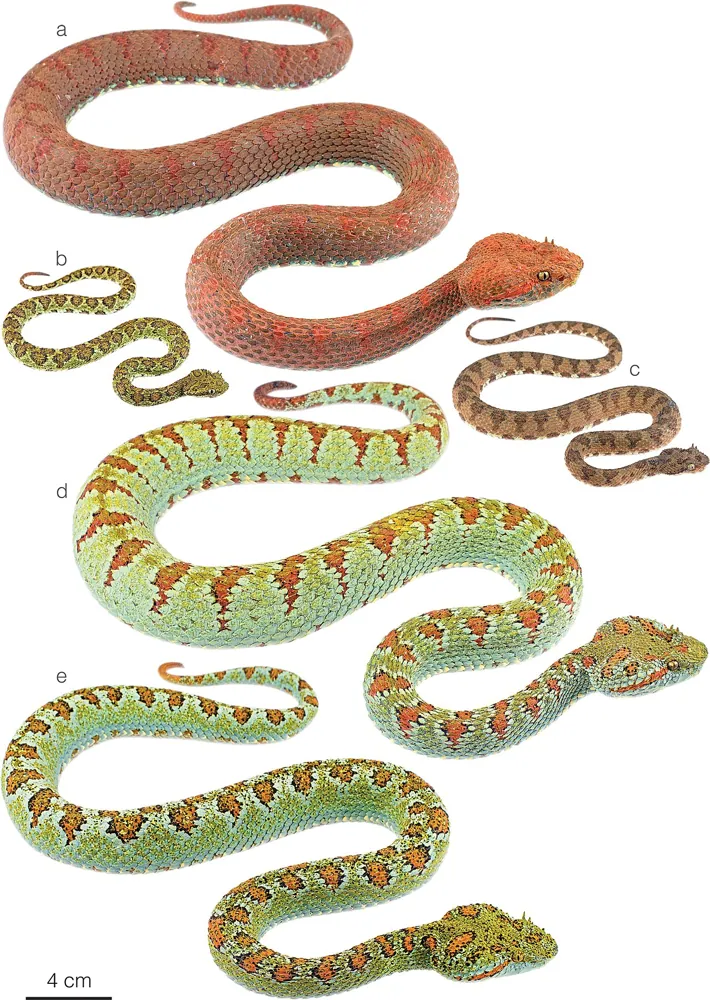
 Ni ngay ko xàmmee
- Usually bright green or moss-green, though it can also be bluish-green, reddish-brown or reddish-maroon.1
- Irregular dark blotches run along the back, and these sometimes join to form crossbands.1
- The belly is light in colour.1
- The head has dark stripes and prominent scales above the eyes, which give it the name eyelash-pitviper.1
- Usually 50–60 cm long including the tail, and can reach 80 cm.1
Kàttanu daŋar
Daŋar bi dafay génn ci bëñam yi su màttee.
Lan la daŋar biy sóob di def?
Its venom has a potent haemorrhagic action, which damages blood vessels and causes bleeding. It also has moderate myotoxicity, which destroys muscle tissue, and a very weak procoagulant effect, which can slightly speed up clotting.1
Ni mu lore nit ñi?
Musiba ci nit: Lu bonMàtt laaj na doktoor. Ñi ciy dee dañoo néew lool. Xibaar bu baax: doktoor yi am nañu garab (sérum antivenimeux) walla ab paj ngir lii.1
 Su màttee
- Def ba nit ki bañ a yëngu te dal, yemale cër bi ñu màtt ak kawewaayu xol bi, dindi jaaro yi ak lu xat lépp, te yóbbu ko lopitaan ci gaaw.
Saa su nekk, woo jëkk sa nimerob urgence (112, 000, 911). Lii ay ndigal yu yaatu ci ndimbal yu jëkk la, du ndigalu doktoor. Li war a xam ci ndimbal yu jëkk
 Sàmmal sa bopp
- Bul laal mukk, bul jàpp, bul sonal ab rab bu àll, doonte bu ndaw la, te doonte dafa mel ni dafa nelaw walla dafa dee.
- May ko bérab. Su nga ko gisee, dalal, dellu ginnaaw ndànk-ndànk te bàyyi ko mu dem yoonam.
- Su benn màttee la: dalal, bul yëngu, woo sa nimerob urgence (112, 000, 911) walla dem lopitaan ci gaaw. Bul fàtte ni mu meloon, ab nataal dina dimbali.
Du la wut. Dafay jëfandikoo daŋaram ngir jàpp lu muy lekk walla ngir aar boppam, te nëbbu moo ko gën a neex. Yeneen ci ni ngay sàmme sa bopp
Ni mu réye?
Ni mu guddoo?
 guddu na ni 1,5 muusu kër, bakkan ba geen
 guddu na ni 4 banaana yu ñu toftale
 mën na daw 100 meetar ci 110 segond (nit ki gën a gaaw soxla na 9,6)
Blotched palm pitviper ni mu réye ci wetu YOW?
Ay waññ rekk ci sa navigateur. Dara du denc te dara du yónnee fenn.
Ni mu gaawe?


Xibaar
Unlike most other Bothriechis species, it spends more time on the ground, and it may rest on the ground or at the base of trees and shrubs during the day.1
Its venom has an estimated LD50 of 6.04 mg/kg. LD50 is the dose that is expected to kill half of a test group, so a lower number means a more toxic venom.1
An antivenom made in horses, using venoms from Bothrops asper, Crotalus simus and another snake species, has been reported to neutralise its venom in tests.1
Females are longer and thicker than males, and this is the only difference between the sexes that has been noted.1
Fa xibaar yi jóge
- Bothriechis supraciliaris (Wikipedia (CC BY-SA 4.0))
- Bothriechis supraciliaris (iNaturalist): tur ak ni ñu leen séddale.
- Venom Wiki: tolluwaayu musiba bi, réyaay bu yem bi ak xalaatu gaawaay bi, nun ñoo leen defar. Seetal ni nu leen waññe: Ni nuy natte musiba.
Xibaar bu nekk ci xët wii am na ab nimero buy won fa mu jóge. Su nu juumee, baal nu, nun ay nit ñu bëgg rab lanu, du ab jurnaalu xam-xam. Wax nu ko ci [email protected] te dinanu ko jubbanti.
 Jiit bi dafa xiif! Venom Wiki ab liggéeyu kenn la: amul pay, amul piblisite te amul traceur. Ab may bu tuuti dafay dimbali ngir mu des ci internet.Leel jiit bi
 Terciopelo
 Eyelash viper
 Cottonmouth
 Eastern copperhead
 Cantil
 Central American bushmaster
 Eastern coral snake
 Eastern diamondback rattlesnake
 Timber rattlesnake
 Western diamondback rattlesnake
 Arizona bark scorpion
 Brown recluse