
 Afrig
Afrig Asi
Asi Tugal
Tugal Amerig gu Bëj-saalum
 Ostarali ak Oseyani
 Antarktig
 Mbàmbulaanu Pasifik
 Mbàmbulaanu Atlantig
 Mbàmbulaanu End
 Mbàmbulaanu Arktik
 Géeju Mediteraane
 Géej gu Xonq
 Géeju Karayib
 Géeju Koraay
 Géeju Siin gu Bëj-saalum
 Géeju Filipin
 Géeju Andaman
 Géeju Bëj-gànnaar
 Géeju Timor ak Arafura
 Golfu Bengal
 Golfu Kaliforni
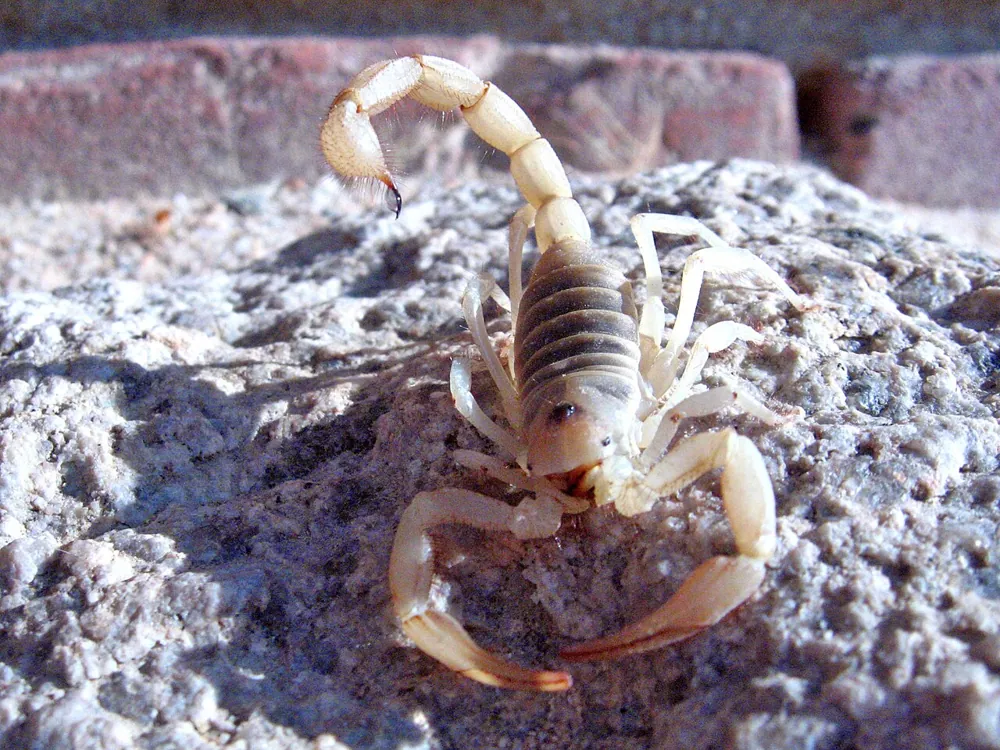
Giant desert hairy scorpion
 Dafay jam
The giant desert hairy scorpion is the largest scorpion in North America. It lives in the hot deserts of the southwest United States and northwest Mexico. Its sting is painful, but its venom is not strong enough to be fatal.1


 Ni ngay ko xàmmee
- Usually tan to olive-green, with a darker back and yellow pedipalps, legs and tail1
- Body covered in brown hairs, which give it its common name1
- Crab-like pincers1
- Length of 10 to 18 cm, with an average of 15 cm1
- Females have wider, stockier bodies; males have larger pincers1
Ñu ngi koy faral di jaxasoo ak: A similar species is Hadrurus spadix. Hadrurus is a genus of large hairy scorpions found in the United States.1
Kàttanu daŋar
Daŋar bi dafay génn ci ab dag buy jam.
Lan la daŋar biy sóob di def?
Its venom is not very potent, but the sting is commonly compared in pain to a honeybee sting. The venom is used to immobilise prey. Allergic reactions are uncommon, but they can cause difficulty breathing, excessive swelling and prolonged pain.1
Ni mu lore nit ñi?
Musiba ci nit: WoyofNi jamu yamb walla lu ko yées. Lu jege, amul lor ci nit.Its venom is not potent enough to be fatal. Most stings are compared to a honeybee sting in pain. Serious allergic reactions are uncommon but possible.1
Lan lay def bu tiitee?
When provoked, it is active and aggressive, and it stings more often when it senses a predator such as a Norway rat by smell.1
 Su jamee
- Sedalal fa mu jam ak mbuusu galaas, te def ba nit ki bañ a yëngu. Wutal ndimbal doktoor ci gaaw, rawatina ngir xale yi: am na ay jiit yuy rey xale.
Saa su nekk, woo jëkk sa nimerob urgence (112, 000, 911). Lii ay ndigal yu yaatu ci ndimbal yu jëkk la, du ndigalu doktoor. Li war a xam ci ndimbal yu jëkk
 Sàmmal sa bopp
- Bul laal mukk, bul jàpp, bul sonal ab rab bu àll, doonte bu ndaw la, te doonte dafa mel ni dafa nelaw walla dafa dee.
- May ko bérab. Su nga ko gisee, dalal, dellu ginnaaw ndànk-ndànk te bàyyi ko mu dem yoonam.
- Su benn jamee la: dalal, bul yëngu, woo sa nimerob urgence (112, 000, 911) walla dem lopitaan ci gaaw. Bul fàtte ni mu meloon, ab nataal dina dimbali.
Du la wut. Dafay jëfandikoo daŋaram ngir jàpp lu muy lekk walla ngir aar boppam, te nëbbu moo ko gën a neex. Yeneen ci ni ngay sàmme sa bopp
Ni mu réye?
Ni mu guddoo?
Ni mu diise?

 guddu na ni 6 bloku tabax yu ñu toftale
 woyof ba doo ko yëg ci sa loxo
 mën na daw 100 meetar ci 140 segond (nit ki gën a gaaw soxla na 9,6)
Giant desert hairy scorpion ni mu réye ci wetu YOW?
Ay waññ rekk ci sa navigateur. Dara du denc te dara du yónnee fenn.
Ni mu gaawe?


Xibaar
Small snakes may make up to 10% of its diet, according to field observations.1
Its blood-like fluid, called hemolymph, can kill some bacteria within 1 to 2 minutes in favourable conditions, according to a 2021 study.1
It is the largest scorpion in North America.1
It digs deep burrows, up to 2.5 m long, and comes out at night to hunt and find mates.1
It can sense vibrations in the soil through its brown hairs.1
Tasukatu léeb
Xalaat bu juum: Big scorpions have dangerous venom.
Dëgg: Although this scorpion is big, its venom is not very potent and is not fatal.1
Fa xibaar yi jóge
- Hadrurus arizonensis (Wikipedia (CC BY-SA 4.0))
- Hadrurus arizonensis (iNaturalist): tur ak ni ñu leen séddale.
- Venom Wiki: tolluwaayu musiba bi, réyaay bu yem bi ak xalaatu gaawaay bi, nun ñoo leen defar. Seetal ni nu leen waññe: Ni nuy natte musiba.
Xibaar bu nekk ci xët wii am na ab nimero buy won fa mu jóge. Su nu juumee, baal nu, nun ay nit ñu bëgg rab lanu, du ab jurnaalu xam-xam. Wax nu ko ci [email protected] te dinanu ko jubbanti.
 Jiit bi dafa xiif! Venom Wiki ab liggéeyu kenn la: amul pay, amul piblisite te amul traceur. Ab may bu tuuti dafay dimbali ngir mu des ci internet.Leel jiit bi
 Arizona bark scorpion
 Cuban blue scorpion
 Striped bark scorpion
 Colima scorpion
 Durango scorpion
 Mexican bark scorpion
 Terciopelo
 Eastern coral snake
 Eastern diamondback rattlesnake
 Eyelash viper
 Timber rattlesnake
 Western diamondback rattlesnake