
 I-Afrika
 I-Asia
 I-Yurophu
 INingizimu Melika
 I-Australia ne-Oceania
 I-Antarctica
 ULwandlekazi iPacific
 ULwandlekazi i-Atlantic
 ULwandlekazi i-India
 ULwandlekazi i-Arctic
 Ulwandle iMediterranean
 Ulwandle Olubomvu
 Ulwandle iCaribbean
 Ulwandle iCoral
 Ulwandle lwaseNingizimu China
 Ulwandle lwasePhilippines
 Ulwandle i-Andaman
 Ulwandle i-North Sea
 Ulwandle lwaseTimor ne-Arafura
 Ichweba laseBengal
 Ichweba laseCalifornia
Banded sea urchin
 Ameva anobuthi
The banded sea urchin is a spiny sea animal that lives on tropical reefs and in lagoons across the Indo-Pacific. It is active at night and hides in cracks or under rocks during the day. Its thin spines can deliver a sting, although the sting is not dangerous.1
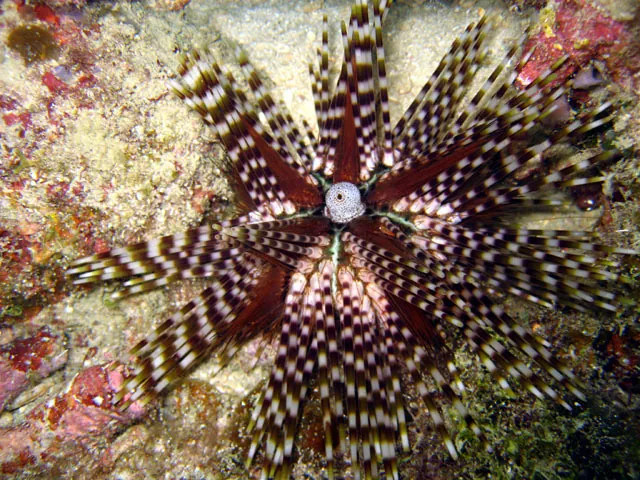
 Indlela yokusibona
- It has a slightly oval shell (test) about 5 cm across.1
- It has two kinds of spines: short, slender spines that run from yellow to dark, and longer, thicker spines that are often banded with light and dark colour.1
- The longer spines reach 10 to 15 cm and can be blunt and hollow.1
- Five bare zones in a star pattern show on the middle of the shell, and these can look blue.1
Ivamise ukudidaniswa ne: Dark forms can look like Diadema setosum or Diadema savignyi. Diadema savignyi is bigger, more uniformly black, and has five white spots on top of its shell and an orange ring around its anus. The most common mix-up is Echinothrix diadema, which can have banded spines when young. Echinothrix diadema has a very small, all-black anal papilla and blue-sheened spines, and its spines do not crush easily, unlike the spines of the banded sea urchin.1
Amandla obuthi
Ameva abukhali aphethe ubuthi. Ukusinyathela noma ukusibamba kubuhlungu.
Ubuthi baso benzani?
The thinner, short spines are venomous, meaning they deliver venom through a sting. The sting is nasty, but the venom is not dangerous.1
Siyingozi kangakanani ebantwini?
Ingozi ebantwini: KubuhlunguKungaba buhlungu ngempela, kodwa cishe akukaze kube kubi kakhulu.The thinner spines are venomous but not dangerous.1
 Uma ameva aso ekugwaza
- Faka inxeba emanzini ashisayo, ashisa ngendlela umuntu angakwazi ukuyibekezelela ngaphandle kokusha, bese uthola usizo lwezokwelapha ukuze kukhishwe ameva. Ungawamambi ngokwakho.
Njalo shayela kuqala inombolo yezimo eziphuthumayo (112, 000, 911). Lokhu kuyiseluleko sosizo lokuqala esijwayelekile, akusona iseluleko sezokwelapha. Izisekelo zosizo lokuqala
 Hlala uphephile
- Ungalokothi uthinte, ubambe noma ugcone isilwane sasendle, ngisho noma sincane, futhi ngisho noma sibukeka silele noma sifile.
- Sinike isikhala. Uma uhlangana naso, hlala uzolile, uhlehle kancane bese usiyeka sihambe ngendlela yaso.
- Uma ameva aso ekugwaza: hlala uzolile, ungashukumi, shayela inombolo yezimo eziphuthumayo (112, 000, 911) noma uye esibhedlela ngokushesha. Khumbula ukuthi besibukeka kanjani, isithombe siyasiza.
Asikuzingeli wena. Sisebenzisa ubuthi baso ukuze sibambe ukudla noma ukuzivikela, futhi singancamela ukucasha. Okwengeziwe mayelana nokuhlala uphephile
Kuphi emhlabeni?
Sikhulu kangakanani?
Side kangakanani?
 side njengezitini zamathoyizi ezingu-5 ezilandelanayo
 sihamba kancane kunomnenke wasengadini
Banded sea urchin mkhulu kangakanani uma uqhathanisa NAWE?
Yizibalo nje kusiphequluli sakho. Akukho okulondolozwayo noma okuthunyelwa ndawo.
Sishesha kangakanani?

Amaqiniso
Its anal papilla is large and whitish with black and white dots, and a ring of visual receptors around it gives it basic vision.1
Young cardinal fish from the family Apogonidae often hide among the spines for protection.1
In Hawaii, this sea urchin often carries a symbiotic crab, Echinoecus pentagonus, that lives with it.1
It is active at night and spends the day hidden in crevices or under rocks.1
Okongoti bobuthi
- Igama lesayensi
- Echinothrix calamaris
- Iqembu
- Izinkalankala zasolwandle ezinameva, izinkanyezi zasolwandle nezikelemu
- Umndeni
- Diadematidae2
- Ukuhleleka
- Diadematoida
- Amazwekazi
- ULwandlekazi i-India, ULwandlekazi iPacific, Ulwandle Olubomvu, Ulwandle iCoral, Ulwandle lwasePhilippines, Ulwandle lwaseTimor ne-Arafura, Ichweba laseBengal, Izilwandlekazi
- Ingozi ebantwini
- 2 / 5: Kubuhlungu3
Lapho amaqiniso evela khona
- Echinothrix calamaris (Wikipedia (CC BY-SA 4.0))
- Echinothrix calamaris (iNaturalist): amagama nokuhlelwa ngezigaba.
- Venom Wiki: izinga lengozi, usayizi ojwayelekile nesiqagela sejubane kungokwethu. Bona ukuthi sikubala kanjani: Indlela esilinganisa ngayo ingozi.
Iqiniso ngalinye kuleli khasi linenombolo ekhomba umthombo walo. Uma senze iphutha, uxolo, singabathandi bezilwane, hhayi iphephabhuku lesayensi. Sitshele ku-[email protected] futhi sizolilungisa.
 Ufezela ulambile! I-Venom Wiki iwumsebenzi womuntu oyedwa: imahhala, ayinazo izikhangiso noma izilandeli. Isipho esincane sisiza ukuyigcina ku-inthanethi.Phakela ufezela
Okunye okuvela eqenjini elifanayo: Izinkalankala zasolwandle ezinameva, izinkanyezi zasolwandle nezikelemu
 Crown-of-thorns starfishIzinkalankala zasolwandle ezinameva, izinkanyezi zasolwandle nezikelemuKudinga udokotelaUngathinti
 Flower urchinIzinkalankala zasolwandle ezinameva, izinkanyezi zasolwandle nezikelemuKungabulala
 Fire urchinIzinkalankala zasolwandle ezinameva, izinkanyezi zasolwandle nezikelemuKudinga udokotelaUngathinti
 Bearded firewormIzinkalankala zasolwandle ezinameva, izinkanyezi zasolwandle nezikelemuKubuhlungu njeUngathinti
 Black long-spined urchinIzinkalankala zasolwandle ezinameva, izinkanyezi zasolwandle nezikelemuKubuhlungu njeUngathinti
 BloodwormIzinkalankala zasolwandle ezinameva, izinkanyezi zasolwandle nezikelemuKubuhlungu nje
Futhi ihlala: ULwandlekazi i-India
 Australian box jellyfishAma-jellyfish nezinye izilwane zasolwandle ezihlabayoKuyabulalaUngathinti
 Geography coneIminenke ye-cone nezingwaneKuyabulala
 Greater blue-ringed octopusIminenke ye-cone nezingwaneKuyabulala
 Southern blue-ringed octopusIminenke ye-cone nezingwaneKuyabulala
 Hawksbill sea turtleEzinye izilwane ezinoshevuKungabulala
 Irukandji jellyfishAma-jellyfish nezinye izilwane zasolwandle ezihlabayoKungabulalaUngathinti