
 Afrika
 Asië
Asië Europa
 Suid-Amerika
 Australië & Oseanië
 Antarktika
 Stille Oseaan
 Atlantiese Oseaan
 Indiese Oseaan
 Arktiese Oseaan
 Middellandse See
 Rooi See
 Karibiese See
 Koraalsee
 Suid-Chinese See
 Filippynse See
 Andamansee
 Noordsee
 Timorsee & Arafurasee
 Baai van Bengale
 Golf van Kalifornië
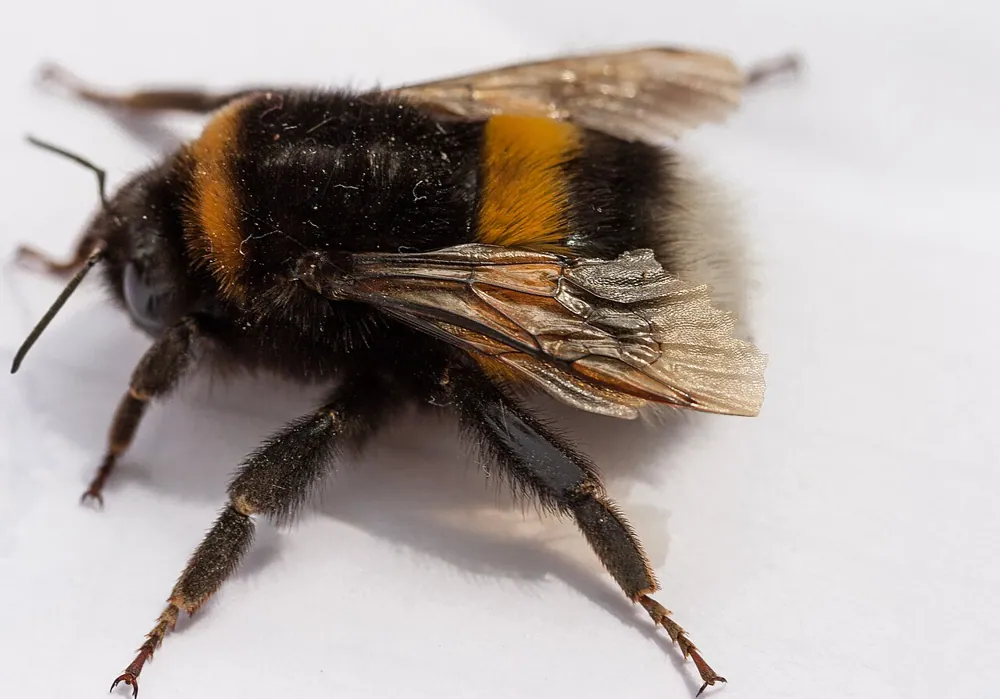
Buff-tailed bumblebee
 Steke
StekeThe buff-tailed bumblebee is a fuzzy, striped bee and one of the most common bumblebees in Europe. It lives in colonies and is one of the main bees used to pollinate greenhouse crops. It can also be found in many places outside its home range, where it has spread after escaping from greenhouses.1
 Hoe om dit te herken
- Workers have white-ended abdomens.1
- The queen has a buff-white abdomen tip, which gives the bee its name.1
- Yellowish bands that are darker than those of the white-tailed bumblebee when the two are compared side by side.1
- Queens are 20 to 22 mm long, males 14 to 16 mm and workers 11 to 17 mm.1
Word dikwels verwar met: The white-tailed bumblebee (Bombus lucorum), a close relative, looks almost identical. When the two are compared side by side, the yellowish bands of the buff-tailed bumblebee look darker.1
Gifkrag
Gif kom deur 'n angel uit.
Hoe gevaarlik is dit vir mense?
Gevaar vir mense: LigSoos 'n bysteek of minder. Basies onskadelik vir mense.Wat doen dit as dit bang is?
Workers defend the colony.1
 As dit steek
- Skraap 'n byangel uit en koel die plek af.
- As die persoon sukkel om asem te haal, die gesig of keel swel, of hy voel flou, is dit 'n allergiese noodgeval: bel jou noodnommer en gebruik sy adrenalienpen (outo-inspuiter) as hy een het.
Bel altyd eers jou noodnommer (112, 000, 911). Dit is algemene noodhulpraad, nie mediese advies nie. Noodhulp-basiese beginsels
 Bly veilig
- Moet nooit aan 'n wilde dier raak, dit vang of terg nie, selfs nie 'n kleintjie nie, en selfs nie as dit lyk of dit slaap of dood is nie.
- Gee dit spasie. As jy een raakloop, bly kalm, stap stadig terug en laat dit sy eie pad gaan.
- As een jou steek: bly kalm, bly stil, bel jou noodnommer (112, 000, 911) of kom vinnig by 'n hospitaal uit. Onthou hoe dit gelyk het, 'n foto help.
Dit is nie uit om jou te kry nie. Dit gebruik sy gif om kos te vang of om homself te beskerm, en kruip baie eerder weg. Meer oor veilig bly
Waar in die wêreld?
Hoe groot is dit?
Hoe lank is dit?
Hoe swaar is dit?
 omtrent so lank soos 'n skuifspeld
 so lig dat jy dit nie op jou hand sal voel nie
 kan in 14 sekondes oor 'n hele sokkerveld vlieg
Hoe groot is Buff-tailed bumblebee in vergelyking met JOU?
Net wiskunde in jou blaaier. Niks word gestoor of enige plek heen gestuur nie.
Hoe vinnig is dit?


Feite
Worker bees vary unusually widely in size, with thorax lengths from 2.3 to 6.9 mm. This is unusual among bees.1
It has escaped from captivity and is now considered an invasive species in places such as Japan, Chile, Argentina and Tasmania.1
It is one of the main species used for greenhouse pollination, which is why it is found in many countries where it is not native.1
The queen usually mates with only one male, unlike many social insects.1
The colony works as a team. It has three social castes, with the queen laying eggs, workers foraging and defending the nest, and males leaving to find mates.1
Waar die feite vandaan kom
- Bombus terrestris (Wikipedia (CC BY-SA 4.0))
- Bombus terrestris (iNaturalist): name en klassifikasie.
- Venom Wiki: die gevaarvlak, die tipiese grootte en die spoedskatting is ons eie. Kyk hoe ons dit uitwerk: Hoe ons gevaar gradeer.
Elke feit op hierdie bladsy het 'n nommer wat na sy bron wys. As ons iets verkeerd het, jammer, ons is dierfanatici, nie 'n wetenskaplike joernaal nie. Laat weet ons by [email protected] en ons maak dit reg.
 Die skerpioen is honger! Venom Wiki is 'n eenmanprojek: gratis, sonder advertensies en sonder spoorsnyers. 'n Klein fooitjie help om dit aanlyn te hou.Voer die skerpioen
Meer uit dieselfde groep: Bye, wespe & perdebye
 Asian giant hornet
 Common wasp
 European hornet
 Western honey bee
 Giant honey bee
 Asian hornet
Leef ook in: Europa
 Common European adderAdders & vipersMoet 'n dokter sien
 Spanish flyAnder diere wat giftig is om aan te raak of te eetMoet 'n dokter sienMoenie aanraak nie
 Fire salamanderGifpaddas, skurwepaddas & salamandersMaak net seerMoenie aanraak nie
 Blunt-nosed viperAdders & vipersKan doodmaak
 Nose-horned viperAdders & vipersKan doodmaak
 Ottoman viperAdders & vipersKan doodmaak