
 Afrika
 Asië
Asië Europa
 Suid-Amerika
 Australië & Oseanië
 Antarktika
 Stille Oseaan
 Atlantiese Oseaan
 Indiese Oseaan
 Arktiese Oseaan
 Middellandse See
 Rooi See
 Karibiese See
 Koraalsee
 Suid-Chinese See
 Filippynse See
 Andamansee
 Noordsee
 Timorsee & Arafurasee
 Baai van Bengale
 Golf van Kalifornië
Port Jackson shark
 Giftige stekels
The Port Jackson shark is a bottom-dwelling shark that lives in the cool coastal waters of southern Australia. It is active mostly at night, when it hunts shellfish, sea urchins and fish. It is harmless to people, though its spines have a reputation that is not confirmed.1



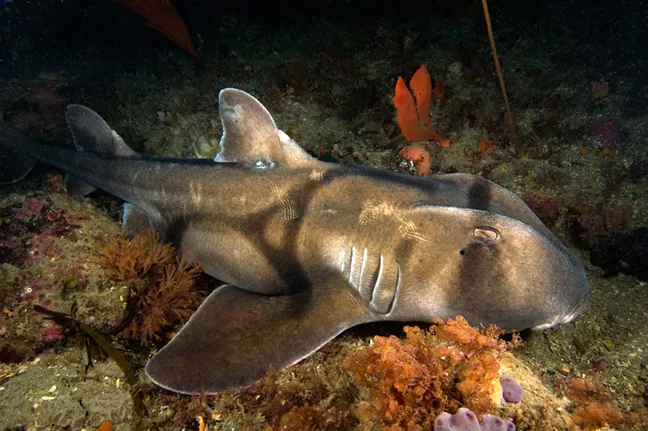
 Hoe om dit te herken
- Grey-brown body with dark brown, harness-like bands, including one that runs across the eyes.1
- Large, blunt, flat head with raised ridges above the eyes.1
- A spine at the front edge of each of its two dorsal fins, which are nearly equal in size.1
- Front teeth are small and pointed, while back teeth are flat and blunt.1
- Adults can grow up to 1.65 metres long.1
Gifkrag
Skerp stekels dra die gif. Dit maak seer as jy daarop trap of dit gryp.
Hoe gevaarlik is dit vir mense?
Gevaar vir mense: LigSoos 'n bysteek of minder. Basies onskadelik vir mense.The shark poses no danger to humans. In October 2011, a man was bitten at Elwood Beach near Melbourne, but the bite did not pierce the skin and he was able to swim away while the shark was still attached to his calf.1
 As sy stekels jou steek
- Sit die wond in warm water, so warm as wat die persoon kan verdra sonder om te brand (toets dit met jou eie hand), vir 30 tot 90 minute. Kry mediese hulp, veral vir klipvisse en pylsterte.
Bel altyd eers jou noodnommer (112, 000, 911). Dit is algemene noodhulpraad, nie mediese advies nie. Noodhulp-basiese beginsels
 Bly veilig
- Moet nooit aan 'n wilde dier raak, dit vang of terg nie, selfs nie 'n kleintjie nie, en selfs nie as dit lyk of dit slaap of dood is nie.
- Gee dit spasie. As jy een raakloop, bly kalm, stap stadig terug en laat dit sy eie pad gaan.
- As sy stekels jou steek: bly kalm, bly stil, bel jou noodnommer (112, 000, 911) of kom vinnig by 'n hospitaal uit. Onthou hoe dit gelyk het, 'n foto help.
Dit is nie uit om jou te kry nie. Dit gebruik sy gif om kos te vang of om homself te beskerm, en kruip baie eerder weg. Meer oor veilig bly
Waar in die wêreld?
Hoe groot is dit?
Hoe lank is dit?
 so lank soos 3 huiskatte neus tot stert
 so lank soos 9 piesangs punt aan punt
 kan die lengte van 'n groot swembad (50 m) in 8,2 sekondes swem
Hoe groot is Port Jackson shark in vergelyking met JOU?
Net wiskunde in jou blaaier. Niks word gestoor of enige plek heen gestuur nie.
Hoe vinnig is dit?


Feite
It can turn its stomach inside out and spit out unwanted contents.1
It can breathe while lying still on the bottom. It pumps water in through its first gill slit and out through the others, so it does not need to swim with its mouth open.1
Juveniles have individual personalities. Some are bolder than others when exploring new places, and they respond differently to stress.1
Juveniles can learn to link bubbles, lights or sounds with food, and they can learn by watching other sharks.1
Adults are often seen resting together in caves, but juveniles do not seem to be social.1
Each year it migrates south in summer and returns north to breed in winter.1
Mite-breker
Mite: Port Jackson sharks are dangerous to people.
Waarheid: The shark poses no danger to humans. Its spines are rumoured to be venomous, but this has not been confirmed.1
Vir gifkenners
- Wetenskaplike naam
- Heterodontus portusjacksoni
- Groep
- Giftige visse
- Familie
- Heterodontidae2
- Orde
- Heterodontiformes
- Kontinente
- Indiese Oseaan, Suidelike Oseaan, Antarktika, Die oseane
- Babas
- It lays eggs rather than giving birth to live young. From late August to mid-November, the female lays pairs of eggs every 8 to 17 days, up to eight pairs in total, and the eggs take 10 to 11 months to hatch.1
- Hoe dit in die natuur gaan
- Least Concern (IUCN Red List)1
- Gevaar vir mense
- 1 / 5: Lig3
Waar die feite vandaan kom
- Port Jackson shark (Wikipedia (CC BY-SA 4.0))
- Heterodontus portusjacksoni (iNaturalist): name en klassifikasie.
- Venom Wiki: die gevaarvlak, die tipiese grootte en die spoedskatting is ons eie. Kyk hoe ons dit uitwerk: Hoe ons gevaar gradeer.
Elke feit op hierdie bladsy het 'n nommer wat na sy bron wys. As ons iets verkeerd het, jammer, ons is dierfanatici, nie 'n wetenskaplike joernaal nie. Laat weet ons by [email protected] en ons maak dit reg.
 Die skerpioen is honger! Venom Wiki is 'n eenmanprojek: gratis, sonder advertensies en sonder spoorsnyers. 'n Klein fooitjie help om dit aanlyn te hou.Voer die skerpioen
Meer uit dieselfde groep: Giftige visse
 Reef stonefishGiftige visseKan doodmaakMoenie aanraak nie
 Red lionfishGiftige visseMoet 'n dokter sienMoenie aanraak nie
 Estuarine stonefishGiftige visseKan doodmaakMoenie aanraak nie
 Short-tail stingrayGiftige visseKan doodmaak
 Striped eel catfishGiftige visseKan doodmaakMoenie aanraak nie
 Bluespotted ribbontail rayGiftige visseMoet 'n dokter sien
Leef ook in: Indiese Oseaan
 Australian box jellyfishJellievisse & see-steekdiereDodelikMoenie aanraak nie
 Geography coneKeëlslakke & seekatteDodelik
 Greater blue-ringed octopusKeëlslakke & seekatteDodelik
 Southern blue-ringed octopusKeëlslakke & seekatteDodelik
 Hawksbill sea turtleAnder diere wat giftig is om aan te raak of te eetKan doodmaak
 Irukandji jellyfishJellievisse & see-steekdiereKan doodmaakMoenie aanraak nie