
 Afrika
 Asië
Asië Europa
 Suid-Amerika
 Australië & Oseanië
 Antarktika
 Stille Oseaan
 Atlantiese Oseaan
 Indiese Oseaan
 Arktiese Oseaan
 Middellandse See
 Rooi See
 Karibiese See
 Koraalsee
 Suid-Chinese See
 Filippynse See
 Andamansee
 Noordsee
 Timorsee & Arafurasee
 Baai van Bengale
 Golf van Kalifornië
Radiant sea urchin
 Giftige stekels
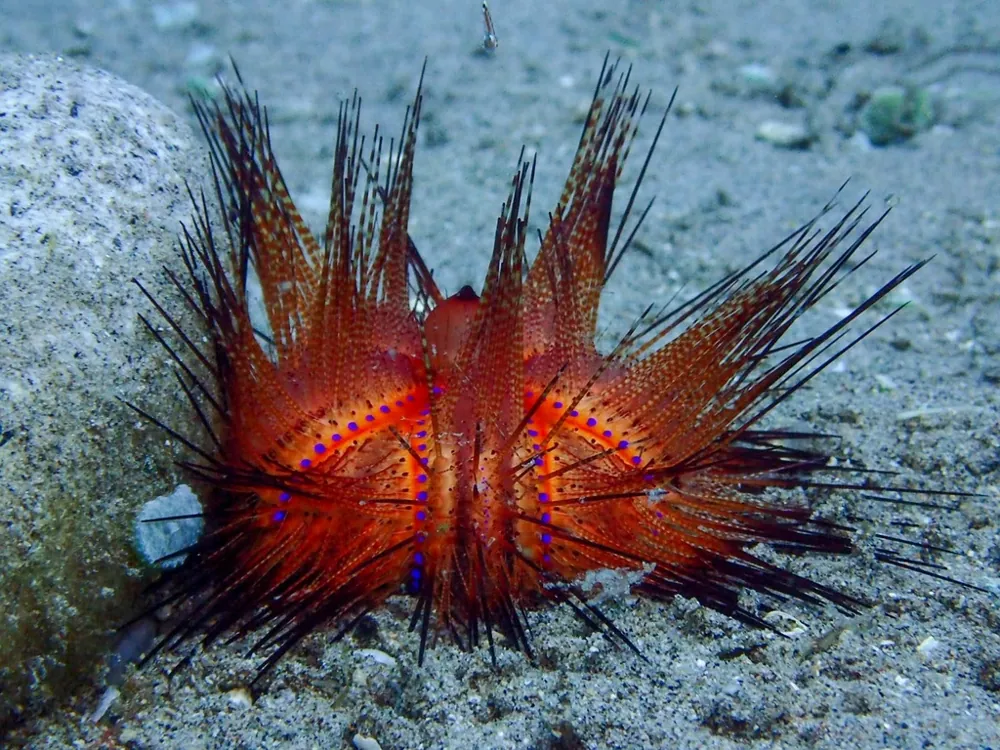
The radiant sea urchin is a large, colourful sea urchin with long, spiky spines. It lives in warm, shallow seas across the Indo-Pacific, from the African coast to Hawaii and Australia. Its spines are venomous, so it is one to admire from a distance.1

 Hoe om dit te herken
- A large urchin, with a body (test) up to 20 cm across.1
- Long, hollow spines up to 4 cm, in five vertical clusters.1
- Between the clusters are bare, V-shaped red areas with lines of iridescent blue dots.1
- The rest of the body and spines range from reddish brown to purple, dark brown or nearly black.1
- Juveniles have spines with banding across them, and this sometimes stays into adulthood.1
Word dikwels verwar met: It is often called the false fire urchin to tell it apart from the true fire urchin, Asthenosoma varium.1
Gifkrag
Skerp stekels dra die gif. Dit maak seer as jy daarop trap of dit gryp.
Wat doen sy gif as dit byt of steek?
Its spines are venomous and can cause painful wounds. The spines are long and hollow, and the shorter of the two kinds are the venomous ones.1
Hoe gevaarlik is dit vir mense?
Gevaar vir mense: PynlikDit kan regtig seermaak, maar dit is amper nooit ernstig nie.It is not deadly to humans, but its spines can cause painful wounds. Because it is large and brightly coloured, divers can usually see it, so injuries from stepping on one are fairly rare. On the 'Kings of Pain' pain index it scores 12 out of 30.1
Wat doen dit as dit bang is?
It is sensitive to light and can angle its spines towards an approaching threat.1
 As sy stekels jou steek
- Sit die wond in warm water, so warm as wat die persoon kan verdra sonder om te brand, en kry mediese hulp om die stekels te verwyder. Moenie self daarna grawe nie.
Bel altyd eers jou noodnommer (112, 000, 911). Dit is algemene noodhulpraad, nie mediese advies nie. Noodhulp-basiese beginsels
 Bly veilig
- Moet nooit aan 'n wilde dier raak, dit vang of terg nie, selfs nie 'n kleintjie nie, en selfs nie as dit lyk of dit slaap of dood is nie.
- Gee dit spasie. As jy een raakloop, bly kalm, stap stadig terug en laat dit sy eie pad gaan.
- As sy stekels jou steek: bly kalm, bly stil, bel jou noodnommer (112, 000, 911) of kom vinnig by 'n hospitaal uit. Onthou hoe dit gelyk het, 'n foto help.
Dit is nie uit om jou te kry nie. Dit gebruik sy gif om kos te vang of om homself te beskerm, en kruip baie eerder weg. Meer oor veilig bly
Waar in die wêreld?
Hoe groot is dit?
Hoe lank is dit?
 so lank soos 6 speelgoed-boublokke in 'n ry
 stadiger as 'n tuinslak
Hoe groot is Radiant sea urchin in vergelyking met JOU?
Net wiskunde in jou blaaier. Niks word gestoor of enige plek heen gestuur nie.
Hoe vinnig is dit?

Feite
A crab called Dorippe frascone carries the urchin on its back.1
Several shrimps, crabs and small fish live among its spines for shelter.1
Its scientific name refers to a star-shaped pattern around its anus, not to the animal's shape as a whole.1
Its bright colours and size make it a favourite subject for underwater photographers and some expert fish-keepers.1
Its young larvae drift in the ocean as plankton before they settle on the seabed.1
Vir gifkenners
- Wetenskaplike naam
- Astropyga radiata
- Groep
- See-egels, seesterre & wurms
- Familie
- Diadematidae2
- Orde
- Diadematoida
- Kontinente
- Indiese Oseaan, Stille Oseaan, Koraalsee, Filippynse See, Timorsee & Arafurasee, Baai van Bengale, Die oseane
- Babas
- Males and females are separate. Eggs and sperm are released into the water, and the larvae drift as plankton through several stages before settling on the seabed and becoming juveniles.1
- Gevaar vir mense
- 2 / 5: Pynlik3
Waar die feite vandaan kom
- Astropyga radiata (Wikipedia (CC BY-SA 4.0))
- Astropyga radiata (iNaturalist): name en klassifikasie.
- Venom Wiki: die gevaarvlak, die tipiese grootte en die spoedskatting is ons eie. Kyk hoe ons dit uitwerk: Hoe ons gevaar gradeer.
Elke feit op hierdie bladsy het 'n nommer wat na sy bron wys. As ons iets verkeerd het, jammer, ons is dierfanatici, nie 'n wetenskaplike joernaal nie. Laat weet ons by [email protected] en ons maak dit reg.
 Die skerpioen is honger! Venom Wiki is 'n eenmanprojek: gratis, sonder advertensies en sonder spoorsnyers. 'n Klein fooitjie help om dit aanlyn te hou.Voer die skerpioen
Meer uit dieselfde groep: See-egels, seesterre & wurms
 Crown-of-thorns starfishSee-egels, seesterre & wurmsMoet 'n dokter sienMoenie aanraak nie
 Flower urchinSee-egels, seesterre & wurmsKan doodmaak
 Fire urchinSee-egels, seesterre & wurmsMoet 'n dokter sienMoenie aanraak nie
 Bearded firewormSee-egels, seesterre & wurmsMaak net seerMoenie aanraak nie
 Black long-spined urchinSee-egels, seesterre & wurmsMaak net seerMoenie aanraak nie
 BloodwormSee-egels, seesterre & wurmsMaak net seer
Leef ook in: Indiese Oseaan
 Australian box jellyfishJellievisse & see-steekdiereDodelikMoenie aanraak nie
 Geography coneKeëlslakke & seekatteDodelik
 Greater blue-ringed octopusKeëlslakke & seekatteDodelik
 Southern blue-ringed octopusKeëlslakke & seekatteDodelik
 Hawksbill sea turtleAnder diere wat giftig is om aan te raak of te eetKan doodmaak
 Irukandji jellyfishJellievisse & see-steekdiereKan doodmaakMoenie aanraak nie