
 Àfrica
 Àsia
Àsia Europa
 Amèrica del Sud
 Austràlia i Oceania
 Antàrtida
 Oceà Pacífic
 Oceà Atlàntic
 Oceà Índic
 Oceà Àrtic
 Mar Mediterrània
 Mar Roja
 Mar Carib
 Mar del Corall
 Mar de la Xina Meridional
 Mar de les Filipines
 Mar d'Andaman
 Mar del Nord
 Mar de Timor i d'Arafura
 Golf de Bengala
 Golf de Califòrnia
Brown-tail moth
 Pèls urticants
The brown-tail moth is a moth whose caterpillars are covered in tiny irritating hairs. It is native to Europe, neighbouring parts of Asia and the north coast of Africa. Its hairs can cause a very itchy rash, so it matters to anyone who works or plays near trees it feeds on.1

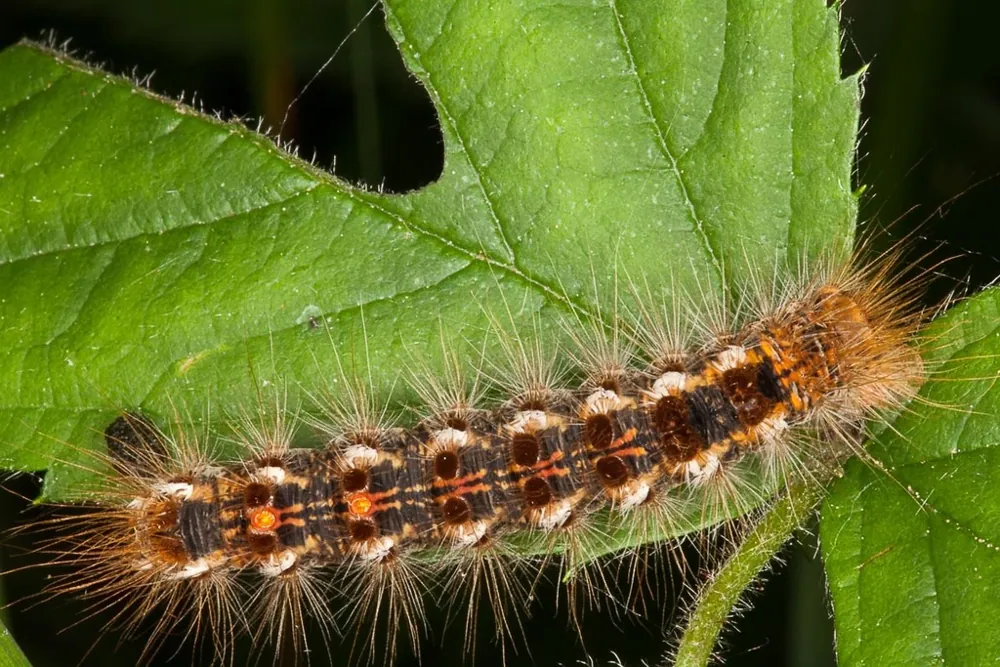
 Com reconèixer-lo
- Adults have pure white upper wings and a hairy white body with a tuft of brown hair at the tip of the tail end.1
- Adults have a wingspan of 36 to 42 millimetres.1
- Caterpillars are very hairy, brown with white markings, and have two prominent red spots toward the tail end.1
- In late autumn and winter, silken tents hang on branch tips, which are a sign that the caterpillars are present.1
Sovint es confon amb: Euproctis similis, also native to Europe, is similar as an adult but the female has a yellow tail tuft. Hyphantria cunea, native to North America, is similar too, but it lacks the coloured tail tuft.1
Poder del verí
Pèls o cerres petitons es trenquen dins la pell i couen.
Què fa el seu verí?
The hairs are not venom injected by a bite or sting. They are toxic and irritating to skin. Barbed hairs lodge in the skin and cause physical irritation, and chemicals in the hairs also irritate it. If inhaled, the hairs can cause breathing difficulties similar to asthma. The toxins stay active for up to three years after the hairs are shed.1
Com de perillós és per a les persones?
Perill per a les persones: DolorósPot fer molt de mal, però gairebé mai no és greu.Contact with the hairs causes a very itchy rash that can last for weeks. Doctors reported rashes worse than poison ivy rash in the early 1900s. Breathing difficulties can occur if the hairs are inhaled.1
Què fa quan té por?
Its hairs protect the caterpillars from predators, and the caterpillars use some hairs in their cocoons.1
 Si toques els seus pèls
- Per als pèls urticants de les erugues: treu-los amb cinta adhesiva i després renta la pell. No freguis.
- Per a les mossegades: renta i refreda. Busca ajuda mèdica si la persona es troba malament o sagna amb facilitat.
Truca sempre primer al número d'emergències (112, 000, 911). Això són pautes generals de primers auxilis, no consells mèdics. Primers auxilis bàsics
 Estigues segur
- No toquis, atrapis ni molestis mai un animal salvatge, encara que sigui petit i encara que sembli adormit o mort.
- Deixa-li espai. Si en trobes un, mantén la calma, recula a poc a poc i deixa que segueixi el seu camí.
- Si toques els seus pèls: mantén la calma, no et moguis, truca al número d'emergències (112, 000, 911) o ves de pressa a un hospital. Recorda com era, una foto ajuda.
No va a per tu. Fa servir el verí per caçar o per defensar-se, i prefereix mil vegades amagar-se. Més sobre com estar segur
Que gran és?
Quant fa de llarg?
 més curt que el teu dit petit
 més lent que un cargol de jardí
Que gran és Brown-tail moth comparat amb TU?
Només càlculs al teu navegador. No es desa ni s'envia res enlloc.
Com de ràpid va?

Dades
The hairs of the caterpillars can cause a rash even when no one touches a caterpillar, because shed hairs can blow in the wind.1
Brown-tail moths were described in outbreaks in Paris, London and Berlin as far back as the 1500s, when they stripped trees of leaves.1
The species spends about nine months of its year as caterpillars, which is unusually long for a moth.1
Caterpillars spend the winter together in silken tents built at branch tips, rather than spreading out.1
A parasitic fly introduced to North America in 1906 to control spongy moths also strongly affected brown-tail moths.1
Desmuntamites
Mite: You can only get the rash by touching the caterpillars.
Veritat: Hairs are shed and can become windblown, and they can be carried indoors on clothing and shoes, so a rash can occur without direct contact with the caterpillars.1
D'on surten les dades
- Brown-tail moth (Wikipedia (CC BY-SA 4.0))
- Euproctis chrysorrhoea (iNaturalist): noms i classificació.
- Venom Wiki: el nivell de perill, la mida típica i la velocitat estimada són nostres. Mira com els calculem: Com valorem el perill.
Cada dada d'aquesta pàgina té un número que porta a la seva font. Si ens hem equivocat en alguna cosa, perdona, som fans dels animals, no una revista científica. Escriu-nos a [email protected] i ho arreglarem.
 L'escorpí té gana! Venom Wiki és un projecte d'una sola persona: gratuït, sense anuncis i sense rastrejadors. Una petita propina ajuda a mantenir-lo en línia.Dona menjar a l'escorpí
Més del mateix grup: Erugues i bestioles
 Oak processionaryErugues i bestiolesNomés fa malNo ho toquis
 Pine processionaryErugues i bestiolesNomés fa malNo ho toquis
 Common bombardier beetleErugues i bestiolesInofensiu
 Asian giant water bugErugues i bestiolesNomés fa mal
 Blue-striped nettle grubErugues i bestiolesNomés fa malNo ho toquis
 Masked hunterErugues i bestiolesNomés fa mal
També viu a: Europa
 Common European adderEscurçons i vibresCal anar al metge
 Spanish flyAltres animals tòxicsCal anar al metgeNo ho toquis
 Common waspAbelles, vespes i vesparronsNomés fa mal
 European hornetAbelles, vespes i vesparronsNomés fa mal
 Fire salamanderGranotes punta de fletxa, gripaus i tritonsNomés fa malNo ho toquis
 Western honey beeAbelles, vespes i vesparronsNomés fa mal