
 Àfrica
 Àsia
Àsia Europa
 Amèrica del Sud
 Austràlia i Oceania
 Antàrtida
 Oceà Pacífic
 Oceà Atlàntic
 Oceà Índic
 Oceà Àrtic
 Mar Mediterrània
 Mar Roja
 Mar Carib
 Mar del Corall
 Mar de la Xina Meridional
 Mar de les Filipines
 Mar d'Andaman
 Mar del Nord
 Mar de Timor i d'Arafura
 Golf de Bengala
 Golf de Califòrnia
Mojave rattlesnake
 Mossegades
The Mojave rattlesnake is a venomous pit viper that lives in the deserts of the southwestern United States and northern Mexico. Its venom is among the most studied of any rattlesnake, and it varies a lot from one population to another. Knowing how to recognise it helps people in its range stay safe.1


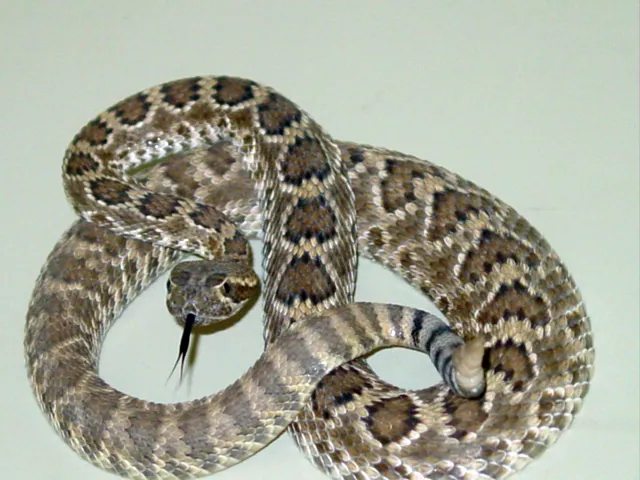
 Com reconèixer-lo
- Has a row of large diamond-shaped blotches along the back, without the dark speckling found on the Western Diamond-backed Rattlesnake.1
- The diamonds usually lack the white edges seen on most Western Diamond-backed Rattlesnakes.1
- The tail has pale and dark rings, and the dark rings are often narrower than the pale ones.1
- The rattle is usually yellow and black, or entirely yellow.1
- Its back colour ranges from green to brown, grey or yellowish, so colour alone is not a reliable guide.1
Sovint es confon amb: It closely resembles the Western Diamond-backed Rattlesnake, which lives in the same areas. The Mojave rattlesnake has no dark speckling on its back, usually lacks white edges on the diamonds, has a facial stripe that bends toward the neck rather than meeting the mouth, and usually has a yellow or bicoloured rattle rather than a black one. No single trait reliably separates the two.1
Poder del verí
El verí surt pels ullals o les dents quan mossega.
Què fa el seu verí?
Its venom comes in two main types. Venom A contains Mojave toxin, a neurotoxic venom that attacks the nerves and can cause delayed respiratory paralysis, meaning the muscles used for breathing fail, with little or no local tissue damage. Venom B has no Mojave toxin and instead contains tissue-destroying enzymes called metalloproteinases.1
Com de perillós és per a les persones?
Perill per a les persones: Molt perillósPot matar una persona que no rep tractament.For decades this snake has been described as one of the deadliest rattlesnakes, and some sources call it the most dangerous snake in the United States. The danger depends on the population, because the neurotoxic venom is not found everywhere in its range. Some animals in between produce a mix of both venom types.1
Què fa quan té por?
It is shy and tends to avoid confrontation, but it will strike and bite vigorously when disturbed, especially if surprised or if there is no nearby vegetation or burrow to escape into.1
 Si mossega
- Mantén la persona quieta i tranquil·la, mantén l'extremitat mossegada a l'altura del cor, treu-li anells i coses que estrenyin i porta-la de pressa a un hospital.
Truca sempre primer al número d'emergències (112, 000, 911). Això són pautes generals de primers auxilis, no consells mèdics. Primers auxilis bàsics
 Estigues segur
- No toquis, atrapis ni molestis mai un animal salvatge, encara que sigui petit i encara que sembli adormit o mort.
- Deixa-li espai. Si en trobes un, mantén la calma, recula a poc a poc i deixa que segueixi el seu camí.
- Si te'n mossega un: mantén la calma, no et moguis, truca al número d'emergències (112, 000, 911) o ves de pressa a un hospital. Recorda com era, una foto ajuda.
No va a per tu. Fa servir el verí per caçar o per defensar-se, i prefereix mil vegades amagar-se. Més sobre com estar segur
Que gran és?
Quant fa de llarg?
 fa de llarg com 2,5 gats de casa del nas a la cua
 fa de llarg com 7 plàtans en fila
 podria recórrer 100 metres en 97 segons (l'humà més ràpid necessita 9,6)
Que gran és Mojave rattlesnake comparat amb TU?
Només càlculs al teu navegador. No es desa ni s'envia res enlloc.
Com de ràpid va?


Dades
Desmuntamites
Mite: Every Mojave rattlesnake bite is extraordinarily deadly.
Veritat: The reputation for deadliness comes mainly from the neurotoxic venom, which is found in most populations but not all. Venom from some populations is non-neurotoxic and mainly destroys tissue.1
Per a experts en verins
- Nom científic
- Crotalus scutulatus
- Grup
- Serps de cascavell
- Família
- Viperidae2
- Ordre
- Squamata
- Continents
- Amèrica del Nord
- Cries
- It bears live young, usually between 2 and 17 (average about eight), from July through September.1
- Com li va a la natura
- Least Concern (IUCN Red List)1
- Perill per a les persones
- 4 / 5: Molt perillós3
D'on surten les dades
- Crotalus scutulatus (Wikipedia (CC BY-SA 4.0))
- Crotalus scutulatus (iNaturalist): noms i classificació.
- Venom Wiki: el nivell de perill, la mida típica i la velocitat estimada són nostres. Mira com els calculem: Com valorem el perill.
Cada dada d'aquesta pàgina té un número que porta a la seva font. Si ens hem equivocat en alguna cosa, perdona, som fans dels animals, no una revista científica. Escriu-nos a [email protected] i ho arreglarem.
 L'escorpí té gana! Venom Wiki és un projecte d'una sola persona: gratuït, sense anuncis i sense rastrejadors. Una petita propina ajuda a mantenir-lo en línia.Dona menjar a l'escorpí
Més del mateix grup: Serps de cascavell
 Eastern diamondback rattlesnakeSerps de cascavellPot matar
 Timber rattlesnakeSerps de cascavellPot matar
 Western diamondback rattlesnakeSerps de cascavellPot matar
 SidewinderSerps de cascavellCal anar al metge
 Aruba rattlesnakeSerps de cascavellCal anar al metge
 Black-tailed rattlesnakeSerps de cascavellCal anar al metge
 Terciopelo
 Eastern coral snake
 Eyelash viper
 Arizona bark scorpion
 Brown recluse
 Cane toad