
 Àfrica
 Àsia
Àsia Europa
 Amèrica del Sud
 Austràlia i Oceania
 Antàrtida
 Oceà Pacífic
 Oceà Atlàntic
 Oceà Índic
 Oceà Àrtic
 Mar Mediterrània
 Mar Roja
 Mar Carib
 Mar del Corall
 Mar de la Xina Meridional
 Mar de les Filipines
 Mar d'Andaman
 Mar del Nord
 Mar de Timor i d'Arafura
 Golf de Bengala
 Golf de Califòrnia
Pumpkin toadlet
 Toxines a la pell
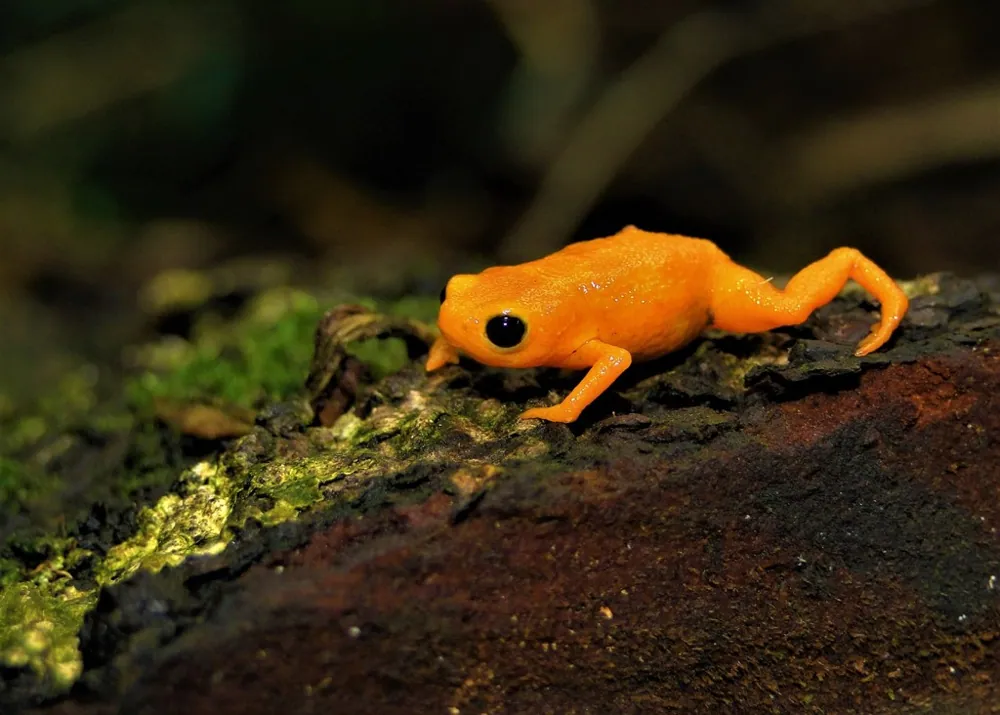
The pumpkin toadlet is a tiny, brightly coloured frog that lives in the leaf litter of the Atlantic rainforests of southeastern Brazil. Adults are bright yellow-orange, a warning sign that their skin and body carry a strong toxin. Scientists have found that the head and back of this frog glow under ultraviolet light.1

 Com reconèixer-lo
- Adults are bright yellow-orange.1
- Newly hatched young are brown and well camouflaged.1
- It is very small, with adults measuring 12.5 to 19.7 mm from snout to vent.1
- Females tend to be larger than males.1
Sovint es confon amb: It is closely related to the red pumpkin toadlet (B. pitanga), which also glows under ultraviolet light and shares its inability to hear its own call.1
Poder tòxic
La seva pell és tòxica. És perillós tocar-lo, llepar-lo o menjar-se'l.
Què fan les seves toxines?
This frog is poisonous rather than venomous, so it does not inject venom. Its main toxin is 11-oxotetrodotoxin, which is extremely rare in animals, even marine ones, and is four to five times more potent than tetrodotoxin. The toxins are found in the skin and ovaries but are mostly concentrated in the liver.1
Com de perillós és per a les persones?
Perill per a les persones: DolorósPot fer molt de mal, però gairebé mai no és greu.Què fa quan té por?
Its bright yellow-orange colour is a warning display (aposematism) that tells predators it is toxic.1
 Si algú l'ha tocat o se l'ha menjat
- Si algú n'ha tocat un: renta-li bé les mans i que no es toqui els ulls ni la boca. Si un nen o una mascota n'ha llepat o menjat un: truca al centre de toxicologia o al número d'emergències.
Truca sempre primer al número d'emergències (112, 000, 911). Això són pautes generals de primers auxilis, no consells mèdics. Primers auxilis bàsics
 Estigues segur
- No toquis, atrapis ni molestis mai un animal salvatge, encara que sigui petit i encara que sembli adormit o mort.
- Deixa-li espai. Si en trobes un, mantén la calma, recula a poc a poc i deixa que segueixi el seu camí.
- Si l'has tocat o te l'has menjat: no et freguis els ulls ni la boca, renta't les mans i busca ajuda mèdica.
No va a per tu. Les seves toxines només hi són perquè ningú no se'l mengi. Més sobre com estar segur
Que gran és?
Quant fa de llarg?
 més curt que el teu dit petit
 podria recórrer 100 metres en 180 segons (l'humà més ràpid necessita 9,6)
Que gran és Pumpkin toadlet comparat amb TU?
Només càlculs al teu navegador. No es desa ni s'envia res enlloc.
Com de ràpid va?


Dades
In 2019, scientists found that the head and back of this frog glow under ultraviolet light because of fluorescent skeletons. Young frogs that have gained adult colours still do not glow.1
Adults cannot hear the frequency of their own calls because their ears are underdeveloped. They communicate with movements such as inflating the vocal sac, gaping the mouth and waving their arms.1
Its main toxin, 11-oxotetrodotoxin, is extremely rare in animals, even in marine species.1
Its young hatch directly into tiny toadlets, skipping the tadpole stage.1
It is among the largest frogs in its genus, Brachycephalus.1
Desmuntamites
Mite: Its glow under ultraviolet light is a warning signal to predators.
Veritat: Studies suggest this is unlikely. Predators attack the frogs at the same rate whether or not they glow.1
Per a experts en verins
- Nom científic
- Brachycephalus ephippium
- Grup
- Granotes punta de fletxa, gripaus i tritons
- Família
- Brachycephalidae2
- Ordre
- Anura
- Continents
- Amèrica del Sud
- Cries
- It breeds by direct development. The female lays a few eggs on land, which hatch into young toadlets with no tadpole stage.1
- Com li va a la natura
- Not considered threatened1
- Perill per a les persones
- 2 / 5: Dolorós3
D'on surten les dades
- Pumpkin toadlet (Wikipedia (CC BY-SA 4.0))
- Brachycephalus ephippium (iNaturalist): noms i classificació.
- Venom Wiki: el nivell de perill, la mida típica i la velocitat estimada són nostres. Mira com els calculem: Com valorem el perill.
Cada dada d'aquesta pàgina té un número que porta a la seva font. Si ens hem equivocat en alguna cosa, perdona, som fans dels animals, no una revista científica. Escriu-nos a [email protected] i ho arreglarem.
 L'escorpí té gana! Venom Wiki és un projecte d'una sola persona: gratuït, sense anuncis i sense rastrejadors. Una petita propina ajuda a mantenir-lo en línia.Dona menjar a l'escorpí
Més del mateix grup: Granotes punta de fletxa, gripaus i tritons
 Golden poison frogGranotes punta de fletxa, gripaus i tritonsMortalNo ho toquis
 Cane toadGranotes punta de fletxa, gripaus i tritonsCal anar al metgeNo ho toquis
 Dyeing poison dart frogGranotes punta de fletxa, gripaus i tritonsNomés fa malNo ho toquis
 Black-legged poison frogGranotes punta de fletxa, gripaus i tritonsPot matarNo ho toquis
 Bruno's casque-headed frogGranotes punta de fletxa, gripaus i tritonsCal anar al metgeNo ho toquis
 Harlequin poison frogGranotes punta de fletxa, gripaus i tritonsCal anar al metgeNo ho toquis
 Terciopelo
 Brazilian wandering spider
 Eyelash viper
 Golden lancehead
 South American bushmaster
 Peruvian giant centipede