
 Àfrica
 Àsia
Àsia Europa
 Amèrica del Sud
 Austràlia i Oceania
 Antàrtida
 Oceà Pacífic
 Oceà Atlàntic
 Oceà Índic
 Oceà Àrtic
 Mar Mediterrània
 Mar Roja
 Mar Carib
 Mar del Corall
 Mar de la Xina Meridional
 Mar de les Filipines
 Mar d'Andaman
 Mar del Nord
 Mar de Timor i d'Arafura
 Golf de Bengala
 Golf de Califòrnia
Red-backed poison frog
 Toxines a la pell
The red-backed poison frog is a tiny frog that lives high in the Amazon rainforest of Peru and Ecuador. It is moderately poisonous, and its skin poison can cause serious injury to people. Its bright red back warns predators to stay away.1



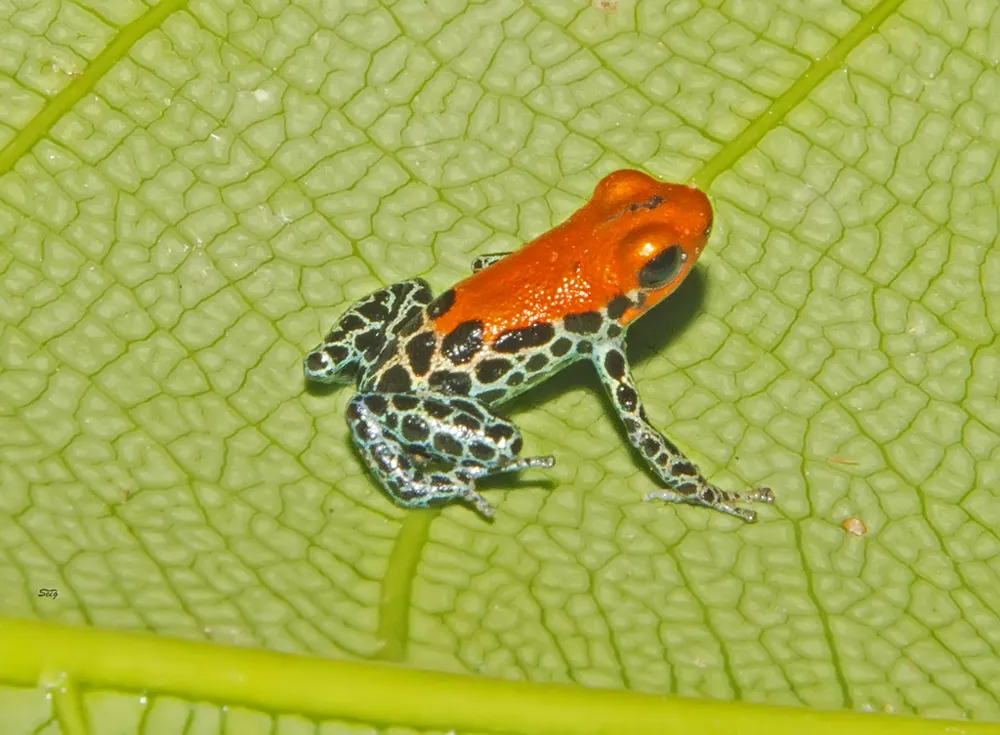
 Com reconèixer-lo
Poder tòxic
La seva pell és tòxica. És perillós tocar-lo, llepar-lo o menjar-se'l.
Què fan les seves toxines?
This frog is poisonous, not venomous, so it does not bite or sting. Its poison is stored in skin glands just beneath the outer layer of skin. It seeps through open wounds, body openings and pores. The poison can cause serious injury to humans and death in animals such as chickens.1
Com de perillós és per a les persones?
Perill per a les persones: DolorósPot fer molt de mal, però gairebé mai no és greu.The poison is moderately toxic and can cause serious injury to humans.1
Què fa quan té por?
When it is threatened, it shows its bright warning colours, climbs trees to escape, or uses its poison if it cannot get away.1
 Si algú l'ha tocat o se l'ha menjat
- Si algú n'ha tocat un: renta-li bé les mans i que no es toqui els ulls ni la boca. Si un nen o una mascota n'ha llepat o menjat un: truca al centre de toxicologia o al número d'emergències.
Truca sempre primer al número d'emergències (112, 000, 911). Això són pautes generals de primers auxilis, no consells mèdics. Primers auxilis bàsics
 Estigues segur
- No toquis, atrapis ni molestis mai un animal salvatge, encara que sigui petit i encara que sembli adormit o mort.
- Deixa-li espai. Si en trobes un, mantén la calma, recula a poc a poc i deixa que segueixi el seu camí.
- Si l'has tocat o te l'has menjat: no et freguis els ulls ni la boca, renta't les mans i busca ajuda mèdica.
No va a per tu. Les seves toxines només hi són perquè ningú no se'l mengi. Més sobre com estar segur
Que gran és?
Quant fa de llarg?
 més curt que el teu dit petit
 podria recórrer 100 metres en 110 segons (l'humà més ràpid necessita 9,6)
Que gran és Red-backed poison frog comparat amb TU?
Només càlculs al teu navegador. No es desa ni s'envia res enlloc.
Com de ràpid va?


Dades
Males stick the tadpoles to their backs using a water-soluble mucus, then carry them into the canopy.1
Males place the tadpoles in tiny pools that collect in the centre of bromeliad plants. The mother then feeds them infertile eggs laid in the water.1
Once they become froglets, the young are led to an existing group, where all members accept them, though only their parents care for them.1
It is the second most poisonous frog in its genus Ranitomeya, after R. variabilis.1
Breeding gatherings take place at the end of the wet season, so the eggs are laid at the start of the next wet season, when the young have a steady supply of water.1
Deforestation for charcoal and the capture of frogs for the international pet trade are the main threats to it.1
Per a experts en verins
- Nom científic
- Ranitomeya reticulata
- Grup
- Granotes punta de fletxa, gripaus i tritons
- Família
- Dendrobatidae2
- Ordre
- Anura
- Continents
- Amèrica del Sud
- Cries
- Females lay eggs on the ground, and after the eggs hatch, males carry the tadpoles up into the canopy.1
- Com li va a la natura
- Least Concern1
- Perill per a les persones
- 2 / 5: Dolorós3
D'on surten les dades
- Red-backed poison frog (Wikipedia (CC BY-SA 4.0))
- Ranitomeya reticulata (iNaturalist): noms i classificació.
- Venom Wiki: el nivell de perill, la mida típica i la velocitat estimada són nostres. Mira com els calculem: Com valorem el perill.
Cada dada d'aquesta pàgina té un número que porta a la seva font. Si ens hem equivocat en alguna cosa, perdona, som fans dels animals, no una revista científica. Escriu-nos a [email protected] i ho arreglarem.
 L'escorpí té gana! Venom Wiki és un projecte d'una sola persona: gratuït, sense anuncis i sense rastrejadors. Una petita propina ajuda a mantenir-lo en línia.Dona menjar a l'escorpí
Més del mateix grup: Granotes punta de fletxa, gripaus i tritons
 Golden poison frogGranotes punta de fletxa, gripaus i tritonsMortalNo ho toquis
 Cane toadGranotes punta de fletxa, gripaus i tritonsCal anar al metgeNo ho toquis
 Dyeing poison dart frogGranotes punta de fletxa, gripaus i tritonsNomés fa malNo ho toquis
 Black-legged poison frogGranotes punta de fletxa, gripaus i tritonsPot matarNo ho toquis
 Bruno's casque-headed frogGranotes punta de fletxa, gripaus i tritonsCal anar al metgeNo ho toquis
 Harlequin poison frogGranotes punta de fletxa, gripaus i tritonsCal anar al metgeNo ho toquis
 Terciopelo
 Brazilian wandering spider
 Eyelash viper
 Golden lancehead
 South American bushmaster
 Peruvian giant centipede