
 Àfrica
 Àsia
Àsia Europa
 Amèrica del Sud
 Austràlia i Oceania
 Antàrtida
 Oceà Pacífic
 Oceà Atlàntic
 Oceà Índic
 Oceà Àrtic
 Mar Mediterrània
 Mar Roja
 Mar Carib
 Mar del Corall
 Mar de la Xina Meridional
 Mar de les Filipines
 Mar d'Andaman
 Mar del Nord
 Mar de Timor i d'Arafura
 Golf de Bengala
 Golf de Califòrnia
Southern house spider
 Mossegades
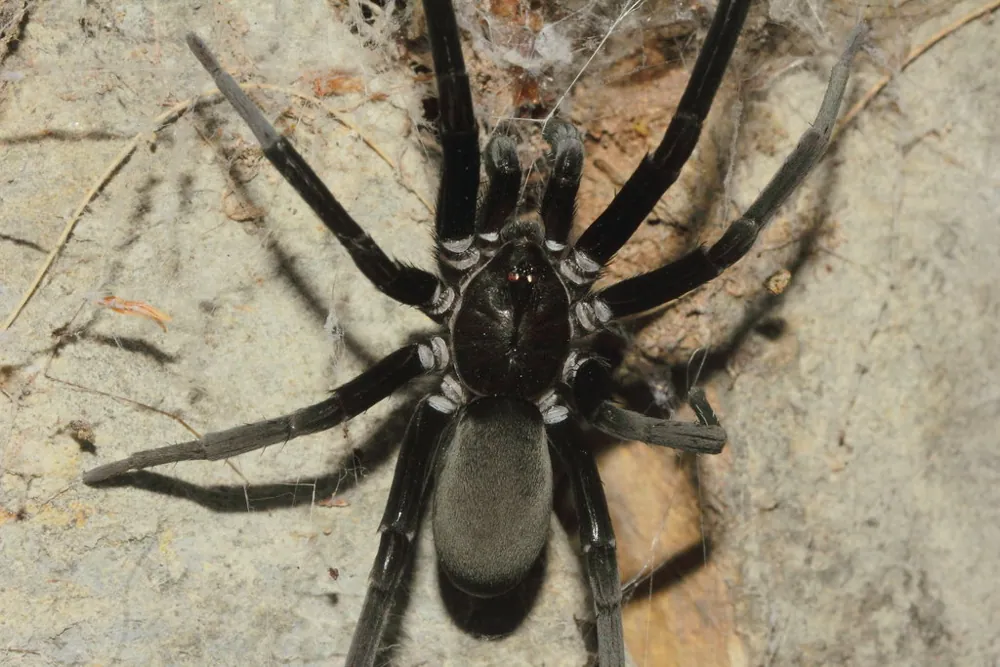
The southern house spider is a large spider that lives in the Americas, from the southern United States to Argentina. It is often mistaken for the brown recluse, but it is not aggressive and rarely bites. Its males wander around looking for mates, and both sexes can squeeze through very narrow cracks.1

 Com reconèixer-lo
- Females are dark brown or black and more compact in shape, with often larger, bulbous bodies.1
- Males have longer legs and unusually long, slender pedipalps (the leg-like feelers near the mouth).1
- Males lack the violin-shaped marking on the front part of the body that the brown recluse has.1
- The abdomen (rear part of the body) is covered in fine, velvety light grey hair.1
- Both sexes may grow to about 5.1 cm across with legs extended.1
Sovint es confon amb: Males are often mistaken for the brown recluse because they have similar colours and body structure. Male southern house spiders are usually larger, have no violin shape on the front of the body, and have long, slender pedipalps.1
Poder del verí
El verí surt pels ullals o les dents quan mossega.
Com de perillós és per a les persones?
Perill per a les persones: LleuCom una picada d'abella o menys. Pràcticament inofensiu per a les persones.Males may seem aggressive, but they bite only when trapped. Their mouthparts are too small to easily get through human skin, so bites are unlikely to be harmful.1
Què fa quan té por?
When it feels threatened, it instinctively plays dead, a tactic that works well against its common predators.1
 Si mossega
- Renta la mossegada i posa-hi gel per al dolor. Busca ajuda mèdica si el dolor és fort, s'estén o la persona es troba malament.
Truca sempre primer al número d'emergències (112, 000, 911). Això són pautes generals de primers auxilis, no consells mèdics. Primers auxilis bàsics
 Estigues segur
- No toquis, atrapis ni molestis mai un animal salvatge, encara que sigui petit i encara que sembli adormit o mort.
- Deixa-li espai. Si en trobes un, mantén la calma, recula a poc a poc i deixa que segueixi el seu camí.
- Si te'n mossega un: mantén la calma, no et moguis, truca al número d'emergències (112, 000, 911) o ves de pressa a un hospital. Recorda com era, una foto ajuda.
No va a per tu. Fa servir el verí per caçar o per defensar-se, i prefereix mil vegades amagar-se. Més sobre com estar segur
Que gran és?
Quant fa de llarg?
 més curt que el teu dit petit
 podria recórrer 100 metres en 330 segons (l'humà més ràpid necessita 9,6)
Que gran és Southern house spider comparat amb TU?
Només càlculs al teu navegador. No es desa ni s'envia res enlloc.
Com de ràpid va?


Dades
It is a cribellate spider, meaning its silk is not sticky. Its web works by tangling silk into a velcro-like net.1
It can crawl through cracks as narrow as 0.66 cm, thanks to its long body and compact legs.1
It is almost blind, so it may crawl over anything in its path, living or not, without meaning to attack.1
Its mating ritual can last over an hour, with long pauses where neither spider moves much.1
Its family, Filistatidae, is known as the crevice weavers because the females build webs around cracks.1
Desmuntamites
Mite: Southern house spiders are aggressive and bite people often.
Veritat: Males may look aggressive, but they bite only when trapped, and their mouthparts are too small to easily penetrate human skin. Their crawling over things is not aggression, as they cannot see larger animals.1
D'on surten les dades
- Southern house spider (Wikipedia (CC BY-SA 4.0))
- Kukulcania hibernalis (iNaturalist): noms i classificació.
- Venom Wiki: el nivell de perill, la mida típica i la velocitat estimada són nostres. Mira com els calculem: Com valorem el perill.
Cada dada d'aquesta pàgina té un número que porta a la seva font. Si ens hem equivocat en alguna cosa, perdona, som fans dels animals, no una revista científica. Escriu-nos a [email protected] i ho arreglarem.
 L'escorpí té gana! Venom Wiki és un projecte d'una sola persona: gratuït, sense anuncis i sense rastrejadors. Una petita propina ajuda a mantenir-lo en línia.Dona menjar a l'escorpí
 Brazilian wandering spider
 Brown recluse
 Southern black widow
 Amazon wandering spider
 Chilean recluse
 Northern black widow
 Terciopelo
 Eastern coral snake
 Eastern diamondback rattlesnake
 Eyelash viper
 Timber rattlesnake
 Western diamondback rattlesnake