
 Bitten or stung?
 All animals
 Pick a continent
 Africa
 Asia
 Europe
 South America
 Australia & Oceania
 Antarctica
 Pacific Ocean
 Atlantic Ocean
 Indian Ocean
 Arctic Ocean
 Mediterranean Sea
 Red Sea
 Caribbean Sea
 Coral Sea
 South China Sea
 Philippine Sea
 Andaman Sea
 North Sea
 Timor & Arafura Sea
 Bay of Bengal
 Gulf of California
 Games
 Venom battle
 Animal race
 Field notebook
 Venom TOP lists
 Stay safe
 Surprise me

Brown recluse
 Bites
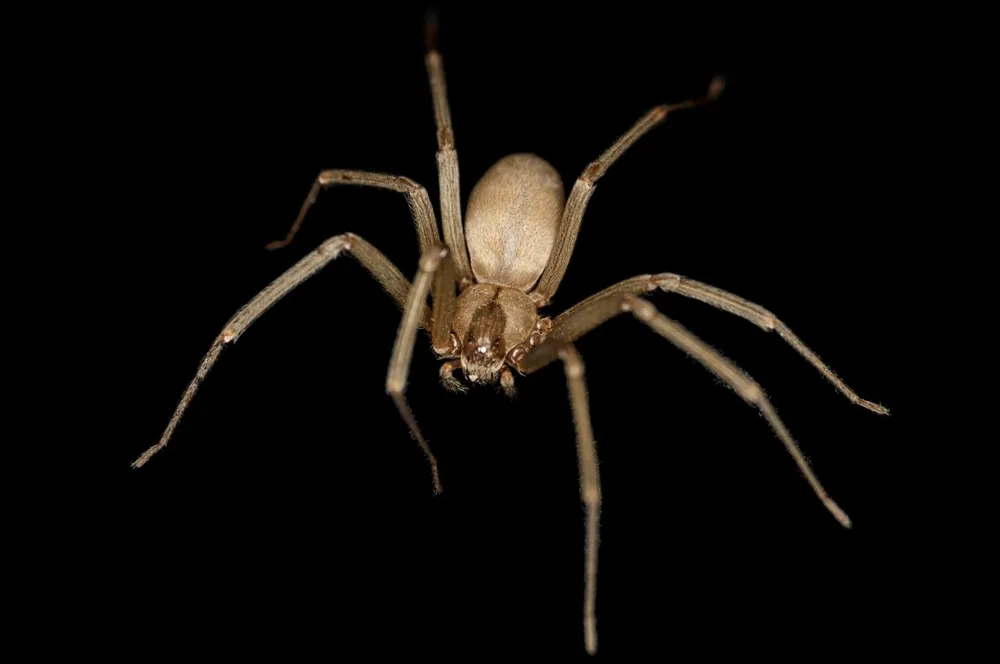
The brown recluse is a small spider with a violin-shaped mark on its back. It lives mainly in the central and southern United States, where it hides in dark, quiet places such as woodpiles and sheds. It is one of only two North American spiders with dangerous venom, the other being the black widow.1
 How to recognise it
- A dark violin-shaped marking on the top of the front body, with the neck of the violin pointing towards the rear of the spider1
- Typically light to medium brown, though colours range from whitish to dark brown or blackish grey1
- Six eyes arranged in three pairs, while most spiders have eight1
- No obvious patterns on the abdomen or legs, and no spines on the legs1
- Usually 6 to 20 millimetres in body length, but may grow larger1
Often confused with: The violin marking is not a reliable identifier, because cellar spiders and pirate spiders can have similar markings. The Mediterranean recluse, an introduced species, looks almost the same as the brown recluse. Many reports of recluses are misidentifications. A spider in the genus Titiotus is the most common spider mistaken for a brown recluse in California, and its bite is considered harmless.1
Venom power
Venom comes out through its fangs or teeth when it bites.
What does its venom do?
The venom is necrotic, meaning it destroys tissue. It contains a dermonecrotic agent called sphingomyelinase D, which kills the skin around the bite. In some cases the venom spreads through the body within minutes, causing nausea, vomiting, fever, rashes and muscle and joint pain. Rarely, it can burst red blood cells (hemolysis).1
How dangerous is it to people?
Danger to people: SeriousA bite needs a doctor. Deaths are very rare.Most bites cause no skin damage, and the spider is rarely aggressive. In one clinical study, skin necrosis occurred in 37% of diagnosed bites and systemic illness in 14%. Rarely, bites can cause organ damage or death. Most fatalities have been in children under seven or in people with weak immune systems. Children, the elderly and seriously ill people may be more susceptible to systemic effects.1
What does it do when it is scared?
When alarmed, it lowers its body, raises its pedipalps and stands still in a defensive pose. It usually flees, and if caught it may play dead.1
 If it bites
Always call your emergency number first (for example 112 in Europe, 911 in North America, 000 in Australia).
- Wash the bite with soap and water and put a cold pack on it. Keep the limb still and raised. See a doctor soon, and get emergency help if a sore grows or the person gets a fever, rash or dark urine.1
- Wash the bite and put an ice pack on it for the pain. Get medical help if the pain is strong, spreads or the person feels unwell.
This is general first aid guidance, not medical advice. Based on the first aid guidelines of the World Health Organization and the Australian Resuscitation Council. Facts come from public sources and may contain mistakes. When in doubt, always get medical help. First aid basics
 Stay safe
- Never touch, catch or tease a wild animal, even a small one, and even if it looks asleep or dead.
- Give it space. If you meet one, stay calm, step back slowly and let it go its own way.
- If one bites you: stay calm, keep still, call your emergency number (for example 112 in Europe, 911 in North America, 000 in Australia) or get to a hospital fast. Remember what it looked like, a photo helps.
It is not out to get you. It uses its venom to catch food or to protect itself, and it would much rather hide. More about staying safe
Where in the world?
How big is it?
How long is it?
 about as long as a paper clip
How big is Brown recluse compared to you?
Just maths in your browser. Nothing is saved or sent anywhere.
How fast is it?


Facts
One brown recluse survived for over five seasons in captivity without any food at all.1
In 2001, more than 2,000 brown recluses were removed from a heavily infested home in Kansas, yet the four residents who had lived there for years were never harmed.1
When a leg is lost, the brown recluse does not grow a new one in later moults, unlike the huntsman spider.1
Brown recluses do not balloon, which limits how far they can spread across the landscape.1
Males move around more when hunting than females, which tend to stay near their webs.1
Myth buster
Myth: Brown recluses are common in California and the western United States, where they cause many bites.
Truth: The brown recluse has not established itself in California or anywhere outside its native range. Many reported bites there are misdiagnosed, and other spiders are often wrongly identified as brown recluses.1
For venom experts
- Scientific name
- Loxosceles reclusa
- Group
- Spiders
- Also called
- fiddleback spider, brown fiddler, violin spider1
- Family
- Sicariidae2
- Order
- Araneae
- Continents
- North America
- Babies
- Each female produces several egg sacs between May and July, with about 50 eggs in each sac. The eggs hatch in about one month, and the young take about a year to reach adulthood.1
- Danger to people
- 3 / 5: Serious3
Where the facts come from
- Brown recluse spider (Wikipedia (CC BY-SA 4.0))
- Loxosceles reclusa (iNaturalist): names and classification.
- Venom Wiki: the danger level, the typical size and the speed guess are our own. See how we work them out: How we rate danger.
Every fact on this page has a number that points to its source. If we got something wrong, sorry, we are animal fans, not a science journal. Tell us at [email protected] and we will fix it.
Get the Venom Wiki app
Every creature, every picture and the games in your pocket, even without internet.


 Support Venom Wiki Venom Wiki is a one-man project: free, with no ads and no cookies. A small tip helps keep it online.Feed the scorpion
 Southern black widow
 Northern black widow
 Western black widow
 Noble false widow
 Bold jumping spider
 Golden silk orb-weaver
 Terciopelo
 Eastern coral snake
 Eastern diamondback rattlesnake
 Timber rattlesnake
 Western diamondback rattlesnake
 Arizona bark scorpion
