
 Bitten or stung?
 All animals
 Pick a continent
 Africa
 Asia
 Europe
 South America
 Australia & Oceania
 Antarctica
 Pacific Ocean
 Atlantic Ocean
 Indian Ocean
 Arctic Ocean
 Mediterranean Sea
 Red Sea
 Caribbean Sea
 Coral Sea
 South China Sea
 Philippine Sea
 Andaman Sea
 North Sea
 Timor & Arafura Sea
 Bay of Bengal
 Gulf of California
 Games
 Venom battle
 Animal race
 Field notebook
 Venom TOP lists
 Stay safe
 Surprise me

Golden silk orb-weaver
 Bites
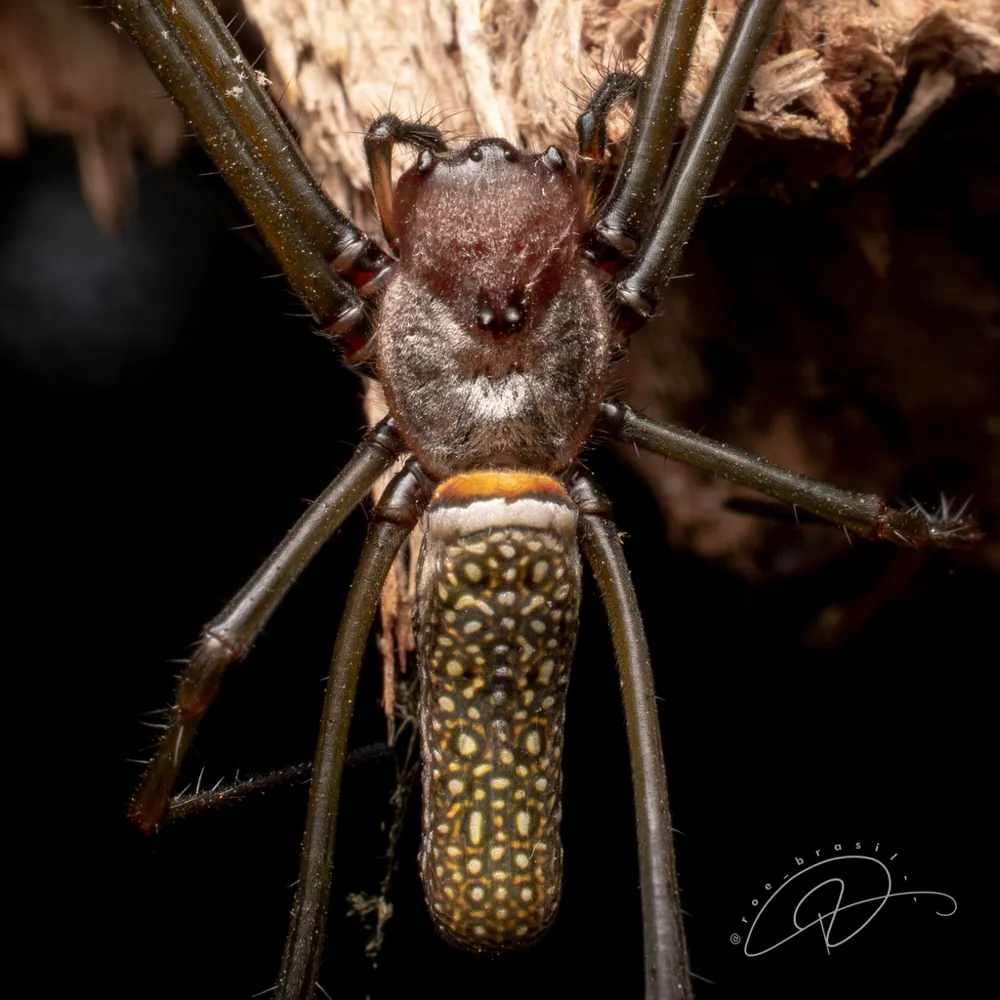
The golden silk orb-weaver is a large spider with silk that shines golden in sunlight. It lives in forests and wooded areas from the southern United States to Argentina. It is special because its silk is studied by scientists, and because it is one of the largest non-tarantula spiders in North America.1
 How to recognise it
- Females have a silvery white front body (cephalothorax) and a longer orange-brown abdomen with two rows of small white-yellow spots.1
- Females have dark yellow and brown banding on their legs, with black brush-like tufts of hair near the joints of the first, second and fourth leg pairs.1
- Females are about 24 to 40 mm long when fully grown.1
- Males are much smaller, about 6 mm long, with a plain dark brown body and legs.1
- The large webs are circular and vertical, and the yellow pigment in the silk gives them a golden glow in good light.1
Often confused with: Trichonephila plumipes also has stiff hairs on its legs. In that species the hairs are set more closely together than in the golden silk orb-weaver.1
Venom power
Venom comes out through its fangs or teeth when it bites.
What does its venom do?
Its venom has low toxicity. It is relatively harmless and poses little health concern to healthy adult humans.1
How dangerous is it to people?
Danger to people: MildLike a bee sting or less. Basically harmless to people, unless the person is allergic.It is not known to be aggressive towards humans. It bites only in self-defence if it is touched, and its venom poses little health concern to healthy adults.1
What does it do when it is scared?
It bites only in self-defence if it is touched.1
 If it bites
Call your emergency number at once if the person has trouble breathing, swelling of the face or throat, or feels faint.
- Wash the bite and put an ice pack on it for the pain. Get medical help if the pain is strong, spreads or the person feels unwell.
This is general first aid guidance, not medical advice. Based on the first aid guidelines of the World Health Organization and the Australian Resuscitation Council. Facts come from public sources and may contain mistakes. When in doubt, always get medical help. First aid basics
 Stay safe
- Never touch, catch or tease a wild animal, even a small one, and even if it looks asleep or dead.
- Give it space. If you meet one, stay calm, step back slowly and let it go its own way.
- If it hurts you: wash the spot, stay calm and get medical help if the pain is strong or spreads, or the person feels unwell.
It is not out to get you. It uses its venom to catch food or to protect itself, and it would much rather hide. More about staying safe
Where in the world?
How big is it?
How long is it?
 about as long as a paper clip
 could cover 100 metres in 210 seconds (the fastest human needs 9.6)
How big is Golden silk orb-weaver compared to you?
Just maths in your browser. Nothing is saved or sent anywhere.
How fast is it?


Facts
Its silk may help in surgeries involving the nervous system, as shown in past experimental studies.1
It produces seven different types of silk, and its silk is valued in spider silk research.1
Its genome was the first of the orb-weaving spiders to be completely annotated, revealing 28 unique genes for spider silk proteins.1
Some individuals living in developed areas have grown significantly larger than their rural counterparts.1
Males rarely suffer sexual cannibalism or genital mutilation, unlike males of many related species, which makes it a focus of study into spider mating.1
Females are some of the largest non-tarantula spiders in North America, and may be the largest orb-weaver species native to the United States.1
Myth buster
Myth: The golden silk orb-weaver is an aggressive spider that attacks people.
Truth: It is not known to be aggressive towards humans. It bites only in self-defence if it is touched.1
Where the facts come from
- Trichonephila clavipes (Wikipedia (CC BY-SA 4.0))
- Trichonephila clavipes (iNaturalist): names and classification.
- Venom Wiki: the danger level, the typical size and the speed guess are our own. See how we work them out: How we rate danger.
Every fact on this page has a number that points to its source. If we got something wrong, sorry, we are animal fans, not a science journal. Tell us at [email protected] and we will fix it.
Get the Venom Wiki app
Every creature, every picture and the games in your pocket, even without internet.


 Support Venom Wiki Venom Wiki is a one-man project: free, with no ads and no cookies. A small tip helps keep it online.Feed the scorpion
 Brazilian wandering spider
 Brown recluse
 Southern black widow
 Amazon wandering spider
 Chilean recluse
 Northern black widow
 Terciopelo
 Eastern coral snake
 Eastern diamondback rattlesnake
 Timber rattlesnake
 Western diamondback rattlesnake
 Arizona bark scorpion