
 Bitten or stung?
 All animals
 Pick a continent
 Africa
 Asia
 Europe
 South America
 Australia & Oceania
 Antarctica
 Pacific Ocean
 Atlantic Ocean
 Indian Ocean
 Arctic Ocean
 Mediterranean Sea
 Red Sea
 Caribbean Sea
 Coral Sea
 South China Sea
 Philippine Sea
 Andaman Sea
 North Sea
 Timor & Arafura Sea
 Bay of Bengal
 Gulf of California
 Games
 Venom battle
 Animal race
 Field notebook
 Venom TOP lists
 Stay safe
 Surprise me

Florida harvester ant
 Stings
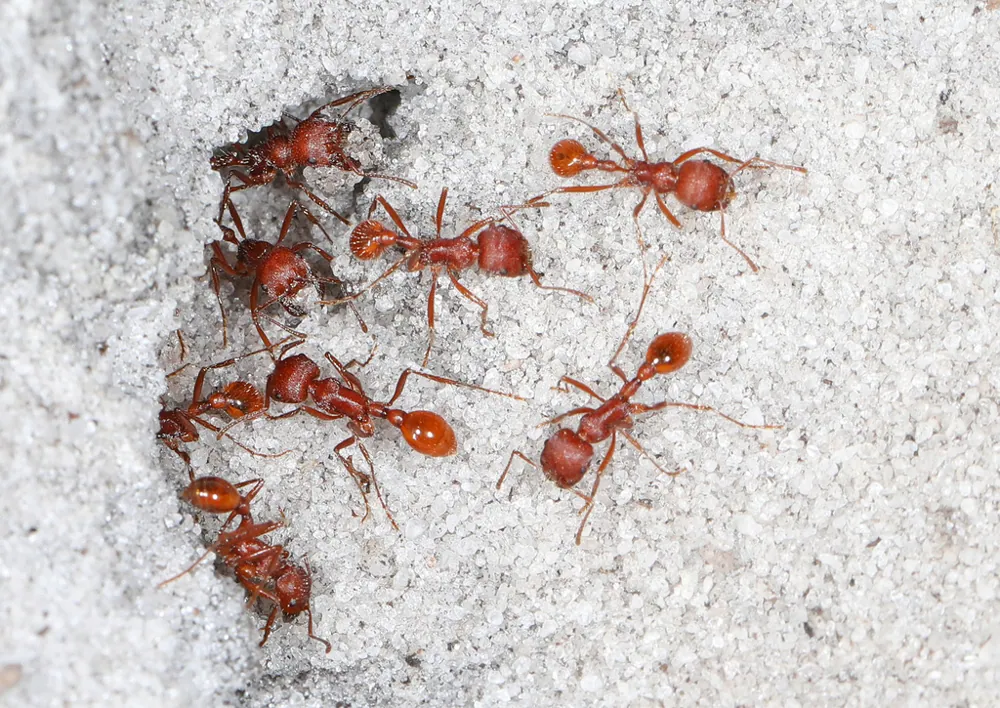
The Florida harvester ant is a relatively large ant that lives in the sandy scrub and coastal areas of Florida and the Atlantic coast of the eastern United States. It is the only Pogonomyrmex harvester ant found on the US east coast. Its sting is painful and highly toxic, but the ant is shy and rarely stings unless it is trapped against skin.1
 How to recognise it
- A relatively large harvester ant. Workers range from 6.35 mm to 9.52 mm long.1
- The nest has a flat mound with no plants growing around it, decorated with bits of debris and charred plant matter.1
- Queens and the largest workers, called majors, have disproportionately large heads.1
- It is a highly active ant that is out during the day.1
Venom power
Venom comes out through a stinger.
What does its venom do?
Its stinger delivers a potent, painful neurotoxic venom, which attacks the nerves. The venom is very toxic: in laboratory tests on mice, the dose that killed half the mice (the LD50) was 0.42 micrograms per gram of body weight, which is comparable to the most toxic snake venoms. Each sting delivers only a small amount of venom.1
How dangerous is it to people?
Danger to people: PainfulIt can really hurt, but it is almost never serious.Dozens of stings are needed to cause potential harm to a healthy adult. The ant is docile and reluctant to sting unless forced to, usually when it is trapped against the skin.1
What does it do when it is scared?
It stings when it is trapped against the skin, and is otherwise reluctant to sting.1
 If it stings
Call your emergency number at once if the person has trouble breathing, swelling of the face or throat, or feels faint.
- Wash and cool the stings.
- If the person has trouble breathing, swelling of the face or throat, or feels faint, it is an allergic emergency: call your emergency number.
This is general first aid guidance, not medical advice. Based on the first aid guidelines of the World Health Organization and the Australian Resuscitation Council. Facts come from public sources and may contain mistakes. When in doubt, always get medical help. First aid basics
 Stay safe
- Never touch, catch or tease a wild animal, even a small one, and even if it looks asleep or dead.
- Give it space. If you meet one, stay calm, step back slowly and let it go its own way.
- If it hurts you: wash the spot, stay calm and get medical help if the pain is strong or spreads, or the person feels unwell.
It is not out to get you. It uses its venom to catch food or to protect itself, and it would much rather hide. More about staying safe
Where in the world?
How big is it?
How long is it?
 smaller than a fingernail
How big is Florida harvester ant compared to you?
Just maths in your browser. Nothing is saved or sent anywhere.
How fast is it?


Facts
Its stinger is barbed. When it stings, the stinger and venom sac can stay stuck in the skin and keep pumping venom, and the ant dies because its insides are damaged when the stinger is pulled out.1
Mature nests are very deep, usually 2.5 to 3.0 metres underground, with seeds stored in large flat granaries about 40 to 100 cm below the surface.1
Unlike most harvester ants, this species often moves its entire nest once a year, relocating about 4 to 10 metres along an established foraging trail.1
A colony must reach about 700 or more workers before it becomes sexually mature and starts producing winged reproductives.1
Mating takes place on the ground. Males fly in from other nests to mate with queens on the surface of the parent nest, while hundreds of workers swarm around the nest.1
Some ants can be infected by a parasitic fungus, Myrmicinosporidium durum, which turns the ant's outer body a near black colour.1
For venom experts
Where the facts come from
- Pogonomyrmex badius (Wikipedia (CC BY-SA 4.0))
- Pogonomyrmex badius (iNaturalist): names and classification.
- Venom Wiki: the danger level, the typical size and the speed guess are our own. See how we work them out: How we rate danger.
Every fact on this page has a number that points to its source. If we got something wrong, sorry, we are animal fans, not a science journal. Tell us at [email protected] and we will fix it.
Get the Venom Wiki app
Every creature, every picture and the games in your pocket, even without internet.


 Support Venom Wiki Venom Wiki is a one-man project: free, with no ads and no cookies. A small tip helps keep it online.Feed the scorpion
 Bullet ant
 Army ant
 Maricopa harvester ant
 Trap-jaw ant
 Acacia ant
 Black imported fire ant
 Terciopelo
 Eastern coral snake
 Eastern diamondback rattlesnake
 Timber rattlesnake
 Western diamondback rattlesnake
 Arizona bark scorpion