
 Bitten or stung?
 All animals
 Pick a continent
 Africa
 Asia
 Europe
 South America
 Australia & Oceania
 Antarctica
 Pacific Ocean
 Atlantic Ocean
 Indian Ocean
 Arctic Ocean
 Mediterranean Sea
 Red Sea
 Caribbean Sea
 Coral Sea
 South China Sea
 Philippine Sea
 Andaman Sea
 North Sea
 Timor & Arafura Sea
 Bay of Bengal
 Gulf of California
 Games
 Venom battle
 Animal race
 Field notebook
 Venom TOP lists
 Stay safe
 Surprise me

Hispaniolan solenodon
 Bites
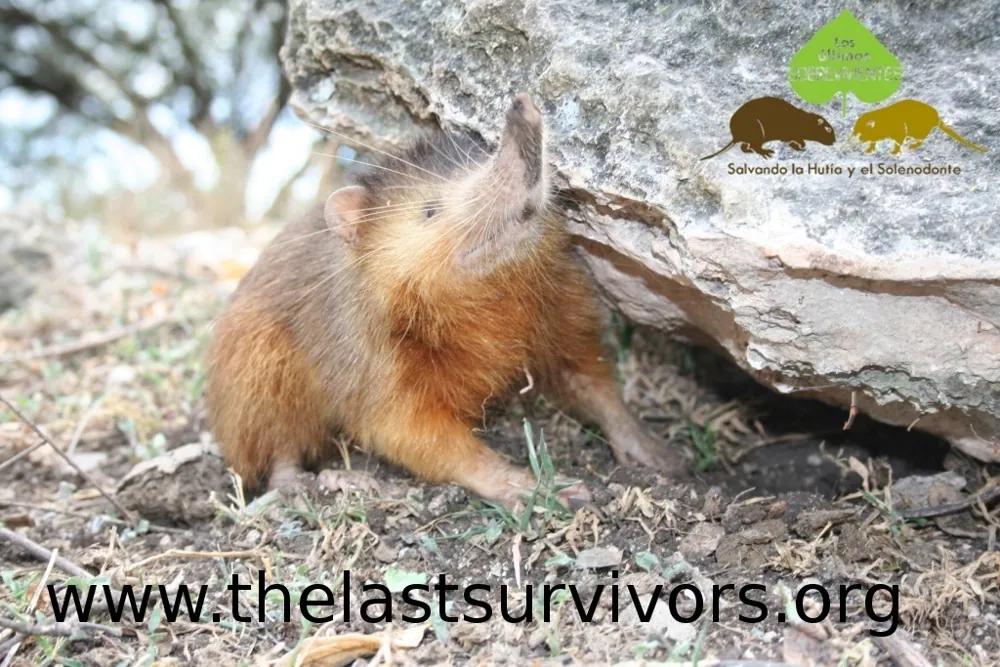
The Hispaniolan solenodon is a small, furry, shrew-like mammal that lives only on the Caribbean island of Hispaniola, in the Dominican Republic and Haiti. It is one of the few venomous mammals in the world. It is shy and hard to see, because it is active at night and hides in burrows during the day.1
 How to recognise it
- Dusky brown fur over most of the body, with a paler underside1
- Reddish fur on the sides of the head, throat and upper chest1
- Hairless tail, legs, snout and eyelids1
- A long snout with about a dozen long whiskers, up to 7 cm1
- Runs on the soles of its feet in an erratic, zigzag course, and is active only at night1
Often confused with: It resembles an oversized shrew. Adults are the largest living members of the shrew-like group (Soricomorpha), so they are much bigger than ordinary shrews.1
Venom power
Venom comes out through its fangs or teeth when it bites.
What does its venom do?
Its venom flows from saliva through a nearly closed channel in the second lower incisor. The exact chemical make-up of the venom is not known. In laboratory tests, a dose of 0.38 to 0.55 mg of venom per gram of body mass killed mice in two to six minutes.1
How dangerous is it to people?
Danger to people: PainfulIt can really hurt, but it is almost never serious.Its venom is strong enough to kill mice in minutes in lab tests. The animal is shy, nocturnal and hard to find, so encounters are uncommon.1
What does it do when it is scared?
It has not evolved strong defences, as it evolved without native land predators, and it is a slow, clumsy runner. When threatened, it makes a loud defensive "chirp" and an aggressive "squeal".1
 If it bites
Call your emergency number at once if the person has trouble breathing, swelling of the face or throat, or feels faint.
- Wash the wound well and get medical help.
This is general first aid guidance, not medical advice. Based on the first aid guidelines of the World Health Organization and the Australian Resuscitation Council. Facts come from public sources and may contain mistakes. When in doubt, always get medical help. First aid basics
 Stay safe
- Never touch, catch or tease a wild animal, even a small one, and even if it looks asleep or dead.
- Give it space. If you meet one, stay calm, step back slowly and let it go its own way.
- If it hurts you: wash the spot, stay calm and get medical help if the pain is strong or spreads, or the person feels unwell.
It is not out to get you. It uses its venom to catch food or to protect itself, and it would much rather hide. More about staying safe
Where in the world?
How big is it?
How long is it?
 as long as 4 bananas end to end
 could cover 100 metres in 45 seconds (the fastest human needs 9.6)
How big is Hispaniolan solenodon compared to you?
Just maths in your browser. Nothing is saved or sent anywhere.
How fast is it?


Facts
It is one of the few venomous placental mammals. Its venom is delivered through grooves in its lower incisors.1
Genetic studies estimate that solenodons split from other living mammals about 78 million years ago.1
It was first described in 1833. It was rediscovered in 1907, but was again believed extinct by 1964.1
It has a bone called the os proboscidis that extends forward from the nostril to support the snout. This bone is not found even in other solenodons.1
It evolved without native land predators, so it never developed strong defences. Today owls, and introduced dogs, cats and small Asian mongooses, can all prey on it.1
Individuals in captivity have lived for over eleven years.1
For venom experts
- Scientific name
- Solenodon paradoxus
- Group
- Venomous mammals
- Also called
- Agouta, Haitian Solenodon1
- Family
- Solenodontidae2
- Order
- Eulipotyphla
- Continents
- North America
- Babies
- Litters have one to three young after a gestation of over 84 days. The young are born blind and hairless, and usually only two survive because the female has two teats.1
- Lifespan
- about 11 years1
- How it is doing in the wild
- Least Concern (IUCN, downlisted from Endangered in 2020)1
- Danger to people
- 2 / 5: Painful3
Where the facts come from
- Hispaniolan solenodon (Wikipedia (CC BY-SA 4.0))
- Solenodon paradoxus (iNaturalist): names and classification.
- Venom Wiki: the danger level, the typical size and the speed guess are our own. See how we work them out: How we rate danger.
Every fact on this page has a number that points to its source. If we got something wrong, sorry, we are animal fans, not a science journal. Tell us at [email protected] and we will fix it.
Get the Venom Wiki app
Every creature, every picture and the games in your pocket, even without internet.


 Support Venom Wiki Venom Wiki is a one-man project: free, with no ads and no cookies. A small tip helps keep it online.Feed the scorpion
 Common vampire bat
 Cuban solenodon
 Northern short-tailed shrew
 Hairy-legged vampire bat
 White-winged vampire bat
 Platypus
 Terciopelo
 Eastern coral snake
 Eastern diamondback rattlesnake
 Timber rattlesnake
 Western diamondback rattlesnake
 Arizona bark scorpion