
 Bitten or stung?
 All animals
 Pick a continent
 Africa
 Asia
 Europe
 South America
 Australia & Oceania
 Antarctica
 Pacific Ocean
 Atlantic Ocean
 Indian Ocean
 Arctic Ocean
 Mediterranean Sea
 Red Sea
 Caribbean Sea
 Coral Sea
 South China Sea
 Philippine Sea
 Andaman Sea
 North Sea
 Timor & Arafura Sea
 Bay of Bengal
 Gulf of California
 Games
 Venom battle
 Animal race
 Field notebook
 Venom TOP lists
 Stay safe
 Surprise me

White-winged vampire bat
 Bites
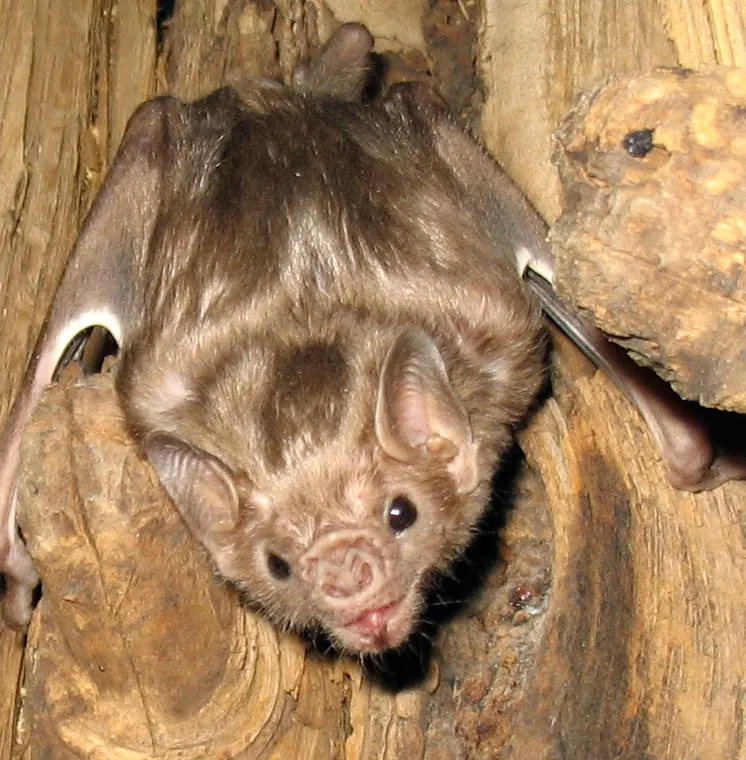
The white-winged vampire bat is a small bat that feeds on blood. It lives from Mexico to northern Argentina, and also on the islands of Trinidad and Margarita Island. Its pale wing edges make it easy to tell apart from some of its relatives.1
 How to recognise it
- Fur is clay-coloured, light brown or dark cinnamon brown.1
- The outline of the wings is white, as is the membrane between the second and third fingers.1
- Ears are 18 mm long, longer than they are wide.1
- Nose to tail length is about 84 mm, and it weighs 31.7 to 48.1 g.1
- Its forearms are 51 to 54 mm long.1
Often confused with: It is often confused with the common vampire bat. The white-winged vampire bat has a smooth outer edge on its tragus (the small flap in front of the ear), while the common vampire bat's is serrated. Its thumb is also much shorter, and it has 22 teeth, compared with 20 in the common vampire bat.1
Venom power
Venom comes out through its fangs or teeth when it bites.
What does its venom do?
Its saliva contains plasminogen activators, which quickly dissolve the clots that form in the host's blood while it feeds. It also contains platelet aggregation inhibitors and other anticoagulants, which stop blood from clotting. These compounds work especially well on birds.1
How dangerous is it to people?
Danger to people: MildLike a bee sting or less. Basically harmless to people, unless the person is allergic.It can transmit rabies, but this appears to be relatively uncommon. The only reports of rabies transmission from this species come from Trinidad.1
What does it do when it is scared?
When disturbed, it produces a foul-smelling odour from cup-shaped scent glands in its mouth, which may help deter predators.1
 If it bites
Call your emergency number at once if the person has trouble breathing, swelling of the face or throat, or feels faint.
- Wash the wound with soap and water for 15 minutes and see a doctor the same day, even for a small bite or scratch: bats can carry rabies, and the rabies shots only work if they are given early.
This is general first aid guidance, not medical advice. Based on the first aid guidelines of the World Health Organization and the Australian Resuscitation Council. Facts come from public sources and may contain mistakes. When in doubt, always get medical help. First aid basics
 Stay safe
- Never touch, catch or tease a wild animal, even a small one, and even if it looks asleep or dead.
- Give it space. If you meet one, stay calm, step back slowly and let it go its own way.
- If it hurts you: wash the spot, stay calm and get medical help if the pain is strong or spreads, or the person feels unwell.
It is not out to get you. It uses its venom to catch food or to protect itself, and it would much rather hide. More about staying safe
Where in the world?
How big is it?
How long is it?
How heavy is it?

 about as long as a bank card
 could fly across a whole football pitch in 19 seconds
How big is White-winged vampire bat compared to you?
Just maths in your browser. Nothing is saved or sent anywhere.
How fast is it?


Facts
In captivity, each bat drinks about 16 ml of defibrinated cow or chicken blood per day, and they should be kept in social colonies with dominance hierarchies.1
It is the only bat species in the world with 22 teeth, although older individuals sometimes lose the last upper molars.1
Its brain is large for its body size, which may be because its hunting needs careful planning and stealth.1
It is not as good as the common vampire bat at walking on all fours, but it is quite good at climbing branches.1
It roosts with many other bat species, including the common vampire bat.1
Where the facts come from
- White-winged vampire bat (Wikipedia (CC BY-SA 4.0))
- Venom Wiki: the danger level, the typical size and the speed guess are our own. See how we work them out: How we rate danger.
Every fact on this page has a number that points to its source. If we got something wrong, sorry, we are animal fans, not a science journal. Tell us at [email protected] and we will fix it.
Get the Venom Wiki app
Every creature, every picture and the games in your pocket, even without internet.


 Support Venom Wiki Venom Wiki is a one-man project: free, with no ads and no cookies. A small tip helps keep it online.Feed the scorpion
 Common vampire bat
 Cuban solenodon
 Hispaniolan solenodon
 Northern short-tailed shrew
 Hairy-legged vampire bat
 Platypus
 Terciopelo
 Eastern coral snake
 Eastern diamondback rattlesnake
 Timber rattlesnake
 Western diamondback rattlesnake
 Arizona bark scorpion
